Male octopuses are induced to mate by female hormones.
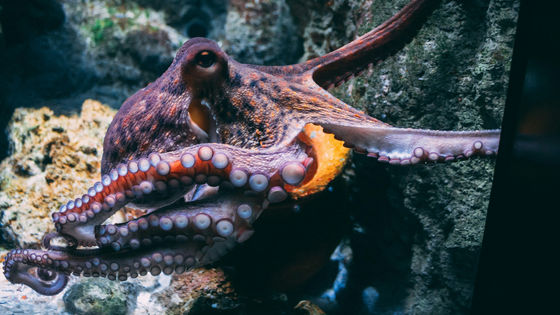
Octopuses are one of the strangest creatures on Earth. They have no bones, making their bodies incredibly soft; they can change color like chameleons; they have three hearts; and their blood is primarily composed of blue copper. A research team at Harvard University has published a paper investigating the sex lives of octopuses, revealing that their sexual behavior is also quite bizarre.
A sensory system for mating in octopus | Science
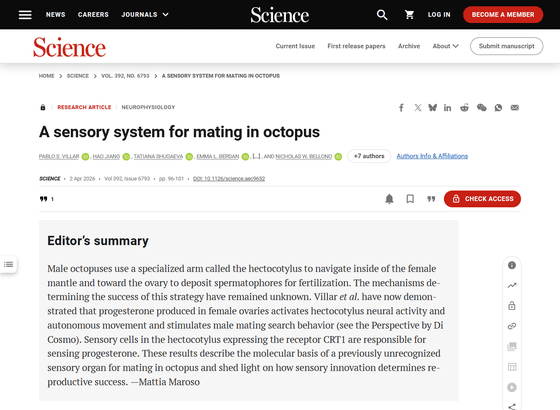
Male octopuses guided through mating by female hormones - Ars Technica
https://arstechnica.com/science/2026/04/male-octopuses-guided-through-mating-by-female-hormones/
The deep sea where octopuses live is a difficult place to find a partner. Furthermore, because octopuses are solitary and not social, encounters with partners are extremely rare. Therefore, the exact mechanisms by which octopuses meet and reproduce have puzzled biologists for many years. What was known until now was that male octopuses use their hectocotyledonous arms to identify females. Any further details seemed to be based more on anecdotal evidence than rigorous scientific proof.
A research team at Harvard University devised an experiment to gain details about the sexual life of octopuses. In the experiment, a male and female California two-spotted octopus, both captured in the wild, were placed in the same tank. However, because wild octopuses are solitary, the research team did not know how the octopuses in the tank would react to each other, so they installed a partition in the tank. This partition was opaque and had holes that the octopuses' arms could pass through.
Pablo S. Villar, a molecular biologist at Harvard University who leads the research team, said, 'The initial idea was to install partitions so that the octopuses could sense each other's presence and feel safe. We intended to remove the partitions later.'
However, the partition didn't need to be removed because the male and female octopuses mated through the opening. The octopuses deepened their relationship through the opening. Regarding this, Bijar said, 'We were very surprised. We didn't expect that to happen.'

During mating, the male octopus extends its hectocotyledon through the opening in the partition, first touching the female octopus before extending its arm into the cavity. Mr. Bijar stated, 'Octopuses have a cavity that is an opening that can reach all of their internal organs. The male can touch all of the female's internal organs, which is quite invasive.' Furthermore, after the male's hectocotyledon entered the female's cavity, the octopus remained completely still for about an hour.
When octopuses mate, the male must locate the opening of the oviduct inside the female's body and use a special appendage to inject sperm. Moreover, the male must do this with little to no visual cues or feedback from the female.
'When the male is inside
Regarding octopus mating, Ars Technica described the process as 'more like a spacecraft docking with the International Space Station or a jet fighter being refueled in mid-air than the commonly imagined image of sex.'
Interestingly, when two male octopuses were placed in the same tank, they touched each other with their hectocotyledonous arms but did not attempt to mate. This suggests that certain chemicals from the female may be inducing mating.
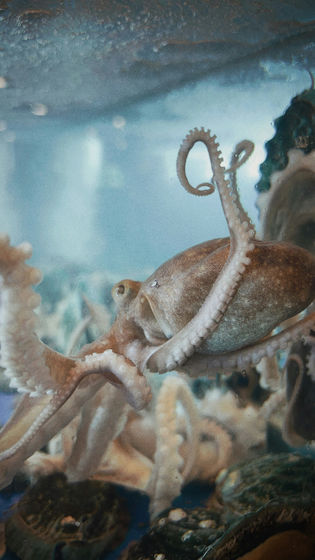
To elucidate the sexual life of octopuses at the molecular level, the research team focused on the reproductive organs of females and discovered that the oviducts and ovaries of females express enzymes essential for the production of sex steroid hormones at high levels. In particular, it was found that the oviducts are rich in enzymes involved in the production of
The research team removed the females from the tank and instead inserted cone-shaped plastic tubes coated with various chemical irritants into holes drilled in the tank's divider. When the males encountered the cones coated with progesterone, they exhibited mating search behavior similar to that they had shown with the females' mantles. However, they did not show the same reaction to cones coated with steroids similar to progesterone, bile acids, or bitter molecules.
This has revealed that male octopuses use a chemotactile receptor called CRT1, located on their hectocotyledon arm, to respond to progesterone released by the female during mating.
Furthermore, scanning electron microscopy revealed that the tip of the octopus's hectocotyledonous arm is covered with a small sucker structurally identical to that of a normal sensory sucker. This is thought to be a sucker used for mating, and it has also been found to be densely packed with nerve cells.

The research team also investigated octopuses other than the California two-spotted octopus, as well as various cephalopods. As a result, they found that all cephalopod ovaries express enzymes necessary for producing sex steroids. Although the shape of the hectocotyledon differed among species, all had suckers that responded strongly to exogenously administered progesterone.
However, the research team led by Mr. Bijar left several questions for future study, such as 'Does mating occur between different species of octopuses?', 'Do octopuses choose their mating partners?', and 'Wouldn't two octopuses remaining almost motionless for an hour while mating leave them extremely vulnerable to predators?'
Related Posts:




in Science, Posted by logu_ii