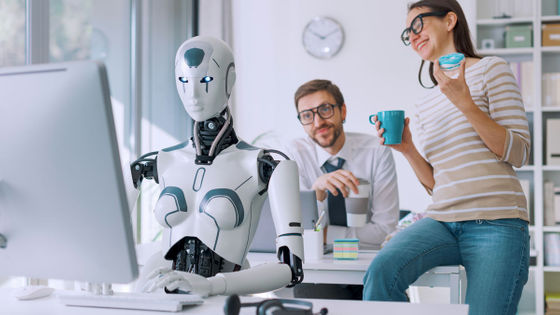
One suggestion is that the reason AI models cannot write creative text is because the creativity and originality seen in early models have been suppressed and they have been specialized for business use.
AI capabilities are developing rapidly, and it can already handle a variety of tasks and complete complex calculations, but its ability to generate creative writing has made little progress since the early days of chat AI. The Atlantic has compiled expert opinions on why AI's writing capabilities haven't improved much.
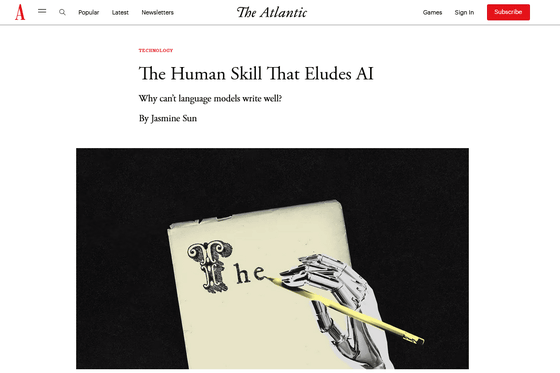
The Human Skill That Eludes AI - The Atlantic
In a November 2025 interview , OpenAI CEO Sam Altman predicted that 'Large-Scale Language Models (LLMs) will soon enable the solution of climate change, the construction of space colonies, and all kinds of discoveries in physics.' However, he also stated that 'even GPT-6 and GPT-7, which may emerge in the future, may only be able to produce something equivalent to 'a moderately good poem written by a real poet.'' Thus, even when LLMs develop to the point where they can perform advanced calculations and scientific research, it is believed that they will still not be able to write creative texts well.
The Atlantic therefore spoke with people working at companies that create LLMs, AI data vendors, computer science departments at universities, and AI writing startups to find out why LLMs often have low writing skills.
According to experts, the problem with the writing abilities of LLMs stems from the current design philosophy of LLMs. The models first learn from a vast amount of text on the internet and generate sentences using 'next token prediction,' which predicts the sequence of words. In this process, quantity is prioritized over quality in the data used for pre-training, so the models are not necessarily learning only high-quality texts. They may be learning to predict 'what word will come next' by referencing low-quality texts, which could be leading to a decline in their writing ability.
Even more important is the subsequent process called 'post-training.' After being trained on a dataset, the AI model is given ideal 'traits,' given examples of conversations for the AI to learn from, and has safety filters applied to block inappropriate requests. In addition, through processes such as 'reinforcement learning with human feedback,' the AI's output is scored by humans based on evaluation criteria, guiding the model towards responses that exhibit desirable traits. The current direction of AI development emphasizes safety and accuracy, resulting in many constraints to avoid political bias, inappropriate content, and misinformation. The more constraints there are, the more bland and homogeneous the AI's output tends to become, stifling free thinking and contributing to low creativity.
In an interview with The Atlantic, a former text evaluator at a major AI research institute spoke about the difficulties of creatively training AI. According to them, in order to translate vague impressions such as 'the tone of the writing' into clear criteria, it is necessary to include rules in the evaluation criteria such as 'use a maximum of two exclamation marks.' However, this resulted in many cases where the AI would evaluate 'A as better' even though 'B felt better overall' because 'B' contained three exclamation marks.
However, literary expression does not conform to these rules; rather, its artistry often arises from its resistance to rules and quantification. Similarly, excellent writing often breaks existing forms, incorporates ambiguity and individuality, and it is difficult to clearly define criteria for evaluation. James Yu, co-founder of Sudowrite , an AI assistant for novelists, said, 'Writing a novel is one of the most focused cognitive activities a human being can engage in.'
A fundamental problem, it has been pointed out, is that because AI lacks human-like experiences and feelings, its metaphors and descriptions can seem unnatural and lack 'weight.' While Yu is impressed by the technological leap of LLM, he says he doesn't want to read a story that is entirely AI-generated, stating, 'Most people's great debut works are autobiographical. Perhaps we need a model that has lived a life and almost died.'
Poet and computer scientist Katie Gero, who has been experimenting with language models since 2017, said, 'The ability to write creative text reached its peak with GPT-2, which appeared in 2019.' GPT-2 was still an incomplete model and little known outside of the tech community, but it was excellent at producing unexpected answers. On the other hand, current AI models are required to have PhD-level mathematical abilities and advanced coding skills, as well as guardrails to protect young people, so if excellent writing skills are also required, there is a possibility that 'accuracy-focused business writing' and 'highly creative, free writing' will clash and result in no output at all. Gero said, 'Large companies like Google and OpenAI want chatbots that can make money. Chatbots that can't make money are weird chatbots,' explaining why AI is not growing in a creative direction.
Related Posts: