NASA's DART experiment, which involved crashing a spacecraft into an asteroid to alter its orbit, has been found to have also changed the orbital period of a binary asteroid group.
.jpg)
by NASA/JHUAPL/Steve Gribben
In September 2022, NASA conducted
Direct detection of an asteroid's heliocentric deflection: The Didymos system after DART | Science Advances
https://www.science.org/doi/10.1126/sciadv.aea4259
NASA's DART Mission Changed Orbit of Asteroid Didymos Around Sun | NASA Jet Propulsion Laboratory (JPL)
https://www.jpl.nasa.gov/news/nasas-dart-mission-changed-orbit-of-asteroid-didymos-around-sun/
NASA's asteroid-smashing DART spacecraft hit so hard, it changed its target space rocks' orbit around the sun | Space
https://www.space.com/space-exploration/asteroid-comet-missions/nasas-asteroid-smashing-spacecraft-managed-to-alter-target-space-rocks-orbit-around-the-sun
NASA's asteroid target practice was a huge success | Mashable
https://mashable.com/article/nasa-dart-dimorphos-didymos-deflected-confirmed
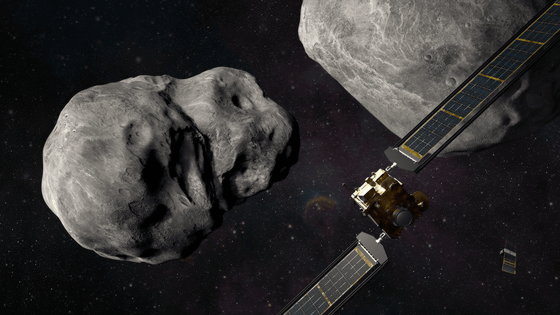
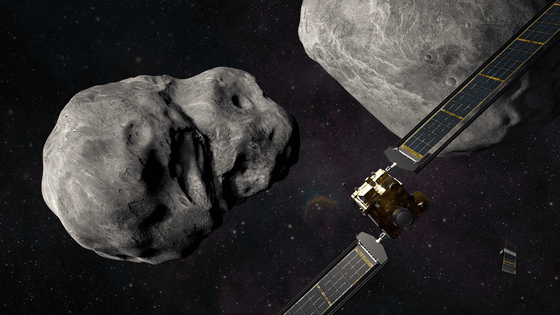
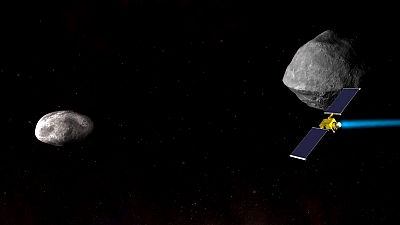
In science fiction works, the idea of 'attacking an asteroid that is about to collide with Earth using spaceships or nuclear weapons to alter its trajectory' sometimes appears. DART is a mission to verify whether this idea is actually feasible, and the asteroid Dimorphos was selected as the target.
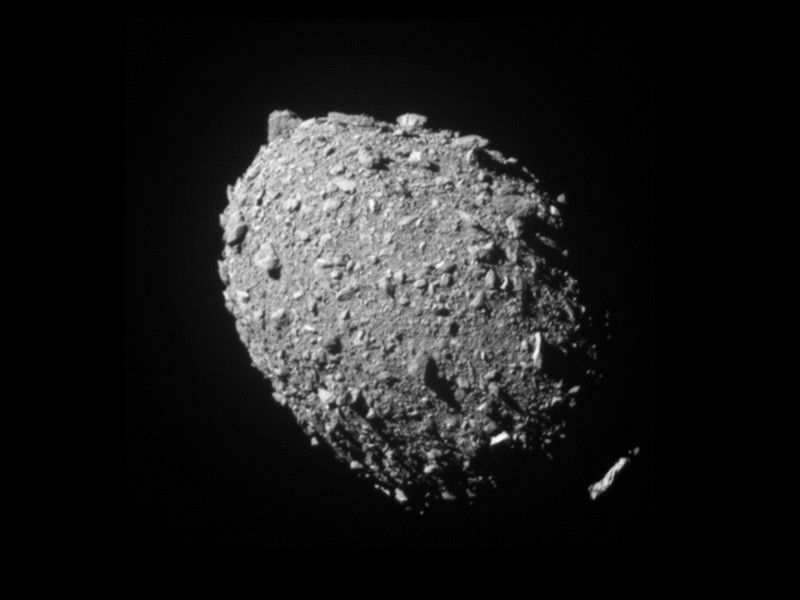
Dimorphos is an asteroid with a diameter of approximately 170m, orbiting the larger asteroid Didymos , which has a diameter of approximately 780m, as a binary asteroid that orbits the sun.
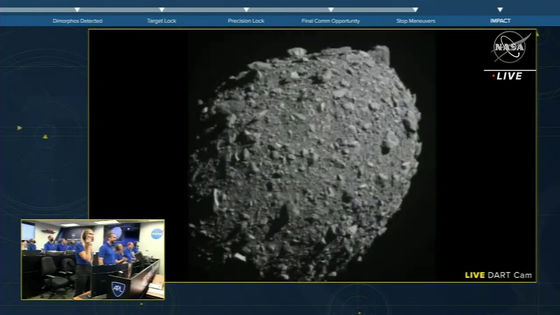
DART was executed on September 26, 2022 , with the spacecraft colliding with Dimorphos at a speed of 6.6 km per second. As a result, the distance between Dimorphos and Didymos was reduced by several tens of meters, and the orbital time of Dimorphos was shortened by 33 minutes.
Furthermore, a paper published in the scientific journal Science Advances in March 2026 reported that the collision of the DART spacecraft with Dimorphos altered the orbital period of the binary asteroid group it forms with Didymos. This is the first instance of an artificial object measurably altering the orbit of a celestial body orbiting the sun.
by NASA
This paper also shows that when the spacecraft collided with Dimorphos, rock fragments were blown into space, and these fragments carried momentum away, giving Dimorphos an explosive thrust. Scientists call this additional thrust the 'momentum enhancement factor,' and the momentum enhancement factor for DART was 'approximately 2.' This indicates that the thrust given by Dimorphos by the initial collision was approximately doubled due to the loss of momentum from the ejection of fragments.
The research team's measurements estimate that the change in the solar orbit velocity of the binary asteroid group Dimorphos and Didymos was approximately 4.3 cm (1.7 inches) per hour, and that its orbital period changed by 0.15 seconds. Rahil Macadia, a member of the DART team and lead author of the paper, said, 'Such small changes in an asteroid's orbit can, over time, be the difference between a dangerous object colliding with Earth or missing it.'
To investigate whether DART affected not only Dimorphos but also Didymos's orbit around the sun, the research team, with the help of volunteer astronomers around the world, observed a phenomenon called occultation , where one celestial body passes in front of another and hides it. By tracking occultations at the right location and timing, it is possible to measure the asteroid's velocity, shape, and position with extreme accuracy.
Steve Chesley of NASA's Jet Propulsion Laboratory, co-leader of the study, commented, 'Combined with years of ground observation data, these occultation observations were a crucial key to calculating how DART altered Didymos's orbit. This research is heavily weather-dependent and sometimes involves traveling to remote locations without a guarantee of success. This achievement would not have been possible without the dedicated efforts of dozens of volunteer occultation observers around the world.'
The research team also calculated the densities of Dimorphos and Didymos based on the changes in their orbits. This revealed that Dimorphos was slightly less dense than previously thought, supporting the hypothesis that it was formed from rock fragments ejected from a rapidly rotating Didymos.
Related Posts:

in Science, Posted by log1h_ik