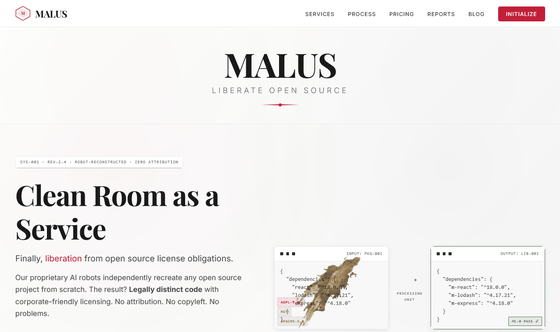
'MALUS' is a service that uses AI to rebuild open-source projects from scratch without copying them, thereby making their licenses independent.
Many open-source software licenses include copyleft clauses that state, 'If you copy the source code to create another software, that software must also be open source.' However, with the spread of AI, a situation has arisen where 'you can generate another source code with the same functionality by specifying the 'software operation' without copying the source code.' A service called ' MALUS ' that satirizes this situation has become a hot topic.
MALUS - Clean Room as a Service | Liberation from Open Source Attribution
https://malus.sh/
MALUS - Thank You for Your Service: On the Obsolescence of Open Source
https://malus.sh/blog.html
In early March 2026, a debate arose regarding open source and licensing surrounding a new version of 'chardet,' a Python library for determining the character encoding of text. The maintainer claimed that 'the new version does not directly reference the existing source code, but instead reimplements it from scratch using Anthropic's AI 'Claude.' Therefore, copyleft does not apply, and there is no need to continue with the previous LGPL license,' and changed the license to the MIT license, which does not require source code disclosure. The original author of chardet has countered this policy, arguing that 'even if it is not a direct copy, it is a clear violation of the LGPL as long as it is based on knowledge of the original code,' but various opinions have been exchanged, with several developers defending it as 'a legitimate action as long as the code is not directly copied.'
The ease with which AI can reconstruct code is destroying the rule that 'if you copy code, you inherit the license' - GIGAZINE
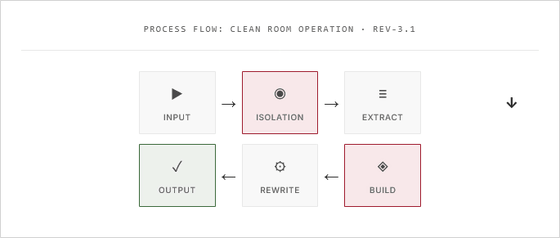
This method of reimplementing software based solely on specifications and tests, without referencing existing code, is called ' cleanroom design .' Normally, this process is extremely time-consuming because it involves reimplementing from scratch, and reproducing the desired specifications is not easy. However, with improvements in AI coding capabilities, the difficulty of cleanroom design has decreased significantly.
MALUS is a service specializing in cleanroom design using AI. MALUS cites 'the hassle of copyright notices,' 'the obligation to disclose code when transferring licenses,' and 'license management due to complex software dependencies' as problems with open source, and claims to provide 'a solution that eliminates the need to deal with all of these.'
MALUS's AI analyzes documentation, API specifications, and public interfaces without referencing any of the original source code, and reconstructs functionally equivalent software from scratch. As a result, the resulting software is '100% robot-written code,' freeing it from copyleft, eliminating the obligation to release the code, preventing the creation of derivative works, and eliminating the need for license inheritance.
In the 1879 case of Baker v. Selden , the U.S. Supreme Court ruled that 'copyright law protects expression, but not ideas.' This means that, in the case of software, copying the expression of the code constitutes copyright infringement, but copying the entire idea of what kind of software to create is not legally problematic. Mike Nolan, CEO of MalusCorp, the developer of MALUS, said, 'We anticipate opposition. Some will argue that our actions are exploitative, that we are exploiting ideas from open source while leaving behind the people who contributed to it. However, many companies use open-source software without contributing anything. We are simply charging those companies a fee in exchange for releasing the license.'
At the end of the blog post announcing the release of MALUS, under the title 'To the Open Source Community,' it says: 'Malus was developed thanks to all of you. Your ideas were and still are truly wonderful. We have simply found a way to separate the ideas themselves from the hassle of dealing with the people who created them. We owe you a debt, but we have no intention of repaying it. We just wanted to express our gratitude.'
Furthermore, the MALUS service and blog are based on a presentation titled ' Let's end open source together with this one simple trick ' given at FOSDEM 2026 in Brussels in February 2026, and are a sarcastic warning that 'AI-driven cleanroom design is destroying the concept of open source.' The name MALUS is Latin for 'bad' or 'harmful,' suggesting that it was created with a critical intent. Of course, MalusCorp is also a fictional company.
The story has also been featured on the social news site Hacker News, with comments such as, 'I almost went crazy until I realized it was satire,' and 'I understand this is satire, but in six months it might not be so far from reality,' expressing concern about the future of open source. On the other hand, one user who 'wanted to see what would happen and actually made a request' reported receiving a clean custom build package for $0.51 (approximately 81 yen), and questioned , 'If you're actually providing the service you're satirizing, can you still call it satire?'
Related Posts:


in AI, Web Service, Posted by log1e_dh