Apple officially announces MacBook Pro with M5 Pro/M5 Max, with graphics performance improved by up to 20% and AI performance four times faster than the previous generation

Apple announced the M5 Pro and M5 Max on March 4, 2026, as the latest models in its M5 series of Apple Silicon chipsets. Pre-orders for the MacBook Pro equipped with the M5 Pro and M5 Max will begin on Wednesday, March 4, 2026, and the devices will go on sale on Wednesday, March 11, 2026.
Apple Introduces M5 Pro and M5 Max, Delivers Incredible Power for the Most Intensive Pro Workflows - Apple (UK)
Apple introduces all-new MacBook Pro with M5 Pro and M5 Max - Apple (UK)
https://www.apple.com/jp/newsroom/2026/03/apple-introduces-macbook-pro-with-all-new-m5-pro-and-m5-max/
◆M5 Pro and M5 Max
The M5 Pro and M5 Max feature the Fusion architecture, which connects two third-generation 3-nanometer dies in a single SoC, achieving high bandwidth and low latency. Both chips feature an 18-core CPU, combining six high-efficiency cores with the world's fastest single-threaded performance and 12 new high-performance cores with excellent power efficiency.
The GPU has evolved to a next-generation architecture with a Neural Accelerator integrated into each core, delivering four times the peak performance for AI calculations compared to the previous generation. It also features a 16-core Neural Engine to accelerate Apple Intelligence, an updated media engine that supports H.264, HEVC, AV1, and ProRes, and a Thunderbolt 5 controller built directly onto the chip. It also supports Memory Integrity Enforcement, an industry-first always-on feature that protects memory without compromising device performance.
The M5 Pro is a chip designed to meet the needs of professional users such as data modelers and sound designers. Compared to the previous-generation M4 Pro, the M5 Pro boasts four additional CPU cores, improving multi-threaded performance by up to 30%. Apple also boasts that graphics performance is up to 20% better than the M4 Pro, and up to 35% better in applications that use ray tracing.
Regarding memory, it supports up to 64GB of unified memory, with bandwidth reaching up to 307GB/s. Apple emphasized that peak GPU performance for AI calculations is more than four times that of the M4 Pro and more than six times that of the original M1 Pro.
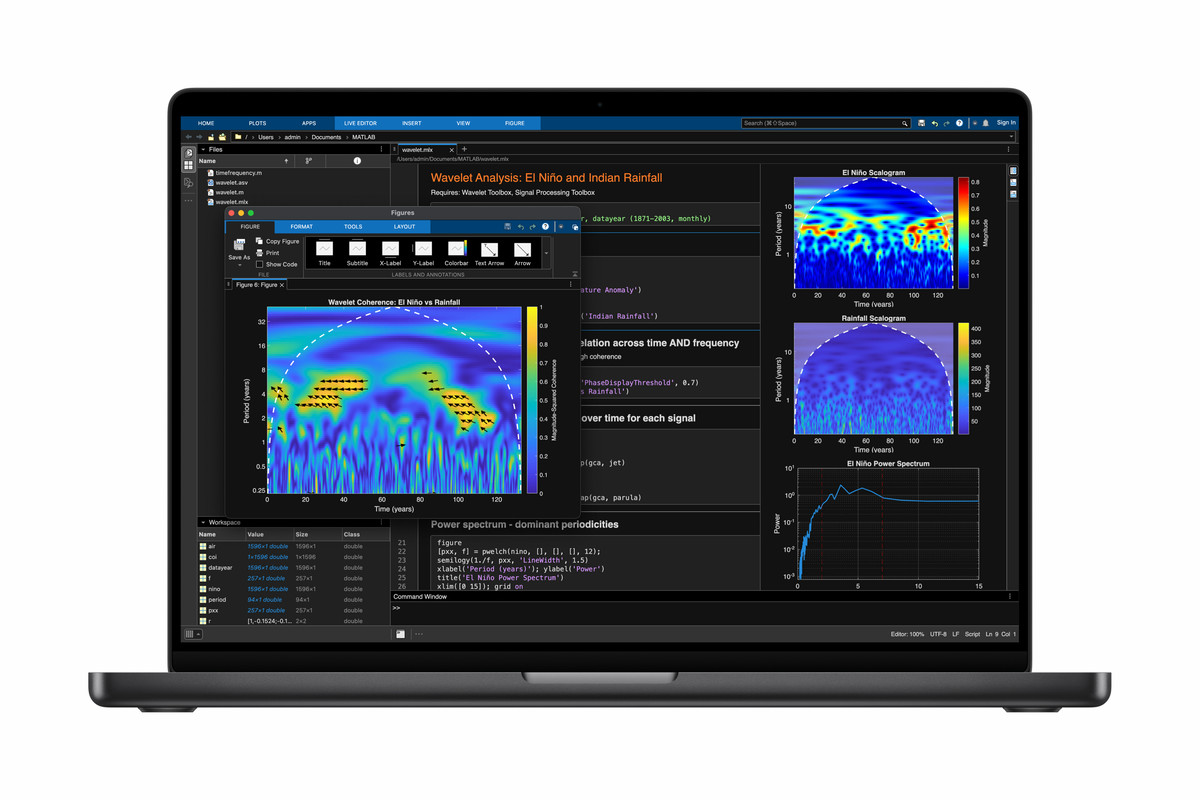
The M5 Max is designed for professionals, such as 3D animators and AI researchers, who require extremely high GPU computing power and memory bandwidth. It features a GPU with up to 40 cores, twice the number of cores as the M5 Pro, and the CPU also has an 18-core configuration. In terms of performance, compared to the M4 Max, the CPU's multi-threaded performance is improved by up to 15% and graphics performance is improved by up to 20%. Apple also claims that ray-traced rendering performance is up to 30% higher than the M4 Max.
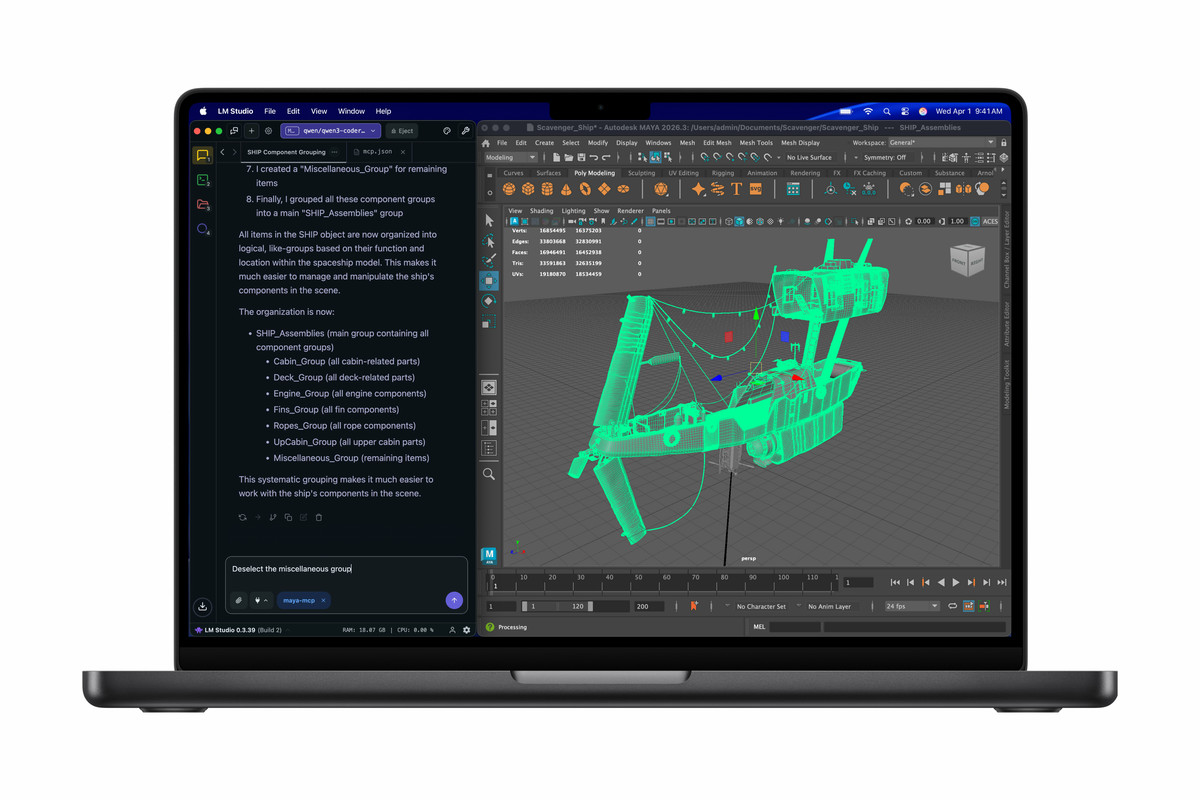
The unified memory can support up to 128GB, with a maximum bandwidth of 614GB/s. This vast bandwidth enables superior results in token generation for large-scale language models and processing of huge data sets. Apple boasts that the peak AI computing performance is more than four times that of the previous generation and more than six times the GPU computing performance compared to the M1 Max.
'The M5 Pro and M5 Max mark a monumental leap forward for Apple silicon, leveraging the new Fusion architecture that extends the capabilities of Apple silicon while maintaining our core principles of performance, power efficiency and a unified memory architecture,' said Johny Srouji, Apple's senior vice president of Hardware Technologies. 'Both chips demonstrate our relentless innovation, integrating the world's fastest CPU cores, a next-generation GPU with Neural Accelerators, a faster Neural Engine and high-bandwidth, large memory capacity, bringing an unparalleled combination of performance, efficiency and incredible on-device AI capabilities to MacBook Pro.'
◆MacBook Pro with M5 Pro/M5 Max
The MacBook Pro with the M5 Pro and M5 Max boasts storage performance that is up to twice as fast as the previous generation, with read and write speeds of up to 14.5GB/s. The minimum storage capacity has also been increased, from 1TB for the M5 Pro model to 2TB for the M5 Max model. Apple says this will further enhance demanding professional workflows, such as 4K and 8K video editing and processing large data sets.
The display uses Liquid Retina XDR, achieving a peak HDR brightness of 1600 nits and a maximum brightness of 1000 nits for SDR content. Additionally, a Nano-texture option is available to reduce reflections. Video calling capabilities have also been improved, with a 12MP center-frame camera supporting desk view, and a studio-quality microphone and a 6-speaker sound system with spatial audio support, providing a high-quality communication environment.
In terms of wireless communications, the M5 Pro is equipped with Apple's proprietary N1 chip, which supports Wi-Fi 7 and Bluetooth 6, improving connection stability and speed. It also comes with a full range of ports, including three Thunderbolt 5 ports, an HDMI port that supports up to 8K resolution, an SDXC card slot, and a MagSafe 3 port. It also has excellent external display output capabilities, with the M5 Pro model able to connect up to two high-resolution displays simultaneously, and the M5 Max model able to connect up to four high-resolution displays simultaneously.
The battery life is said to reach up to 24 hours, with an upgrade from the Intel-based model offering up to 13 hours of battery life, and up to 3 hours longer than the M1 model. Additionally, with a 96W or higher power adapter, fast charging is available, allowing you to charge up to 50% in 30 minutes. The entire product is made from 45% recycled materials, including 100% recycled aluminum for the casing.

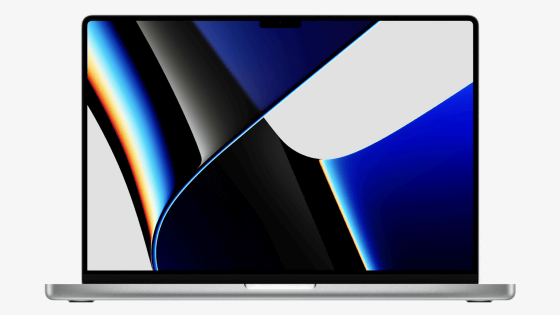
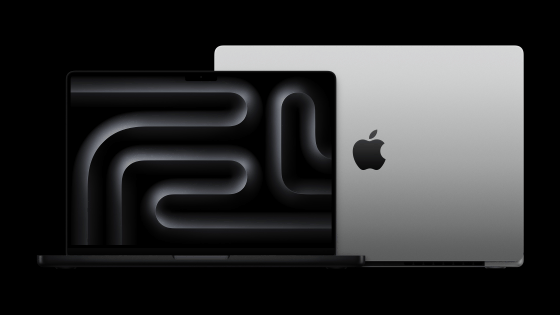
The MacBook Pro with M5 Pro/M5 Max is available in two display sizes, 14 inches and 16 inches, and two body colors, space black and silver.
The basic configurations available for the MacBook Pro with M5 Pro/M5 Max are as follows. The cheapest, minimum basic configuration is 369,800 yen (tax included) for the 14-inch model, and 449,800 yen (tax included) for the 16-inch model. Conversely, the most expensive configuration is the 16-inch model with M5 Max (40-core GPU), 128GB of unified memory, and an 8TB SSD, priced at 1,159,800 yen (tax included). If you add the additional options of a nano-texture display or pre-installed Final Cut Pro and Logic Pro, the total price rises to 1,263,800 yen (tax included). The 14-inch model also comes with an M5 model, starting at 279,800 yen (tax included).
| MacBook Pro | SoC | Unified Memory | SSD | Power adapter |
|---|---|---|---|---|
| Model equipped with M5 Pro | 15-core CPU, 16-core GPU (14-inch only) | 24GB 48GB | 1TB 2TB 4TB | 70W USB-C 96W USB-C |
| 18-core CPU, 20-core GPU | 24GB 48GB 64GB | 1TB 2TB 4TB | 96W USB-C | |
| Models equipped with M5 Max | 18-core CPU, 32-core GPU | 36GB | 2TB 4TB 8TB | 96W USB-C |
| 18-core CPU, 40-core GPU | 48GB 64GB 128GB | 2TB 4TB 8TB | 96W USB-C |
Pre-orders for the MacBook Pro with M5 Pro/M5 Max will begin on Wednesday, March 4, 2026, and sales will begin on Wednesday, March 11.
Related Posts: