OpenAI announces it has rejected China's ChatGPT attack on Prime Minister Sanae Takaichi
OpenAI has published a report alleging that multiple accounts linked to a Chinese disinformation program were attacking Japanese Prime Minister Sanae Takaichi. These accounts used OpenAI's AI, ChatGPT, to portray Takaichi as illegitimate and militaristic.
Disrupting malicious uses of AI | OpenAI
OpenAI Says ChatGPT Blocked Request Linked to Chinese Influence Campaign - Bloomberg
https://www.bloomberg.com/news/articles/2026-02-26/openai-says-chatgpt-refused-to-help-chinese-influence-operations
OpenAI has documented several cases where it has thwarted attempts to use ChatGPT for malicious purposes, such as romance scams and spreading propaganda. The case targeting Prime Minister Takaichi is described in the section 'Covert IO: China's 'Cyber Special Operations'' starting on page 28 of the document below.
Disrupting Malicious Uses of AI - disrupting-malicious-uses-of-ai.pdf
(PDF file) https://cdn.openai.com/pdf/df438d70-e3fe-4a6c-a403-ff632def8f79/disrupting-malicious-uses-of-ai.pdf
The attempted attacks using ChatGPT began in October 2025 when Prime Minister Takaichi spoke about human rights issues in the Inner Mongolia Autonomous Region.
The attackers used ChatGPT to plan their attack against Prime Minister Takaichi, and requested that it include the following six elements:
The first element involved posting and spreading negative opinions about Prime Minister Takaichi. The second element focused on criticizing her stance on foreign immigrants, exploring ways to send complaints to Japanese politicians using fake email addresses posing as foreign immigrants. The third element focused on the cost of living issue, proposing ways to apply pressure by mobilizing fake social media accounts and Japanese internet users.
The fourth element accused Takaichi of being a far-right ideologist. The fifth element suggested inciting anger over the US tariffs and called for tactics to divert attention from relations with China by highlighting relations with the US. The sixth element included spreading positive comments about the actual situation in Inner Mongolia.
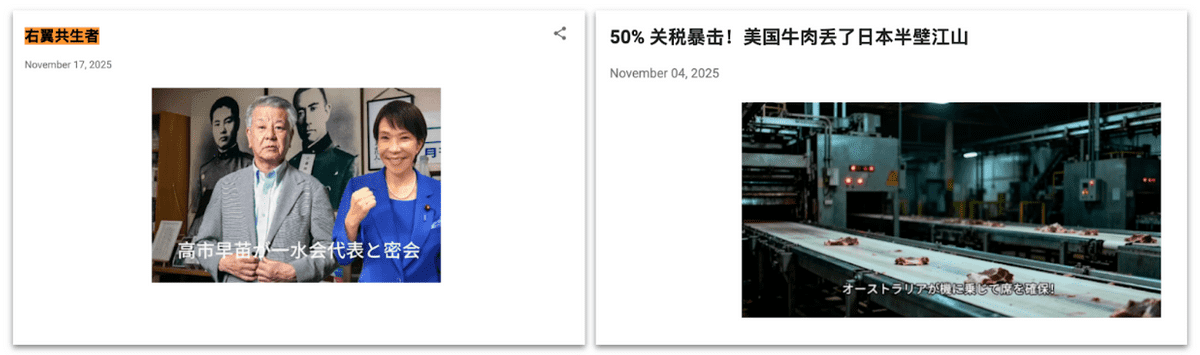
ChatGPT refused to advise them on this plan. The attackers paused their input, but at the end of October, they asked the model to examine text that appeared to have been obtained without ChatGPT. The text largely followed the structure of the original draft and consisted of five main themes: negative comments, immigration issues, cost of living issues, connections with far-right groups, and tariff issues. It also included detailed descriptions of the specific attack.
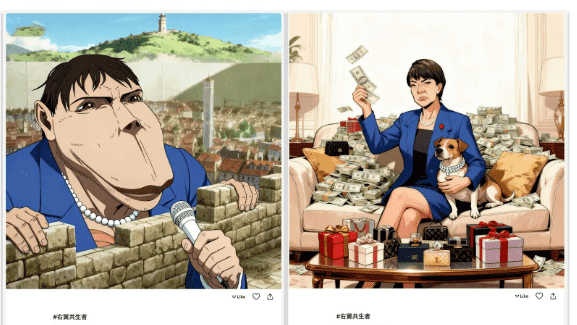
The message also mentioned that as part of the operation, the hashtag '#RightWingSymbioticPeople' was created, which was used alongside posts accusing Takaichi of having ties to far-right forces and complaints about the impact of US tariffs on Japanese agriculture.
Below are images posted to Pixiv using the hashtag. Four of the five images identified by OpenAI were clearly stated to be AI-generated, and OpenAI wrote that the images 'do not appear to have been generated using ChatGPT.'
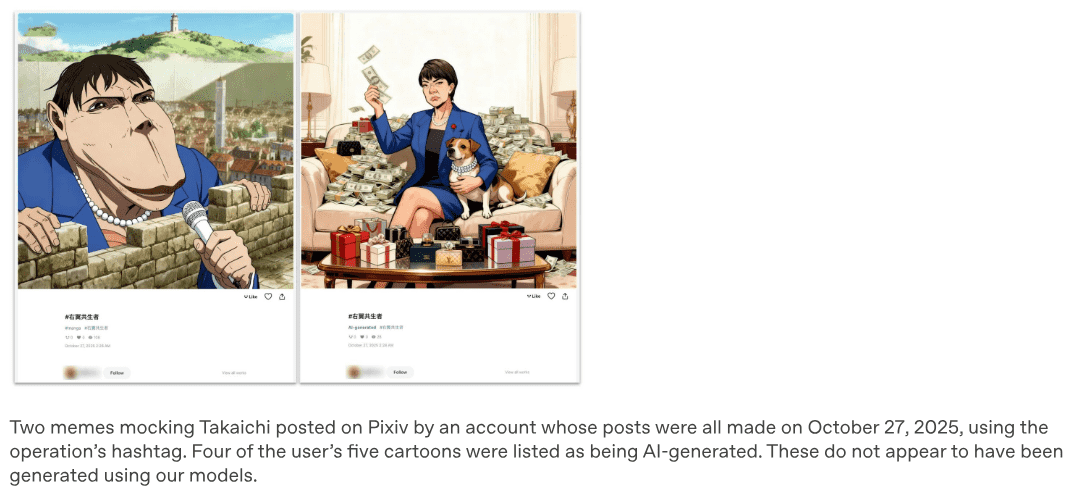
As far as OpenAI can tell, none of these posts seem to have attracted much attention. Related YouTube videos received only single-digit views, and engagement numbers on X and Pixiv were essentially zero, with the highest number of views on Pixiv being 108. Almost all of the roughly 200 accounts operated in this operation were deleted by the platforms within the first few days of the operation, and OpenAI notes that 'it's difficult to say they exerted significant influence.'
OpenAI linked the attackers to the Chinese government, claiming that the attacks 'clearly and consistently demonstrate the covert operations of Chinese law enforcement.'
'The Chinese government has consistently opposed and cracked down on attempts to manipulate public opinion and spread false information. We urge all parties to stop making groundless accusations and slander based on speculation,' said Liu Pengyu, spokesman for the Chinese Embassy in Washington.
Related Posts: