A new hypothesis suggests that the rise in myopia may be due to indoor eye use rather than screen time.
While the rise in myopia is often linked to increased time spent looking at smartphone and PC screens, a research team at
Human accommodative visuomotor function is driven by contrast through ON and OFF pathways and is enhanced in myopia - Cell Reports
https://www.cell.com/cell-reports/fulltext/S2211-1247(26)00016-1
New Research Suggests Myopia Could Be Caused By How We Use Our Eyes Indoors - SUNY College of Optometry
https://www.sunyopt.edu/new-research-suggests-myopia-could-be-caused-by-how-we-use-our-eyes-indoors/
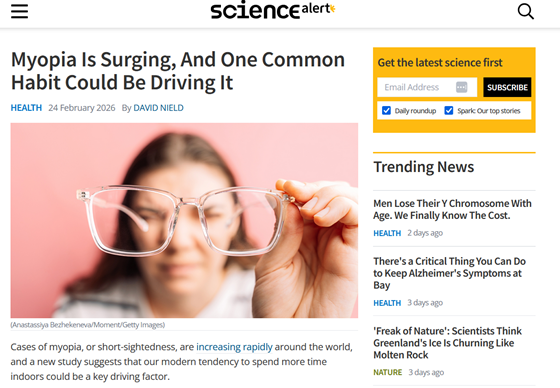
Myopia Is Surging, And One Common Habit Could Be Driving It : ScienceAlert
https://www.sciencealert.com/myopia-is-surging-and-one-common-habit-could-be-driving-it
Myopia is a visual disorder that affects distance vision. It occurs when changes in the length of the eyeball cause light entering the eye to focus in front of the retina. While genetics play a large role, environmental factors are also thought to be important, given the rapid increase in prevalence over the past few generations. The SUNY College of Optometry explains that myopia affects approximately half of young adults in the United States and Europe, and approximately 90% of people in parts of East Asia.
A research team led by Ursha Maharjan of the SUNY College of Optometry looked at the multiple processes that occur simultaneously when the human eye looks at something close: focusing, moving the eyes inward (convergence), and adjusting pupil dilation.
The research team reported that people with myopia tended to have a stronger reaction, particularly changes in the pupil that made them more susceptible to excessive constriction, and that these changes may be related to a decline in the information processing function of the retina.
According to Science Alert, the researchers conducted an experiment involving 34 participants, including 21 myopic and 13 non- myopic people. They were asked to look at rectangular targets of varying brightness and contrast, and then repeatedly focus one eye at a time on a nearby object. They then measured eye movements and pupil responses.
Science Alert reports that the key point in this experiment was that it was the difference in contrast, rather than brightness, that had a stronger effect on eye inward movement and pupil constriction. It also noted that people with myopia tended to have their eyes turn slightly inward even before focusing.
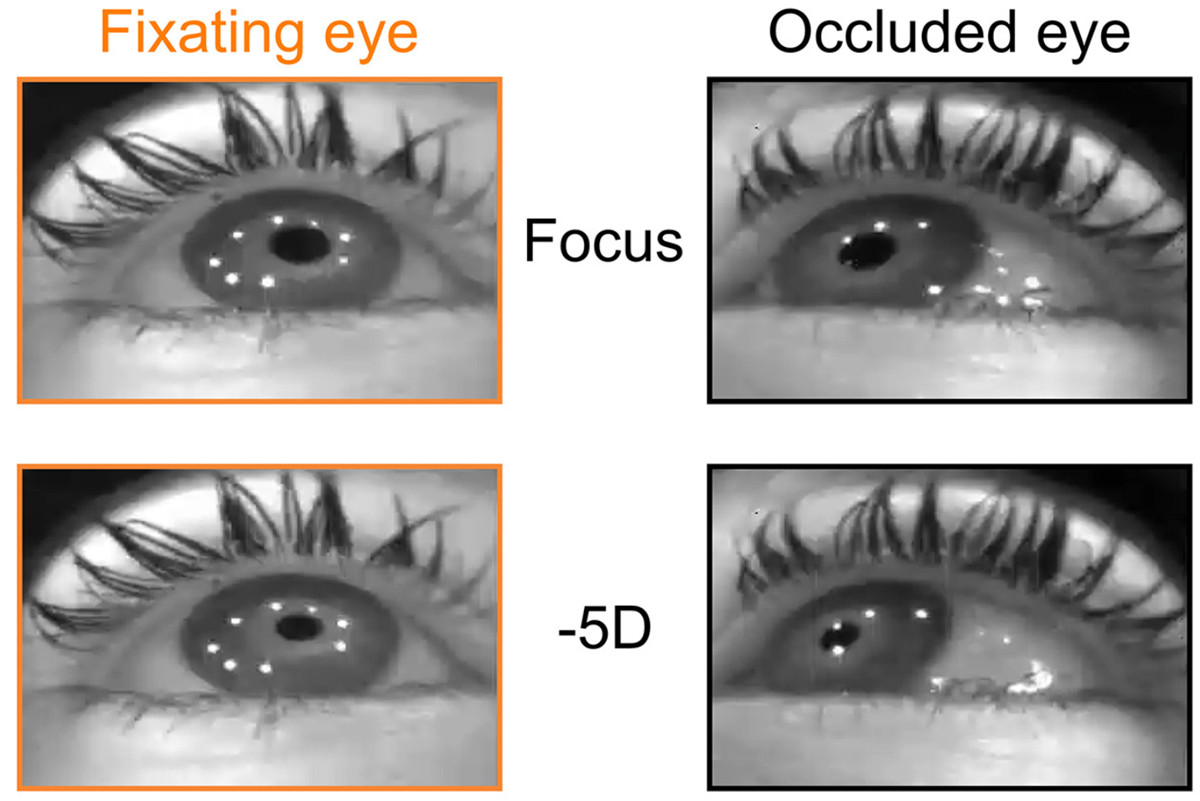
The images below show the state of the eyes photographed during the experiment. The left is the fixing eye looking at the target, and the right is the occluded eye to block out visual information. The top row shows the normal focusing condition, and the bottom row shows the condition with a -5D focus load. The pupil of the fixing eye is smaller under the -5D condition, showing how the pupil constricts when looking at something close.
The researchers hypothesize that when people look at close objects indoors, like smartphones, tablets, or books, their pupils constrict to ensure clarity rather than brightness, potentially resulting in less light reaching the retina in darker environments. Science Alert describes this mechanism as a 'loop where focus is prioritized over brightness, leading to overcompensation and worsening vision.'
If this hypothesis is correct, the research team says it may be possible to unify myopia-related phenomena that have often been explained separately up until now, such as the fact that outdoor activities can help prevent myopia, that treatments such as atropine eye drops and multifocal lenses can help slow its progression, and that the combination of close-up tasks and dark indoor environments can be problematic.
However, the research team emphasized that this is merely a testable hypothesis and not a final conclusion. Science Alert cited limitations of the study, including a small sample size, lack of longitudinal tracking of visual acuity changes, and a lack of direct comparison between indoor and outdoor conditions.
Related Posts:



in Science, Posted by log1b_ok