Life in space changes the 'brain position' and this state continues for some time after returning to Earth

As NASA advances its
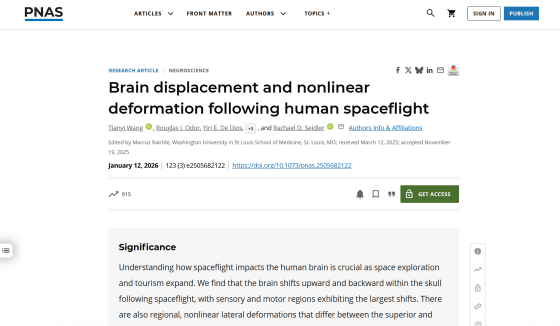
Brain displacement and nonlinear deformation following human spaceflight | PNAS
https://www.pnas.org/doi/10.1073/pnas.2505682122
Living in space can change where your brain sits in your skull – new research
https://theconversation.com/living-in-space-can-change-where-your-brain-sits-in-your-skull-new-research-273663
On Earth, gravity is constantly pulling bodily fluids and the brain toward the center of the Earth, but gravity is extremely weak in space. As a result, bodily fluids move to the head, causing facial swelling and disrupting the balance of the brain, cerebrospinal fluid , and surrounding tissues that is stable on Earth.
'Without gravity, the brain becomes suspended within the skull, and various forces are applied by the surrounding soft tissue and skull. Previous studies have shown that the brain is higher within the skull after spaceflight, but these studies focused on average values for the entire brain, and the effects on different brain regions are not well understood.'
To address this issue, a research team led by Rachel Seidler, a professor of applied physiology and kinesiology at the University of Florida, conducted MRI scans of the brains of 26 astronauts who had spent various periods in space, from a few weeks to a year. To focus on brain movement, the research team aligned the scans taken before and after spaceflight and divided the brain into regions to examine how it moved relative to the skull.
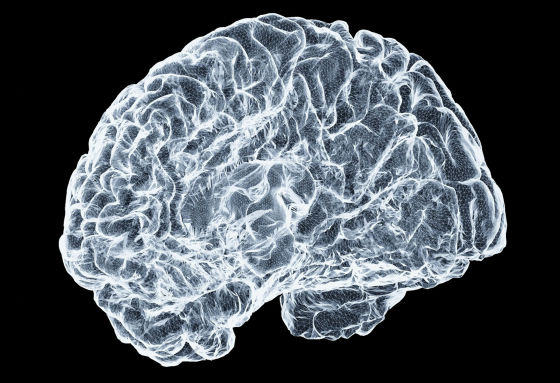
The analysis revealed a consistent pattern of upward and backward brain movement after spaceflight, and the magnitude of this change increased with the duration of space travel.
The researchers found that the brains of astronauts who stayed on the International Space Station (ISS) for about a year had shifted upward by more than 2 mm in the upper part of their brains, but the rest of their brains barely shifted. While 2 mm may seem like a small amount, it has significant implications within the confined space of the skull.
Additionally, motor and sensory regions on both sides of the brain shifted toward the midline, meaning the left and right sides of the brain shifted in opposite directions. These opposing patterns canceled out the changes, potentially missing from previous studies.
The astronauts' brain movements returned to nearly normal within six months of returning to Earth. The backward shift took a little longer to recover, but this is thought to be because Earth's gravity pulls the brain downwards rather than backwards.
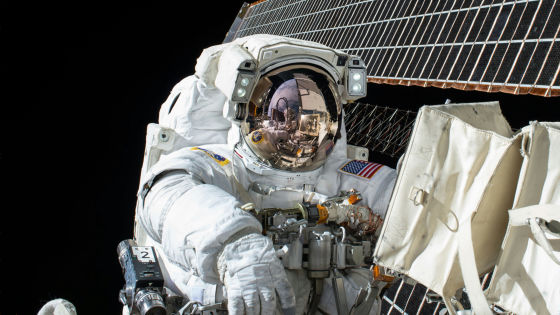
The research team also investigated the relationship between balance function and brain movement after spaceflight and found that changes in the position of brain regions responsible for sensory processing correlated with changes in balance function after flight, but the astronauts did not experience any obvious symptoms that might be related to brain relocation, such as headaches or cognitive decline.
Seidler and his colleagues argue that the results of this study do not indicate any direct health risks. 'Understanding the brain's movements during spaceflight and its subsequent recovery will help researchers understand the effects of microgravity on human physiology, which could help space agencies design safer missions,' they said.
Related Posts:

in Science, Posted by log1h_ik