MIT researchers develop silicon structure that can run calculations using a computer's own waste heat instead of electricity
Waste heat from hardware can cause a variety of problems and is generally considered unnecessary, but researchers at the Massachusetts Institute of Technology (MIT) have reported that they have developed a silicon structure that can run calculations using excess heat instead of electricity.
Thermal analog computing: Application to matrix-vector multiplication with inverse-designed metastructures | Phys. Rev. Applied
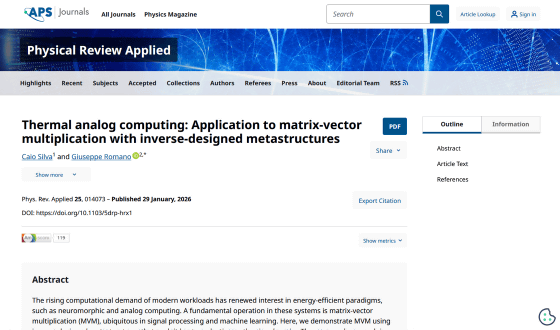
MIT engineers design structures that compute with heat | MIT News | Massachusetts Institute of Technology
https://news.mit.edu/2026/mit-engineers-design-structures-compute-with-heat-0129
MIT designs computing component that uses waste heat 'as a form of information' | Live Science
https://www.livescience.com/technology/computing/mit-designs-computing-component-that-uses-waste-heat-as-a-form-of-information
As computing demands continue to grow due to advances in AI and other technologies, there is growing interest in more energy-efficient methods of computing. To address this, MIT student Caio Silva and his colleagues have developed a silicon structure that performs calculations by using heat as information itself.
Silva and his colleagues used a software system developed in 2022 by MIT researcher Giuseppe Romano and his colleagues to design nanostructures that conduct heat in specific ways . This software system uses a technique called 'inverse design,' which works backward from the required function to design the optimal shape for that task.
'These structures are so complex that they can't be invented by human intuition alone, so we need to teach computers how to design them. That's why inverse design is such a powerful technique,' said Romano, a co-author of the paper.
The image below shows how the software system designs the optimal silicon structure for thermal computation: Powerful algorithms continually adjust each pixel in the grid, iteratively refining the shape and thickness until the desired structure is reached.
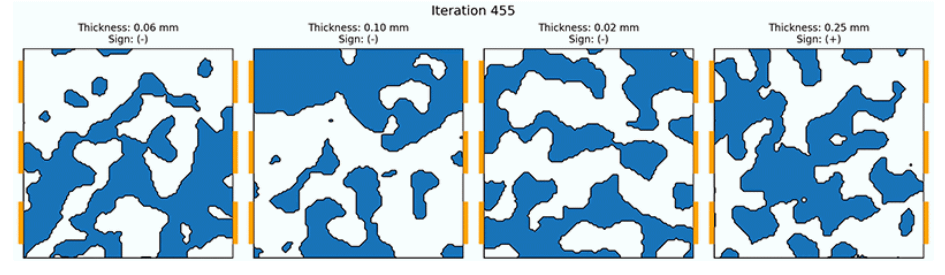
The researchers used a software system to design complex silicon structures the size of a dust particle that could perform calculations using thermal conduction, a type of analog computing that processes signals using continuous physical values (temperature and heat flow) instead of digital bits ('0' or '1').
Heat flows through the silicon structure from hotter regions to cooler regions, and the geometry of the structure encodes the coefficients to perform matrix multiplication . The researchers simulated simple structures with two or three columns and reported that they were often able to perform the calculations with over 99% accuracy.
'When computing with electronic devices, heat is often a waste product, so we want to remove as much heat as possible,' Silva said. 'But we took the opposite approach and showed that it's possible to perform computations using heat by using heat as information itself.'
While matrix multiplication is a fundamental mathematical technique widely used in signal processing and machine learning, applying this silicon structure to large-scale applications such as deep learning requires tiling millions of silicon structures. Furthermore, accuracy decreases as the distance between input and output terminals increases, and the device bandwidth is limited. Nevertheless, the silicon structure may be useful for tasks such as thermal management in microelectronics, detecting temperature gradients and heat sources.
Related Posts: