Why is the sky blue? Why are sunsets on Earth red and sunsets on Mars blue?

We often look up at the sky without even thinking about it, but when asked why it's blue, many people probably only know that it's due to a phenomenon called '
Why is the sky blue?
https://explainers.blog/posts/why-is-the-sky-blue/
When asked, 'Why is the sky blue?', the answer is often 'Rayleigh scattering,' but Kennedy points out, 'This is not wrong, but it's not very useful. Simply knowing the name and understanding it are completely different.' Therefore, Kennedy provides a detailed explanation of Rayleigh scattering and other related phenomena, not only in terms but also in terms of how they work.
◆Why is the sky blue?
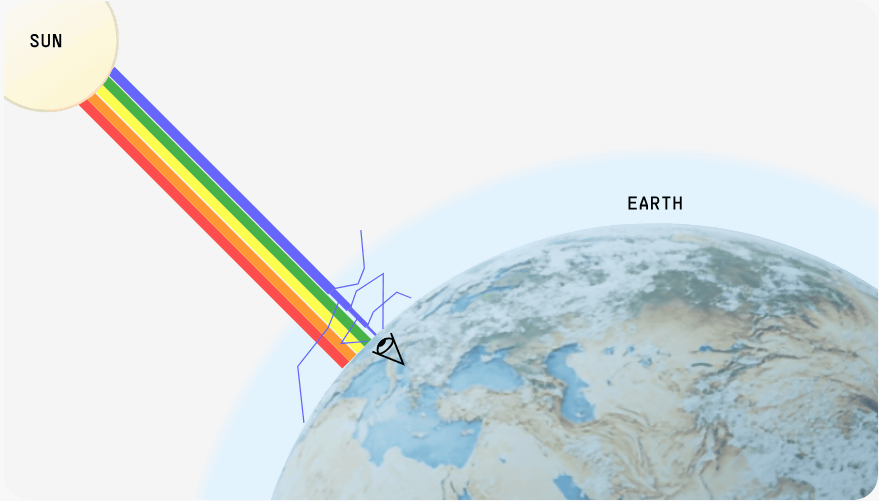
The reason we see color is because wavelengths of light emitted from sources like the sun or electric lights are reflected by something and reach our eyes. When sunlight reaching the Earth hits the atmosphere, most wavelengths of light pass through unimpeded, but blue wavelengths of light are scattered and dispersed throughout the atmosphere.
This is why, when you look up at the sky in the dark on a clear day, you see scattered blue. The wavelengths of light that aren't scattered by the atmosphere reach us as they are, but they reach us directly from the direction of the sun, so they only reach our eyes when we look at the sun. The reason the sun appears white when we look directly at it is because the wavelengths of various colors of light mix together to form white.
◆Why does only blue scatter?
However, the explanation that the sky appears blue because only blue light is scattered when sunlight hits the atmosphere is not much different from the explanation that it is due to Rayleigh scattering. Kennedy goes a step further and explains that the blue and violet frequencies are closest to
When light passes through small molecules in the atmosphere, the electron clouds of the molecules vibrate at the same frequency as the light. Each molecule's electron cloud has a unique resonant frequency, and the closer the frequency of the light is to that resonant frequency, the stronger the vibrations become, increasing the likelihood that the light will be polarized (scattered) in a different direction rather than straight ahead. This phenomenon is called Rayleigh scattering.
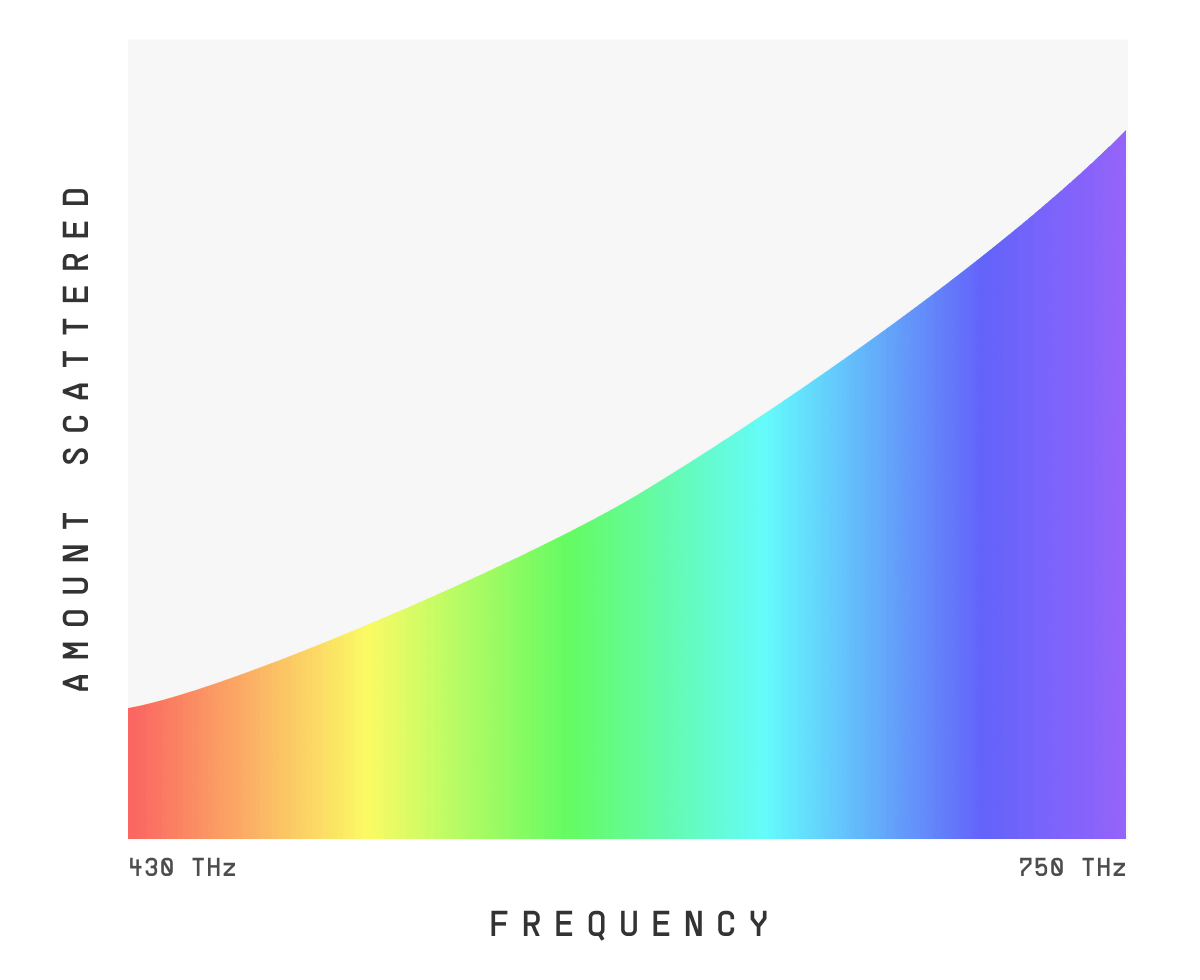
The resonant frequencies of nitrogen and oxygen molecules, which make up 99% of the atmosphere, are in the ultraviolet range, which is lower than visible light , so violet and blue light, which are closer to the ultraviolet range, are more likely to be scattered. While some green and red light, as well as blue and violet, are scattered, the proportions are small, so when the scattered light mixes, it ultimately becomes blue.
The question that arises here is, 'If not only blue but also violet is scattered, why doesn't the sky appear purple?' Kennedy said, 'It seems silly, but the real answer is, 'Our eyes don't like seeing purple.' Violet is the highest frequency of light we can see, and it's right at the edge of our perception.' Below is a graph showing the frequency of light, and wavelength and frequency are inversely proportional.
◆Why is the sunset red?
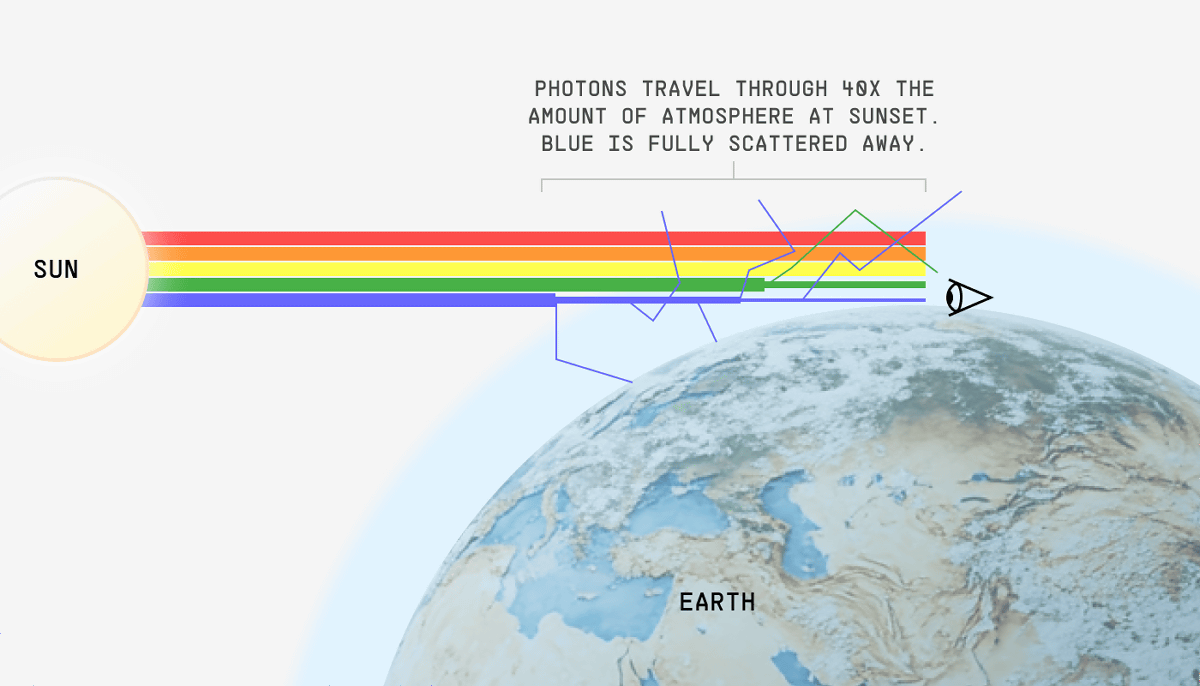
Now that we know why the sky is blue, you may be wondering, 'Why are sunrises and sunsets red?' The answer to this question has to do with the distance sunlight travels through the atmosphere. During the day, sunlight shines at a high angle, but in the morning and evening, sunlight enters the atmosphere at a lower angle, so the distance it travels through the atmosphere is longer. When the sun is above the horizon, sunlight has to pass through 40 times thicker atmosphere to reach our eyes than at noon.
As a result, most of the blue light from sunlight is scattered before it reaches our eyes, either flying off into space or hitting the ground, making it invisible. Similarly, less green light reaches our eyes, leaving only the yellow and red light, which are least likely to be scattered, to remain until the end, resulting in the appearance of sunrises and sunsets.
◆Why are clouds white?
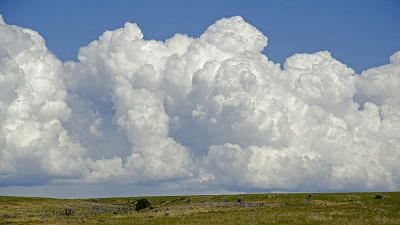
To understand how the colors of the sky are formed, we also need to understand why clouds appear white. Clouds are made up of countless tiny water droplets, each about 0.02 mm in diameter, which is considerably larger than nitrogen or oxygen molecules. When sunlight hits these droplets, it is reflected and scattered in the same way as light hitting a prism or glass, and some of it is absorbed as is. As a result, the sunlight that hits the droplets is scattered in random directions.
Clouds are made up of countless water droplets, which reflect, scatter, and absorb sunlight, causing all wavelengths of light to be emitted in all directions. As a result, all wavelengths of light combine, causing clouds to appear white. This phenomenon of light scattering by particles with wavelengths of visible light or larger is called '
◆Why is the sky on Mars red?
While the sky on Earth appears blue, the sky on Mars, another planet in the solar system, appears red. This is because the iron-rich fine dust particles in the Martian atmosphere absorb blue light and scatter only red light. Blue and violet light have higher frequencies (energy), which raise the energy state of the electrons in the dust molecules, making them more easily absorbed by the dust.
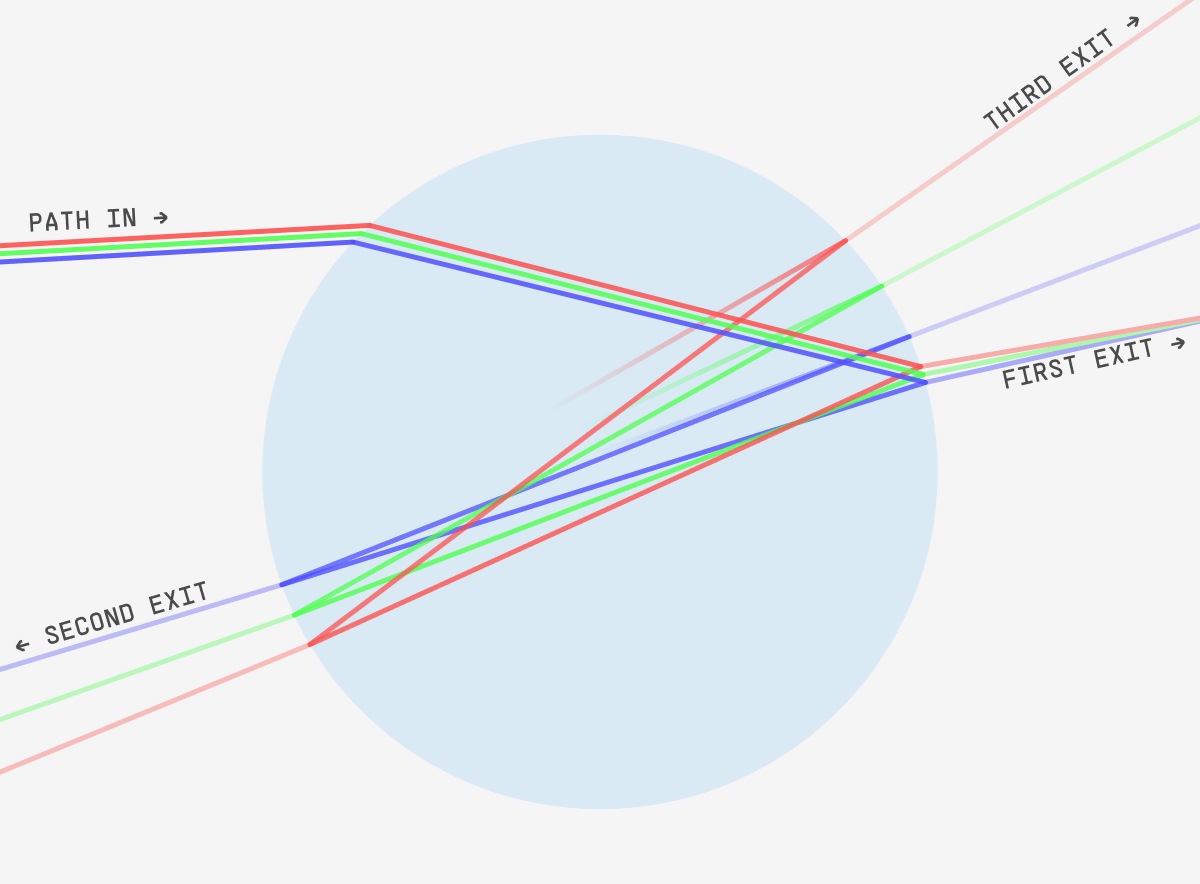
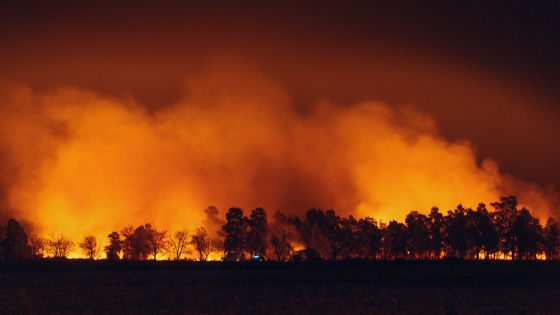
When the atmosphere contains solid particles roughly the same size as the wavelength of light, as on Mars, the atmosphere typically takes on warm colors like red, orange, and yellow, the same principle that causes the sky to appear reddish during a fire, Kennedy explains.
◆Why are sunsets on Mars blue?
Surprisingly, sunsets on Mars are known to be blue, not red. Martian dust not only absorbs blue and purple light, but also scatters it. The light scattering phenomenon caused by Martian dust is also due to Mie scattering, just like clouds.
'The characteristic of Mie scattering is that light is scattered equally regardless of its wavelength or frequency, so the probability of red light hitting a blue particle and scattering from it is the same. However, because red light has a larger angle of refraction and blue light has a smaller angle of refraction, the red light either flies off into space or hits the ground before reaching our eyes, and as a result, only blue light reaches us,' Kennedy explained.
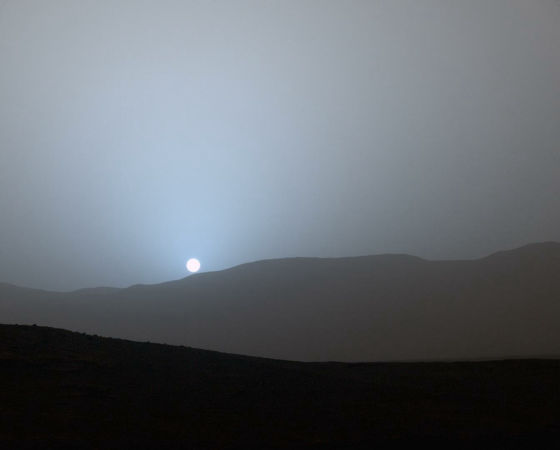
by NASA/JPL-Caltech/MSSS/Texas A&M Univ.
Related Posts:
in Science, Posted by log1h_ik