Documents showing that Google, TikTok, Meta, etc. designed platforms to be addictive after understanding the adverse effects on the health of children and young people will be submitted to the court
ECH OVERSIGHT REPORT: UNSEALED COURT DOCUMENTS SHOW TEEN ADDICTION WAS BIG TECH'S “TOP PRIORITY” - Tech Oversight Project
https://techoversight.org/2026/01/25/top-report-mdl-jan-25/
The documents , filed in the District Courts of California and North Dakota on January 20, 2026, include past internal emails and documents from Google, Meta, TikTok, and others. The Tech Oversight Project pointed out that these documents suggest that Google, Meta, TikTok, and others intentionally designed their platforms to encourage social media addiction among children and young people.
◆Meta
In 2016, an internal exchange took place at Facebook (now Meta) that stated, 'Mark [Zuckerberg] has decided that teenagers will be the company's top priority for the first half of 2017.'
Additionally, internal emails from July 2016 show 'extensive discussions about the Lifestage app' and indicate that the app was released with few safeguards in place to address internal concerns.
Meta also discussed 'school blasts' (mass notifications sent during school hours) as a strategy to attract more high school students, although the mention of school blasts is in undated and heavily redacted internal documents, so it's unclear when they were mentioned.
An internal message exchanged in 2016 stated, 'Attracting the attention of a large number of teenagers in a given area or school through our products is crucial to increasing the overall time spent in the same area, especially in messaging,' suggesting that there is a common understanding among employees that 'teenagers' are the target audience.
The internal documents , created in February 2018, include information about the development of a product called 'Tweens on Facebook' and the testing of Facebook's 'private mode.' They also include internal discussions about how to counter myths that Facebook is a bad influence on young people, and internal data showing a correlation between Facebook use and decreased happiness.
In 2018, an internal document was created discussing a program to recruit 'teen trendsetters to act as Instagram spokespeople at local high schools.' The ideal ambassadors for the program were described as '13-17 years old, diverse individuals with good peer relationships.' The ambassadors would be paid, receive incentives, and receive prizes, and would be required to sign a non-disclosure agreement (NDA).
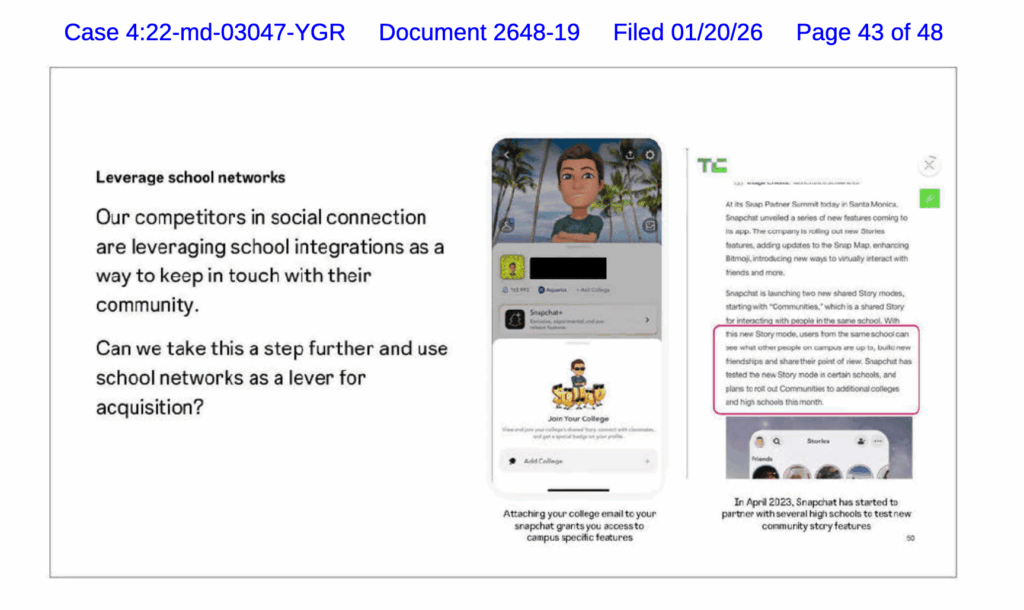
Other slides from 2023 include suggestions that Instagram may 'use school networks as an acquisition vehicle' to better compete with Snap, and a desire to 'position Instagram as essential for building relationships with schools, especially during transitional periods like graduation and transfers.'
Elsewhere, a May 16, 2025 expert
Furthermore, an internal slide titled 'Market Environment Review: Opportunity Cost and Lifetime Value of Teens' infamously states that 'the lifetime value of a 13-year-old is approximately $270 (approximately 42,000 yen) per person.'
Additionally, a slide titled 'Teen Mental Health: Creatures of Habit' reported the results of a study on the mental health of teenagers, stating, 'Teens can't stay away from Instagram even if they want to,' and 'Teens tell the 'addict' story' about Instagram: they feel unable to resist even though they know it's wrong, and they spend a lot of time engaging in compulsive behaviors.'
In a slide about the role of YouTube's autoplay feature, Google concluded, 'Autoplay can disrupt sleep patterns. Disabling or limiting autoplay at night may help save you some sleep.'
In May 2018, YouTube's then-director of product management, James Bezer, revealed that an educator had told him, 'We're suggesting that parents limit their children's screen time before school starts.'
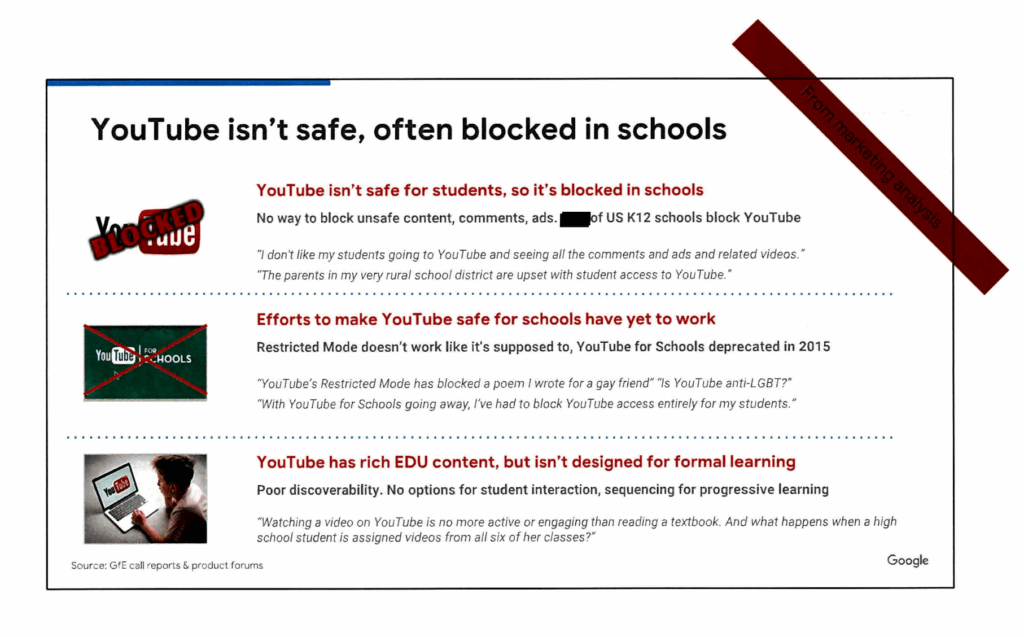
A slide deck about G Suite for Education created in December 2018 included statements such as, 'YouTube is unsafe and is often blocked in schools,' 'There is no way to block unsafe content, comments, or ads,' and 'Efforts to make YouTube safe for schools have not yet been successful.'
In a 2019
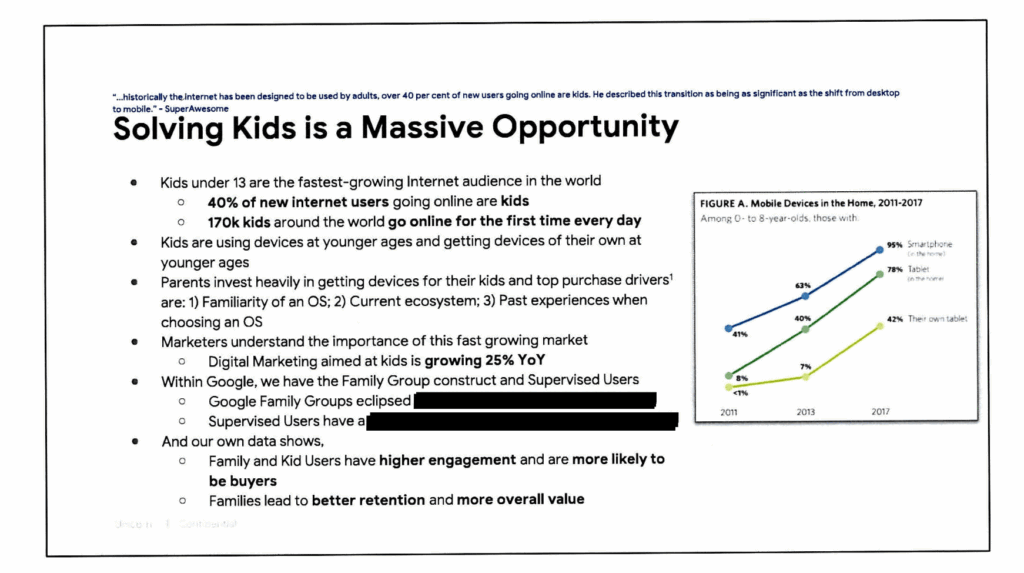
A slide created in November 2020 detailing Google's business plan for expanding its products and access to children states, 'Welcoming kids into the Google ecosystem leads to lifelong brand trust and loyalty.' 'This essentially asserts that this isn't just about schools, but also about engaging, 'cool' products that will keep kids and teenagers engaged for life.' This clearly shows that the company is intentionally targeting children and young people.
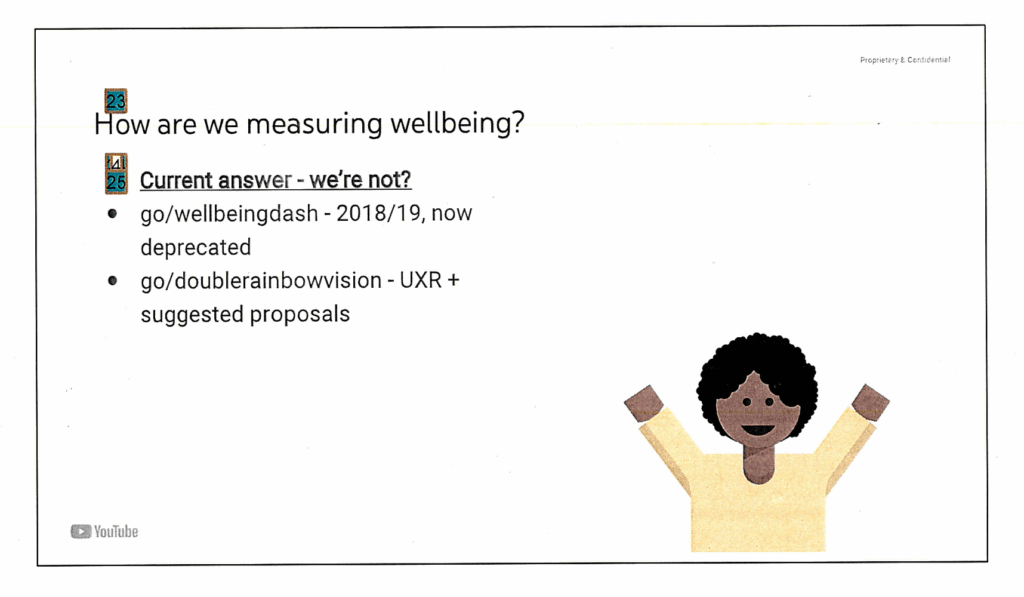
In addition, an email sent in February 2023 revealed internal discussions about how to appeal to teens, stating, 'Short videos play a major role in attracting the attention of teens. However, we are not limited to short videos; we are focusing on teens across our core content, including setting OKRs specifically for teens, such as fun, engagement, and responsibility.'
The slide deck , which analyzes teen and millennial views and behaviors regarding YouTube, notes that 'one in four millennials admits to being late for work because they spent too much time on their smartphone,' and includes statistics on YouTube's influence in shaping the personal opinions and lives of 13- to 17-year-olds.
The document , which discussed awareness and challenges regarding the health and safety of teens on YouTube, stated, 'However, there are two major challenges to the health and safety of teens on YouTube: the promotion of low-quality content that conveys and normalizes unhealthy beliefs and behaviors, and unintended prolonged use that takes away valuable time from friends and sleep. These concerns are most pronounced with short-form content (popular with teens) that lacks depth and allows for an endless feed experience.'
Furthermore, a slide prepared for internal use stated that 'user behaviors may have adverse health effects,' and listed four video viewing behaviors that could have adverse health effects: (1) late-night use, (2) habitual frequent use, (3) unintentional use, and (4) problematic content.
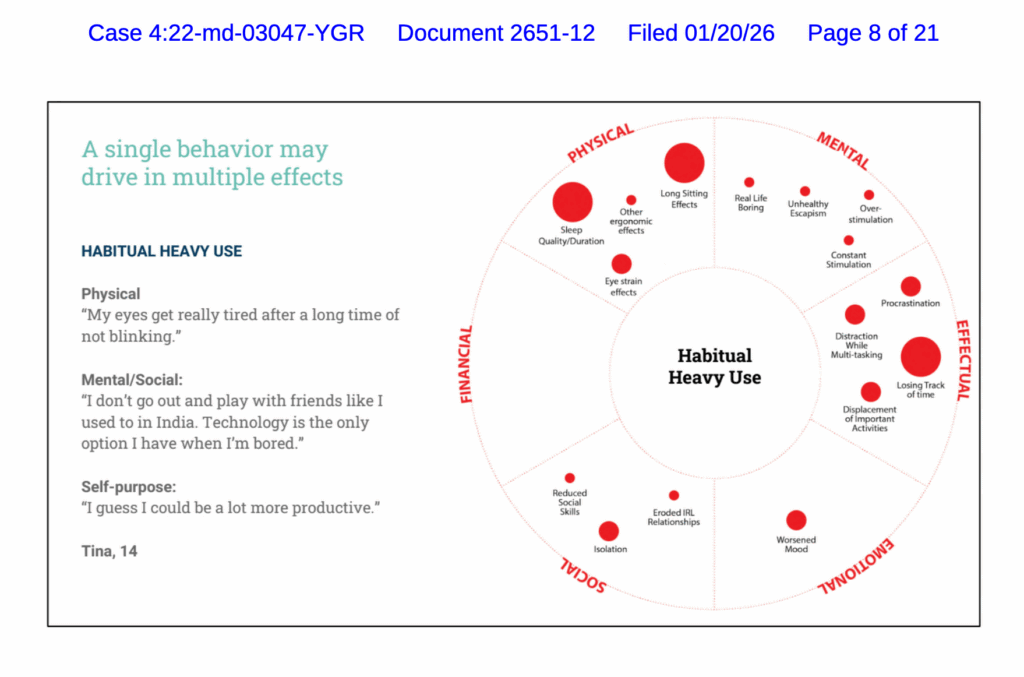
Additionally, a literature review of research into the impact of digital video on viewers' sense of well-being found that 'watching short videos produces an 'immediate' release of dopamine. Dopamine is associated with the reward system and produces a feeling similar to the sense of accomplishment felt when consuming drugs or other addictive substances.' It also pointed out which features of YouTube are addictive, saying, 'Researchers believe that YouTube is purposefully designed to be addictive, with mechanisms (autoplay, recommendations, etc.) designed to encourage binge-watching .' It also pointed out that 'notifications are an important element of YouTube and contribute to its addictive nature.'
◆TikTok
In an internal document created by TikTok in September 2021, the company stated, 'We have built some important foundational features (for digital well-being), but these still have a lot of room to grow.' 'We have found that the biggest factor preventing users from using TikTok is their belief that the platform is addictive.' 'Compulsive use of TikTok is widespread, and users need better tools to understand their usage, effectively manage it, and make their time on TikTok meaningful.' 'TikTok is particularly popular with younger users, who are particularly sensitive to reinforcement in the form of social rewards and have little ability to effectively regulate themselves.'
Related Posts:




in Software, Web Service, Posted by logu_ii