China's space program is advancing, fueling a sense of competition within NASA for its lunar exploration program.
NASA's
China Moon Mission: Aiming for 2030 Lunar Landing - IEEE Spectrum
https://spectrum.ieee.org/china-moon-mission-mengzhou-artemis
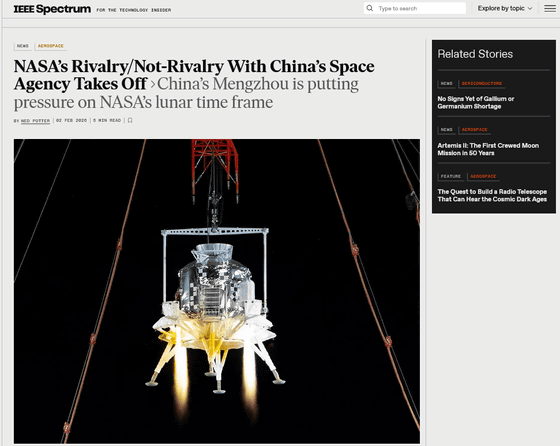
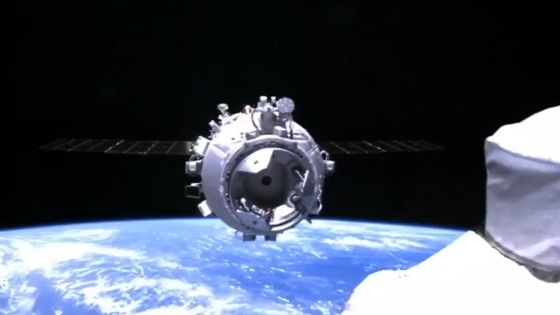
The China Manned Space Agency (CMSA) set its initial goal as 'sending astronauts into space,' and after successfully operating the space station ' Tiangong, ' it is now planning to achieve lunar orbit and lunar landing. According to the IEEE, CMSA has set a goal of 'landing astronauts on the moon by 2030,' and because this plan is part of a consistent, long-standing space policy, it seems to reject any rivalry with the United States like the lunar landing race of the 1960s.
However, NASA Administrator Jared Isaacman, at a hearing held in December 2025, stated that the agency is aware of the competition, saying, 'We are engaged in fierce competition with rivals who have the will and the means to challenge America in multiple domains, including the heights of space. Now is not the time for delay, but for action. Because if we fall behind—if we make mistakes—we may never catch up, and the balance of power on Earth could shift.'
Isaacman also emphasized the importance of NASA's leadership in space development, writing in his X post, 'NASA ensures America's leadership in space, and we are fortunate to have so many commercial and international partners supporting our ambitious endeavors. America needs NASA. The world needs NASA.'
NASA will ensure American leadership in space, and we are fortunate to have many commercial and international partners supporting our grand efforts. We will never hit the pause button on progress--we can address the real hardships we face here on Earth while building a more… pic.twitter.com/dQWCq8iVbs
— NASA Administrator Jared Isaacman (@NASAAdmin) December 20, 2025
Professor Namrata Goswami of Johns Hopkins University, who has written extensively on China's space development, also pointed out that China is also conscious of the competition, saying, 'No one in China would dispute that we are in a space race. China may be engaged in activities to demonstrate its status as a space power, and they are very serious about reaching somewhere first.'
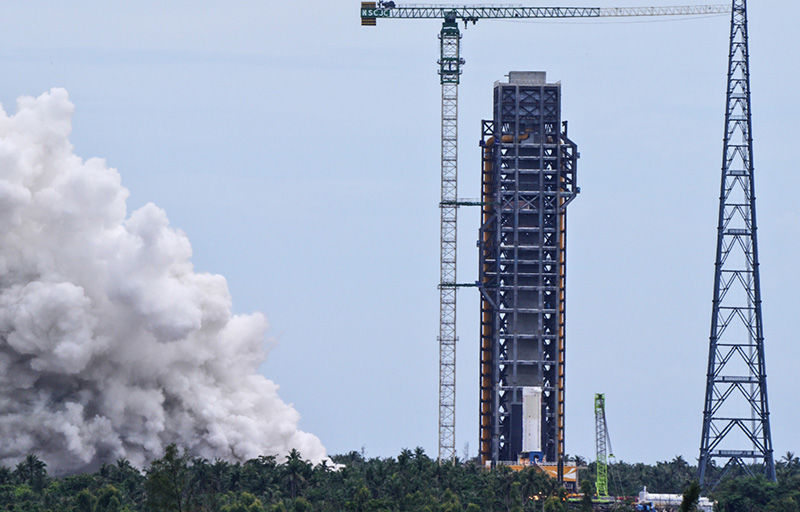
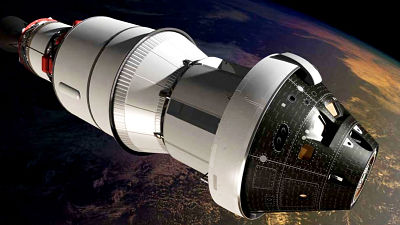
China's lunar probe is based on a multipurpose manned spacecraft called 'Mengzhou,' which can accommodate six to seven astronauts, though analysis suggests that only around three people will actually be able to board a mission from Earth to low lunar orbit. According to information released by CMSA, Mengzhou has a conical crew compartment, with a service module equipped with power and propulsion systems located at the rear. Mengzhou is scheduled to be launched aboard the Long March 10, a new large rocket that completed its launch firing test in August 2025. Below is a static firing test of the Long March 10, as released by Chinese media outlet Xinhua News Agency.
Mengzhou will launch the lunar lander 'Lan Yue' before heading to the Moon, and the two will dock in lunar orbit. Two astronauts will transfer to Lan Yue and land on the lunar surface, while Mengzhou will wait in orbit for return. Chinese authorities have stated that 'Lan Yue testing began in 2024,' and have revealed that Mengzhou is scheduled to make its first unmanned flight in 2026, and Lan Yue in 2027. The first joint test mission is scheduled for 2028-2029, with an actual lunar landing mission planned for 2030.
China's manned moon landing is scheduled to come after the Artemis program, but Goswami said that while the Artemis program was a 'product of controversy' that was repeatedly reworked and suspended within the United States, with changes made with each new president, China's moon landing program is a continuation of a nearly consistent program that began in 1992 with the Chinese Communist Party's first program, known as 'Project 921.'
'I have many friends who have been following China's space program for decades, and the thing about the Chinese space program is that once they announce a schedule, they usually stick to it,' a former senior NASA official who spoke on condition of anonymity told IEEE.
Some veteran NASA officials say the success of the Apollo program was largely due to competition with the Soviet Union at the time, and that 'China's rapid and timely space program may be pushing NASA to be more agile.' While Isaacman did not specifically mention 'China,' he described it as a 'strong competitor,' and emphasized the importance of winning the competition, saying, 'We are anxious about the consequences of not being able to maintain our technological, scientific, or economic advantage in space. And the clock is ticking.'
Related Posts:

in Science, Posted by log1e_dh