As AI becomes more widespread, two types of AI users are emerging. How can AI improve productivity?

In recent years, AI-powered chatbots and coding tools have become popular, and many companies are exploring the use of AI to improve productivity. Meanwhile, Martin Alderson, a technology writer and software developer, points out that 'two different types of AI users are emerging.'
Two kinds of AI users are emerging. The gap between them is astonishing. - Martin Alderson
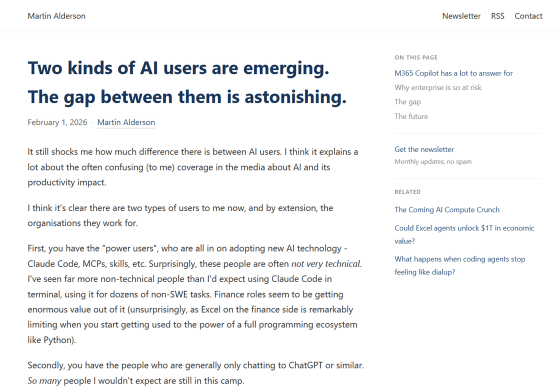
There are various views on how AI tools can improve productivity. Some argue that AI will significantly improve productivity, while others argue that companies are forcing AI adoption and reducing productivity. Alderson points out that there are two types of AI users.
First, Alderson lists AI 'power users,' people who are fully committed to implementing AI technologies like Claude Code and Model Context Protocol (MCL) . Surprisingly, many of these power users aren't particularly tech-savvy, but they use Claude Code in their terminals and leverage AI for dozens of non-software tasks.
While power users are actively introducing AI into their work, there are also 'light users' who only use AI to ask questions to ChatGPT. Asking simple questions alone is not enough to improve productivity, and the answers provided by chat AI may contain errors or hallucinations.

Alderson argues that the AI tools and IT policies used by companies also affect whether AI can improve productivity. He criticized
Despite this, Microsoft Copilot is the only AI tool many companies are allowed to use. 'Copilot is slow, its code execution tools don't work properly, and it fails miserably on moderately large files, likely due to very strict memory and CPU limitations,' Alderson said. 'This is becoming an existential risk for many companies. Executives are using these tools but are giving up on AI because of poor results, or they're spending a lot of money on large consulting firms and management consulting firms with little to no results.'
Additionally, some companies have strict IT policies that mean their internal systems are almost locked down, not even allowing basic interpreters to run locally. Others are often tied to legacy software with few internal APIs for their core workflows, meaning they can't work with AI tools even if they have them, Alderson said.
In some cases, a company's engineering department is isolated from the rest of the company or is completely outsourced, making it difficult to build the infrastructure to run securely sandboxed AI agents and to safely leverage AI tools in-house.
Under these circumstances, Alderson says, there are cases where employees at small and medium-sized enterprises, which have an environment where it is easy to utilize AI, are outperforming their employees at large companies in terms of productivity. 'In the past, employees at small and medium-sized enterprises tended to be envious of the resources and teams their large corporate competitors had, but in recent years, that trend seems to be reversing,' he said.

Alderson paints the following vision for AI and the future of work:
1: Real breakthroughs will come organically from employees, not from top-down AI strategies
Alderson believes the real productivity gains will come from small teams experimenting with AI-driven workflows. These employees, who are familiar with the processes on the ground, can outperform outsourced engineering teams that don't know the actual processes.
2: Companies that have implemented some kind of API into their systems will benefit
AI tools can be expanded beyond prompts to a much more diverse range of use cases by integrating with various APIs, which means that companies that adopt APIs will benefit greatly, from APIs like read-only data warehouses that employees query on behalf of users to APIs that turn entire complex core business processes into APIs.
3. AI models need to be safeguarded
Alderson believes that any internal AI agent deployment should be wrapped up in a secure mechanism, and that a hosted virtual machine running some kind of code agent with network restrictions would work, at least for read-only reporting. However, when it comes to creating and editing data, he says the situation is not yet ready for non-technical users to safely use AI models.
4: It's important to have APIs in place
Most companies don't use API-first products, and even if they do have APIs, they're optimized for developers and not freely accessible to thousands of employees. Therefore, Alderson pointed out, lack of access to internal APIs can be a bottleneck when companies want to introduce AI to improve productivity.
Related Posts:




in AI, Posted by log1h_ik