Chinese researchers discover a new cooling principle, the 'solution pressure caloric effect,' that can reduce the temperature by 30 degrees in room temperature within 20 seconds
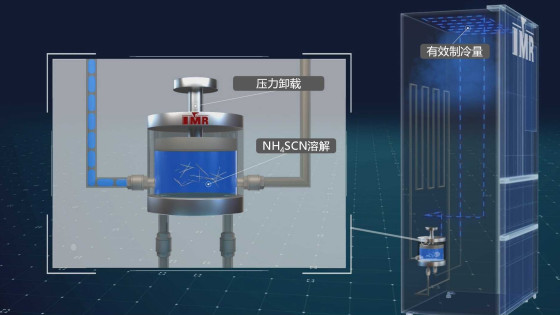
A research team from the Institute of Metallurgy, Chinese Academy of Sciences, Beijing High Pressure Research Center, and Xi'an Jiaotong University has discovered a new cooling principle using water and ammonium thiocyanate that is far more efficient than conventional refrigerants while also being environmentally friendly. The team has named this principle the 'solution pressure caloric effect.'
Metal laboratory, etc., melting laboratory, laboratory of metallurgy, Chinese Academy of Sciences, etc.
Extreme barocaloric effect at dissolution | Nature
https://www.nature.com/articles/s41586-025-10013-1
Frost in 20 seconds: can this supercooling tech give China an edge in AI race? | South China Morning Post
https://www.scmp.com/news/china/science/article/3341756/frost-20-seconds-can-supercooling-tech-give-china-edge-ai-race
Chinese researchers discover new salty cooling solution that can drop temperatures by more than 50 degrees Celsius in seconds — depressurizing saturated fluid triggers massive amounts of heat transfer | Tom's Hardware
https://www.tomshardware.com/pc-components/liquid-cooling/chinese-researchers-discover-new-salty-cooling-solution-that-can-drop-temperatures-by-more-than-50-degrees-celsius-in-seconds-depressurizing-saturated-fluid-triggers-massive-amounts-of-heat-transfer
Refrigeration is one of the most important fundamental technologies in modern civilized society, and plays a major role in everyday life. The most common method is vapor compression refrigeration, which was developed in the 19th century and involves compressing a vaporized refrigerant to a liquid, and then using the heat of vaporization to remove heat.
The refrigeration technology industry contributes approximately 2% of China's GDP, but it also consumes 20% of the total electricity and accounts for 7.8% of carbon dioxide emissions. In order to achieve both energy savings and carbon dioxide reduction, academia and industry are working together to develop solid-state phase transition refrigeration technology materials.
Solid-state cooling solves the problem of gas emissions, but has difficulties with heat conduction, limiting its application in high-power applications.
The principle discovered by a joint team including the Institute of Metals, Chinese Academy of Sciences, is expected to simultaneously address the three challenges of low carbon emissions, large-scale refrigeration, and high heat exchange efficiency.
The research team applied pressure to an aqueous solution of ammonium thiocyanate (NH₄SCN). When the ammonium thiocyanate solution is pressurized, the salt precipitates and releases heat, and after decompression, the salt quickly dissolves and rapidly absorbs heat.
In experiments conducted at room temperature, the temperature of the solution dropped by 20 to 30 degrees. The higher the temperature, the greater the temperature drop, far exceeding the properties of known solid-state phase transition materials. The research team calls this principle the 'solution pressure caloric effect.'
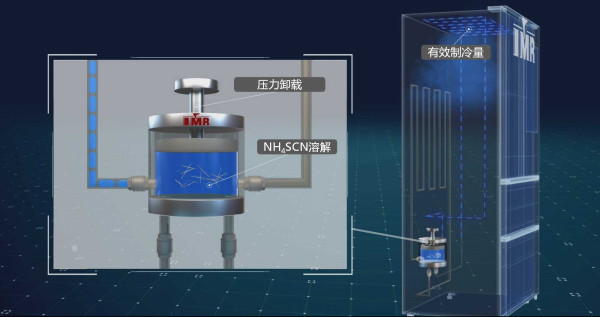
According to the research team, one cycle consisting of four steps - pressurization and heating → heat dissipation → depressurization and cooling → cooling - can absorb 67 joules of heat, reaching a theoretical efficiency of 77%.
The research has been funded by grants from the National Natural Science Foundation of China and the Frontier Science Key Research Program of the Chinese Academy of Sciences, and has also benefited from support from SPring-8 .
Related Posts: