LED lighting may have adverse health effects due to lack of infrared light

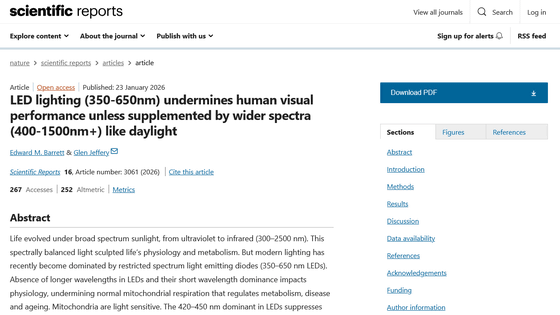
LED lighting (350-650nm) undermines human visual performance unless supplemented by wider spectra (400-1500nm+) like daylight | Scientific Reports
https://www.nature.com/articles/s41598-026-35389-6
LED lighting (350-650nm) undermines human visual performance unless supplemented by wider spectra (400-1500nm+) like daylight - PubMed
The research was conducted by Edward M. Barrett and Glenn Jeffrey of University College London, and the paper was published in the open-access online academic journal Scientific Reports on January 23, 2026.
Barrett and Jeffrey argue that life evolved under sunlight, which has a wide wavelength range from 300nm to 2500nm, and that physiological functions and metabolism are generated by a balanced wavelength balance. Therefore, they argue that the wavelengths of LEDs, which are mainstream in recent years, are limited to 350nm to 650nm, which is insufficient.
The two researchers measured color contrast sensitivity using wavelength-restricted LEDs in combination with broadband illumination from 400nm to 1500nm or more for over two weeks.
The researchers found significant improvements in indicators of color contrast sensitivity, which persisted for two months after the combined use of lighting was discontinued.
'Mitochondria communicate throughout the body, so localized light exposure can have systemic effects. These effects are likely to involve changes in serum cytokine expression patterns, suggesting that elderly and debilitated individuals may be more susceptible to the adverse effects of LEDs,' Barrett and Jeffrey said.
For this reason, they say, changing lighting could be an economical way to improve public health.
Related Posts:








in Science, Posted by logc_nt