Can 'toxic masculinity' be measured?

The term '
Are Men Toxic? A Person-Centered Investigation Into the Prevalence of Different Types of Masculinity in a Large Sample of New Zealand Men
https://www.researchgate.net/publication/398587881_Are_Men_Toxic_A_Person-Centered_Investigation_Into_the_Prevalence_of_Different_Types_of_Masculinity_in_a_Large_Sample_of_New_Zealand_Men
Can 'toxic masculinity' be measured? Scientists try to quantify controversial term | Nature
https://www.nature.com/articles/d41586-026-00144-4
The term 'toxic masculinity' was coined in the 1980s and describes the idea that traits that society tends to view as masculine, such as dominance and aggression, can be harmful to the individual and those around them. It is used to explain a variety of behaviors, from sexual violence to avoiding housework, but it has also been pointed out that this can easily lead to misunderstandings, such as 'does this mean that all masculine traits are rejected?' or 'does this mean that all men are considered harmful?'
The question then becomes, 'Can toxic masculinity even be measured?' A research team led by Deborah Hill-Corn of the University of Auckland assessed approximately 15,000 heterosexual adult men included in the data of the New Zealand Attitudes and Values Study (NZAVS), a large-scale panel survey of social attitudes, personality, ideology, and health status conducted in New Zealand, by categorizing them into eight types of 'potentially problematic masculinity.' The eight indicators used by Hill-Corn and her colleagues include the following elements:
How important is it to me to be a man?
・Prejudice against sexual minorities
Hostile sexism against women
- Benevolent sexism against women
- Opposition to efforts to prevent domestic violence (DV)
・Self-love tendency
-Low level of cooperation
・Social dominance orientation
After statistical analysis, the research team divided the subjects into five groups. The largest group was 'atoxic,' with low overall scores on all eight indicators. The smallest group was 'hostile toxic,' with only 3.2% of participants showing high levels of hostility.
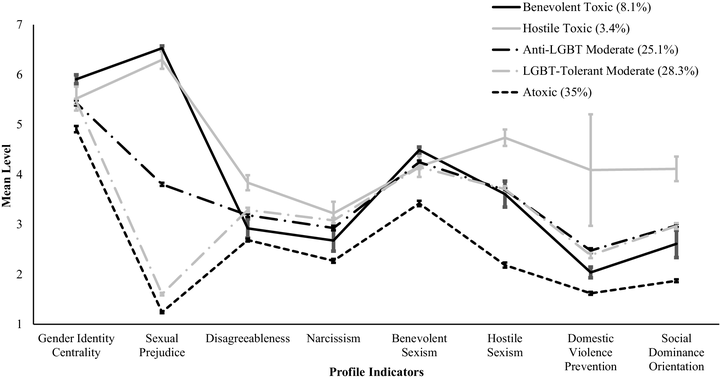
Furthermore, Hill-Corn and his colleagues cite factors such as being older, single, unemployed, religious, and belonging to an ethnic minority, as well as political conservatism, economic deprivation, difficulty regulating emotions, and low educational attainment as factors that make people more likely to be associated with 'hostile toxic' groups. In an interview with Nature, Hill-Corn said, 'It wasn't the powerful figures with money and status that were at the center, but rather the majority of the participants were men in disadvantaged positions.'
What's important is that 'whether being a man is important to me' alone was not a strong predictor of which type a person fell into. Even in the 'hostile toxic' group, there were people who felt that gender was important, but there were also people in other groups who felt the same or even higher, which shows that it cannot be said with certainty that 'masculinity = toxic.'
However, because the results of this study are based on NAVZS data, it is not guaranteed that the exact same five profile structures will be reproduced in other countries or cultural areas, even if the same indicators are used. Taking this into consideration, the research team says that it is important to take a person-centered view that focuses on which factors appear in which combinations, rather than applying 'toxicity' uniformly to all men.
Related Posts:






in Science, Posted by log1b_ok