The choice of whether to drink tea or coffee may affect the risk of osteoporosis
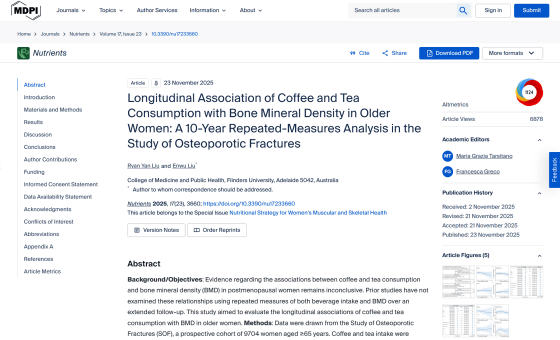
Longitudinal Association of Coffee and Tea Consumption with Bone Mineral Density in Older Women: A 10-Year Repeated-Measures Analysis in the Study of Osteoporotic Fractures | MDPI
https://www.mdpi.com/2072-6643/17/23/3660
Tea linked to stronger bones in older women – News
https://news.flinders.edu.au/blog/2025/12/11/tea-linked-to-stronger-bones-in-older-women/
Choice of Tea or Coffee Could Influence Risk of Osteoporosis in Older Women : ScienceAlert
https://www.sciencealert.com/choice-of-tea-or-coffee-could-influence-risk-of-osteoporosis-in-older-women
Osteoporosis is estimated to affect one in three women over the age of 50, causing a large number of fractures worldwide each year. Therefore, by understanding the relationship between everyday habits such as drinking tea or coffee, which are common among many people, and osteoporosis, it may be possible to prevent a huge number of patients from fractures.
This time, a research team led by Dr. Enwu Liu of the School of Nursing and Health Sciences at Flinders University analyzed data from the Study of Osteoporotic Fractures (SOF), which followed approximately 9,700 American women, to examine the relationship between tea or coffee intake and osteoporosis risk.
The study involved women aged 65 or older living in the United States. Four bone mineral density tests were conducted over a 10-year period to measure bone mineral density at the hip and femoral neck, which are closely related to fracture risk. The subjects also reported their coffee and tea intake.

The analysis found that women who regularly drank black tea had slightly higher bone mineral density at the hip compared to women who did not. This is likely due to
On the other hand, the relationship between coffee drinking habits and osteoporosis was mixed. While there was no adverse effect on bones with 2-3 cups per day, women who drank 5 or more cups per day tended to have lower bone mineral density. Furthermore, even small amounts of coffee intake were associated with decreased bone mineral density in women with high lifetime alcohol intake.
'The differences observed in this analysis were small but statistically significant, and could have a significant impact on the overall population. 'Our findings don't mean that people need to stop drinking coffee or start drinking large amounts of tea,' Liu said. 'But they suggest that moderate tea consumption is one easy way to support bone health, and that excessive coffee consumption may not be ideal, especially for women who drink alcohol.'

Related Posts: