Successful demonstration of quantum teleportation at wavelengths close to those used in optical fiber communications

In science fiction, teleportation is a common feature, like the teleportation device in
Telecom-wavelength quantum teleportation using frequency-converted photons from remote quantum dots | Nature Communications
https://www.nature.com/articles/s41467-025-65912-8
From sci-fi to reality: Researchers realise quantum teleportation using today's internet tech | News | CORDIS | European Commission
https://cordis.europa.eu/article/id/462587-from-sci-fi-to-reality-researchers-realize-quantum-teleportation-using-today-s-internet-tech
Physicists Pull Off 'Impossible' Quantum Teleportation Using Existing Internet Technology
https://studyfinds.org/physicists-pull-off-quantum-teleportation-using-existing-internet-technology/
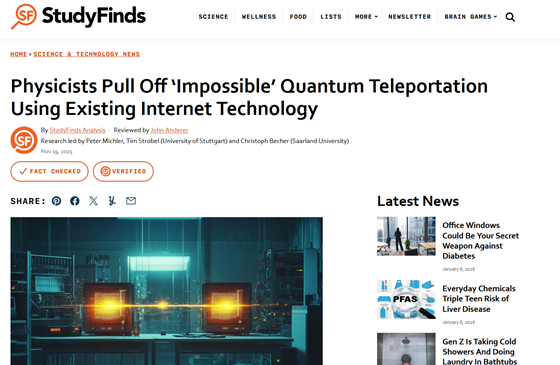
A research team led by Tim Strobel of the University of Stuttgart in Germany has achieved quantum teleportation between two separate devices using quantum dots, which are small semiconductor light-emitting devices.
The research team first prepared 'light carrying the information to be transferred' in one device, and 'a pair of quantum entangled light' in the other device. Then, using a procedure that utilizes quantum entanglement, the quantum state of the first light was transferred to the other half of the entangled pair.
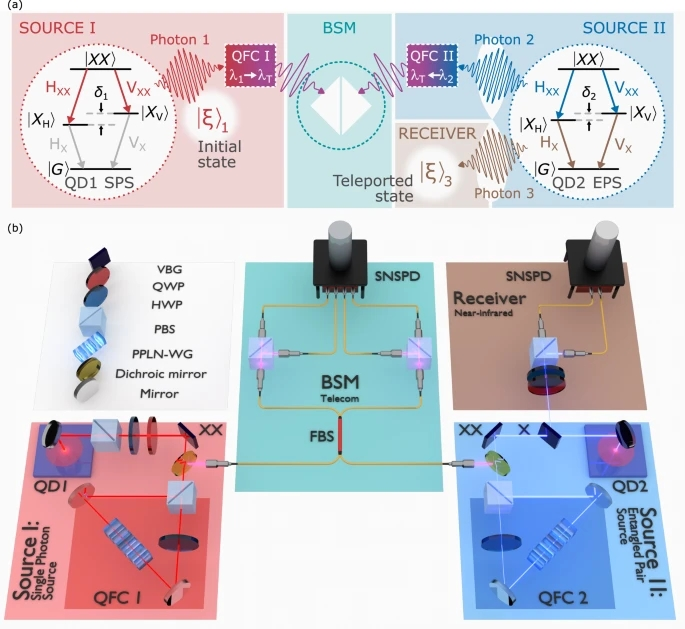
To align the light to a frequency suitable for communication, the research team used a frequency converter that changes the wavelength of the light while preserving the quantum information. Science media outlet Study Finds explains how the device works: 'Like a translator, it only changes the wavelength, preserving the quantum information.'
CORDIS, a European Commission research information site, points out that the researchers converted light to a telecommunications wavelength of 1515nm, which is compatible with the optical fiber typically used for internet connections. CORDIS also emphasizes that 'instead of sending a regular signal, they recoded the quantum state of light.'
According to CORDIS, the success rate of this experiment was 72.1%, exceeding the 66.7% that is considered the benchmark for making it look like quantum teleportation without using quantum mechanics. CORDIS uses this difference as evidence that quantum teleportation was successful. In their paper, they also evaluated the success of quantum teleportation using fidelity, which indicates how close the transcription is to the original state.
However, Study Finds notes that 'the frequency of success was only a few times per hour,' and that the current stage is to demonstrate the conditions for success. Furthermore, Study Finds notes that 'the experiment required extremely low temperatures of around minus 260 degrees Celsius.' CORDIS also cites the complexity and cost of the wavelength conversion mechanism, as well as the need for extremely low temperatures, as challenges.
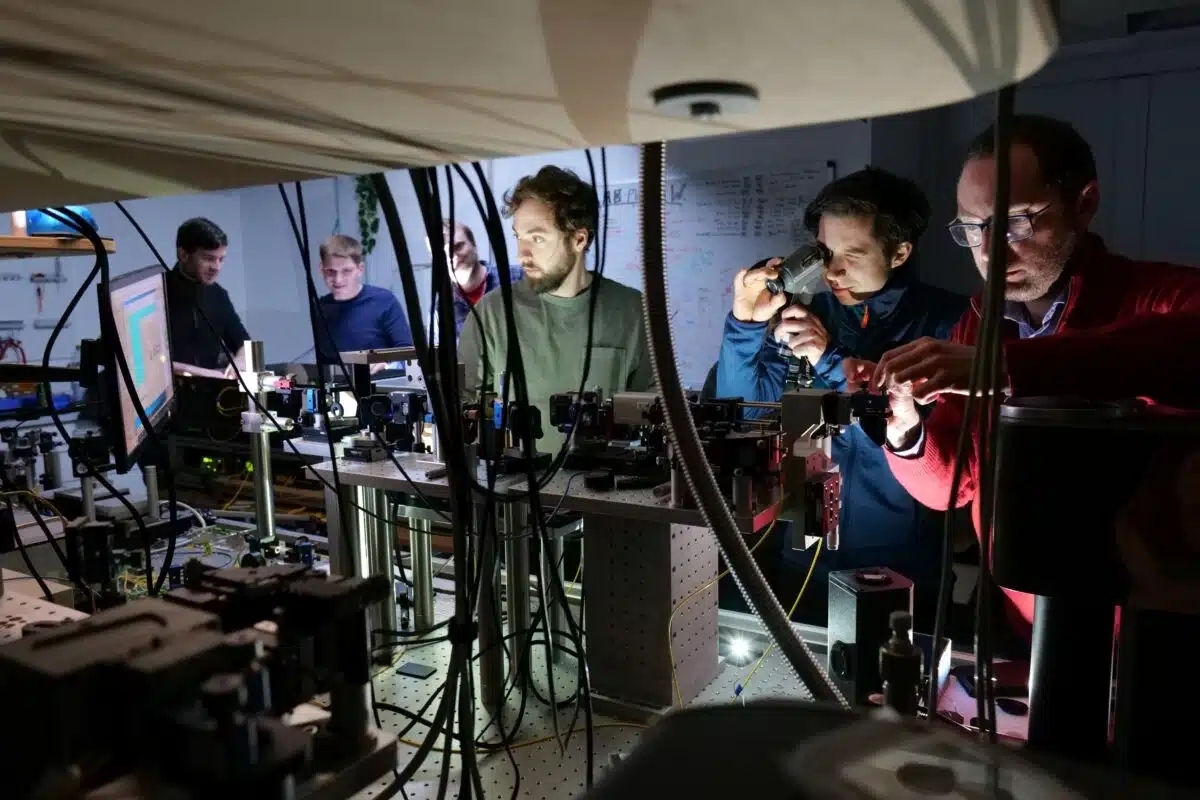
CORDIS believes that the demonstration of quantum teleportation between separate devices while shifting to wavelengths suitable for communication 'leads to the possibility of utilizing existing optical fiber infrastructure.'
On the social news site Hacker News , a question was posed asking, 'Doesn't quantum teleportation violate the theory of relativity?' A response was given that, 'Quantum states cannot be measured directly, so even if a state appears to have moved faster than light, that alone does not convey information. Teleportation also requires classical communication, so ultimately it cannot exceed the speed of light.'
Related Posts:






in Science, Posted by log1b_ok