Mammal 'monogamy ranking' announced, humans between beavers and white-handed gibbons

Some animals have multiple partners throughout their lives, while others, like modern humans, are primarily monogamous. Mark Dyble of the University of Cambridge investigated the reproductive behavior of various mammals and visualized the degree of monogamy.
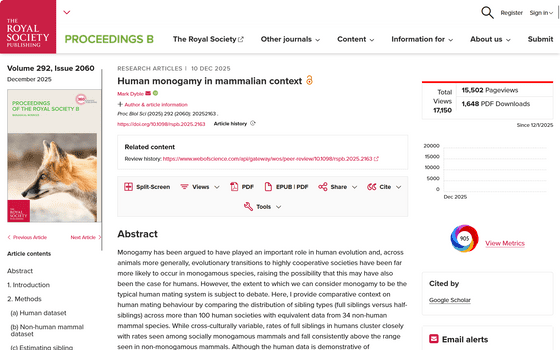
Human monogamy in mammalian context | Proceedings B | The Royal Society
Humans rank between meerkats and beavers in monogamy 'league table'
Humans rank above meerkats but below beavers in monogamy league table | Science | The Guardian
https://www.theguardian.com/science/2025/dec/10/humans-rank-among-leading-monogamous-mammals-study-finds
To investigate the reproductive patterns of multiple species, Dyble looked at the proportion of full-siblings (full-sibs) across a number of species. He found that species and societies with a high degree of monogamy tend to have more siblings born from the same parents, while societies with a high degree of promiscuous mating patterns tend to have more half-siblings.
The study found that humans have a higher level of monogamy than most of our primate relatives, and is closer to species like meerkats and beavers than to primates.
Of the 35 mammal species Dybl studied, humans ranked seventh with a sibling ratio of 66%, meaning that humans have twice as many full brothers and sisters as half brothers and sisters.
The rankings from 1st to 10th are as follows:
・California White-footed Mouse (100%)
African wild dog (85%)
Damaraland mole rat (79.5%)
・Mustache tamarin (77.6%)
Abyssinian jackal (76.5%)
・European beaver (72.9%)
Humans (66%)
White-handed gibbon (63.5%)
・Meerkat (59.9%)
Gray wolf (46.2%)
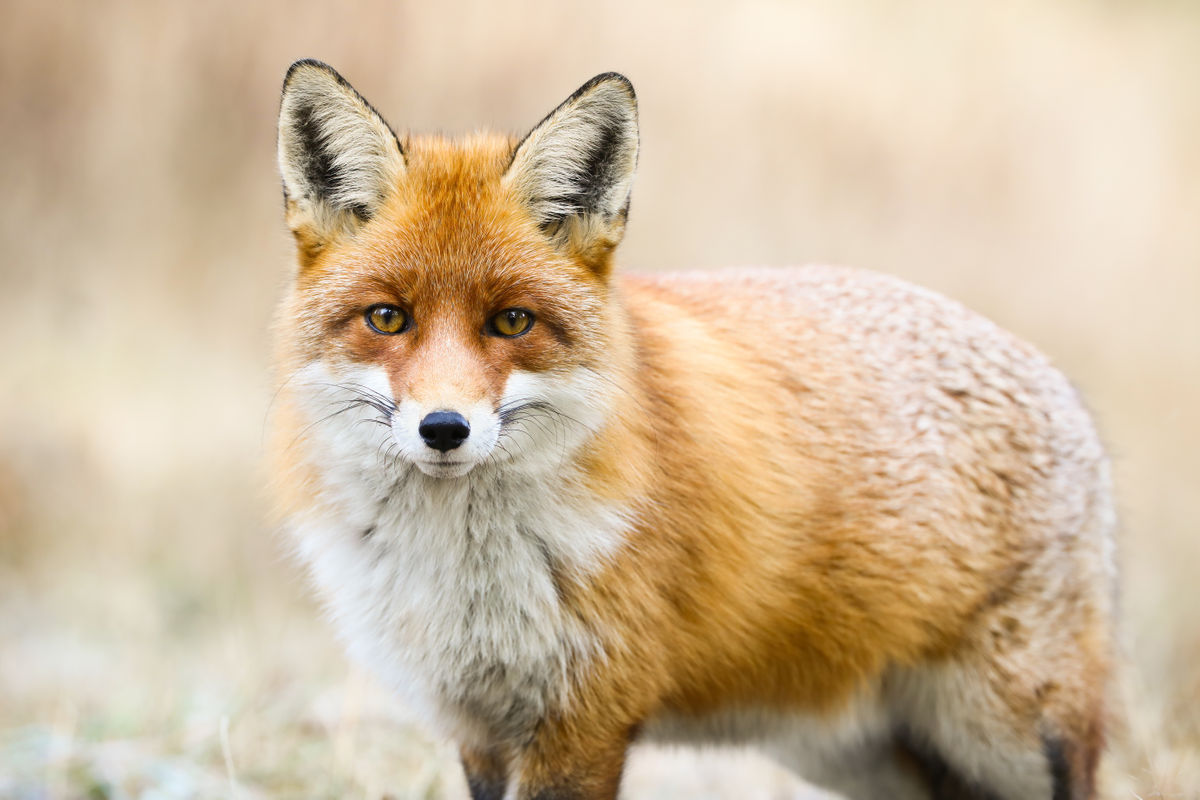
・Red fox (45.2%)
The primate most closely related to humans in the study, the white-handed gibbon, had a sibling ratio of 63.5%. The bearded tamarin, which usually gives birth to twins or triplets, had the highest ratio of any primate.
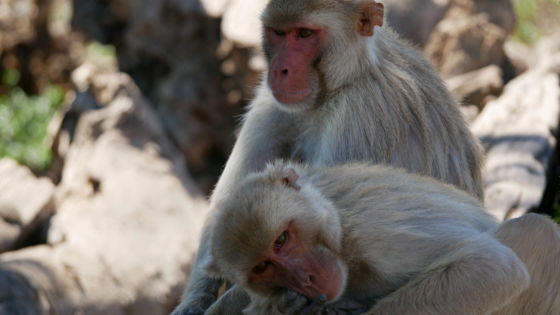
On the other hand, other primates considered to be closely related to humans showed low sibling ratios. For example, mountain gorillas had a sibling ratio of 6%, while chimpanzees only had a sibling ratio of 4%. Macaques in particular were at the bottom of the list, with Japanese macaques at 2.3% and rhesus macaques at 1%.
The top-ranked California footed mouse, which maintains a lifelong partnership with its mate, has a sibling rate of 100%. The lowest-ranked breed is the Soay sheep, which lives in Scotland, with a sibling rate of just 0.6%. Soay sheep are known for their females mating with multiple males.

'What sets humans apart from other monogamous mammals is that we live in social groups where multiple females breed. Social, monogamous mammals typically tend to live in either groups consisting of only one pair and their offspring, or in groups where only one of many females breeds. In addition, given that other apes have polygamous or polyandrous systems, this suggests that the evolution of monogamy in humans was driven by different selection pressures than in other mammals, possibly related to the energy demands associated with our large brains and slow growth,' Dyble said.
Robin Dunbar, a professor of evolutionary psychology at Oxford University who was not involved in the study, said: 'Previous research has shown that humans are on the border between monogamous and polygamous species. Humans are often driven to monogamy by religious taboos or other social pressures, so polygamy will emerge quickly if these pressures lose force. Inherently, humans want polygamy, but are reluctantly bound to it by religious or social pressures.'
Related Posts: