It turns out that humans unconsciously blink when listening to music

When we listen to music, we sometimes unconsciously move our bodies or find ourselves singing along to the melody. New research has revealed that these unconscious movements also affect our eyelids.
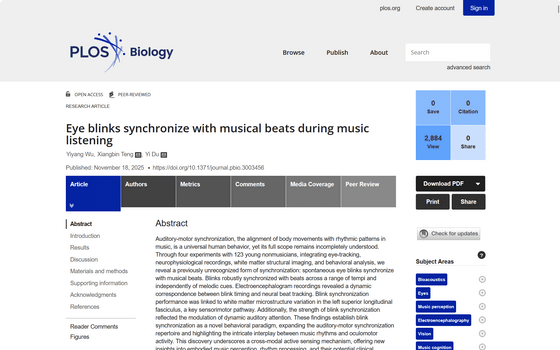
Eye blinks synchronize with musical beats during music listening | PLOS Biology
Blink to the beat: Scientists discover that when we listen to music, we unconsciously blink our eyes
How Eye Blinks Reveal the Musical Beat | Psychology Today
https://www.psychologytoday.com/us/blog/illusions-delusions-and-reality/202512/how-eye-blinks-reveal-the-musical-beat
The neurological process of moving the body to music has long been known: stomping your feet, nodding your head at a concert, or listening to music at a specific tempo can help runners maintain a steady pace. However, these phenomena are not commonly seen in species closely related to humans, suggesting that specialized neural circuits have evolved in the human brain.
To gain a deeper understanding of the neural connections between hearing and movement, Yi Du and his colleagues at the Chinese Academy of Sciences investigated whether eye blinks are synchronized with music.
Du and his colleagues first had over 100 subjects listen to 10 classical pieces (Bach chorales) played at a tempo of 85 beats per minute, and measured their brain waves and eye movements. They listened freely without any mention of blinking, and examined whether the beats of the music matched the timing of their blinks.
As a result, many of the subjects began blinking in time with the music, and their blinking began to synchronize with the beat of the song. Just to be sure, they played the song backwards, but the results were the same, so Du and his colleagues concluded that the blinking was simply occurring in rhythm. However, since none of the subjects were familiar with music, it is clear that this phenomenon is not common among musicians.

In the next experiment, participants listened to music played at tempos of 66, 85, and 120 beats per minute to see if the blinking cycle changed depending on the speed of the music. The results showed stable blink synchronization at 66 and 85 beats per minute, but no correlation was observed at 120 beats per minute. This suggests that a certain slow tempo is a necessary condition for blink synchronization.
In the third experiment, participants were not only asked to listen to the music, but also to press a button whenever they heard a note that was not in the original song. This experiment showed that people who tended to blink more in sync with the beat tended to perform more accurately, but it has not been determined whether blinking actually increases accuracy.
In the fourth experiment, participants listened to a song and were tasked with pressing a button whenever a red dot appeared on a screen. The timing of the dots was unpredictable, sometimes matching the beat of the song and sometimes not. During this experiment, participants' blinks were not synchronized with the song, indicating that whether the dots were on beat or not had no bearing on their performance.
Based on these experiments, Du said, 'It is possible for blinking to be synchronized with music, but the tempo of the music must not be too fast and the listener must be fully focused on the music. What surprised me was that minute movements like blinking can be so reliably synchronized with the beat. The findings from this study may support clinical testing of rhythm-related disorders.'
Related Posts:







in Science, Posted by log1p_kr