The least reliable AWS region in 2025 will be us-east-1

by
StatusGator, a systems management service provider, continuously monitors and aggregates information published on the official AWS status page to determine whether Amazon Web Services (AWS) outages are concentrated in certain regions or whether trends change from year to year. Using this data, they have compiled a list of outages by region and service for 2025.
The Least Reliable AWS Region in 2025 | StatusGator
https://statusgator.com/blog/aws-least-reliable-region-in-2025/
The analysis covers the period from January 1 to December 9, 2025, and is based on major outages announced by AWS. It covers commercial regions and excludes GovCloud. StatusGator states that the large-scale outage that occurred in the Northern Virginia (us-east-1) region on October 20, 2025 , 'provoked a reexamination of past analysis,' and in addition to comparing regions, it also looked at the breakdown of affected AWS services.
In conclusion, StatusGator reports that 'us-east-1 was the least reliable AWS region in 2025.' us-east-1 (N. Virginia) ranked first in the number of outages, cumulative outage time, and number of affected components, with 10 outages, a cumulative outage time of 33 hours and 49 minutes, and 126 affected components.
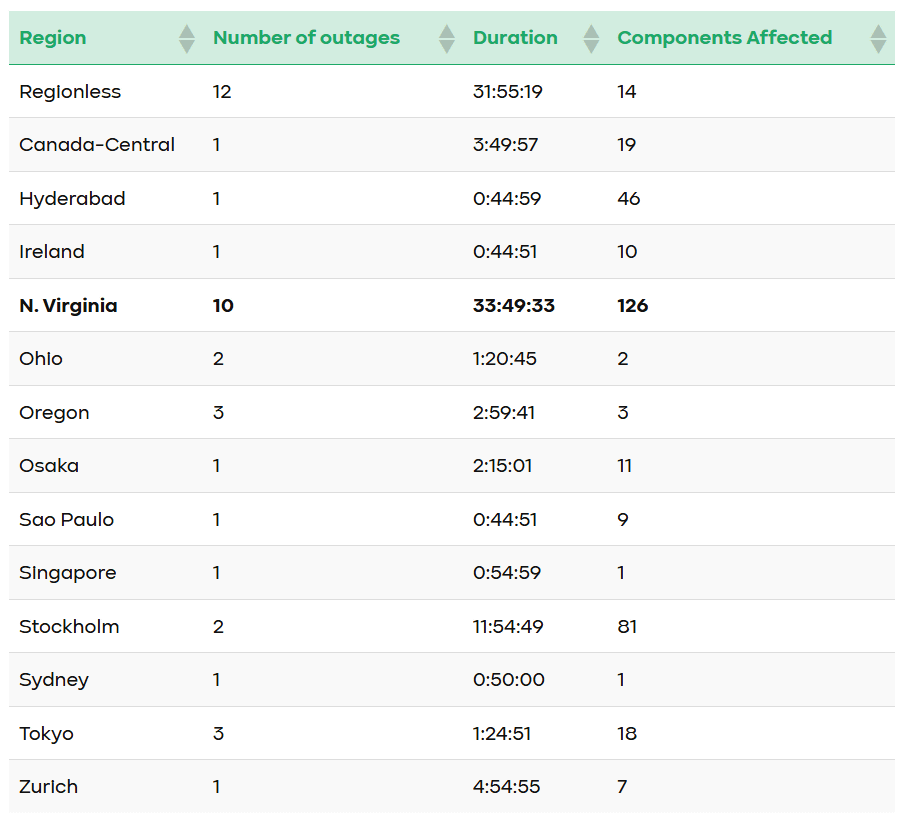
StatusGator's analysis also found that there were more outages than usual in 2025 that could not be attributed to a specific region. There were a total of 12 outages that could not be attributed to a specific region, with a cumulative outage time of approximately 32 hours. This is explained as indicating a possible increase in outages that span multiple regions or are global in nature, rather than issues that are specific to a single region.
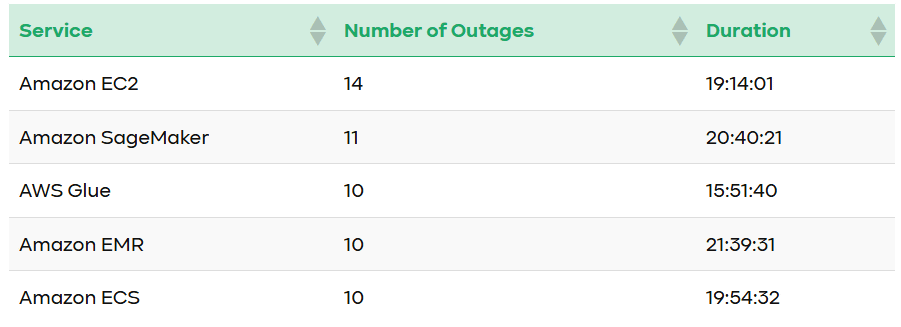
Furthermore, when outages are organized not only by region but also by service, cloud computing, analytics, AI, and machine learning services are said to have been prominent. Services with the most outages were
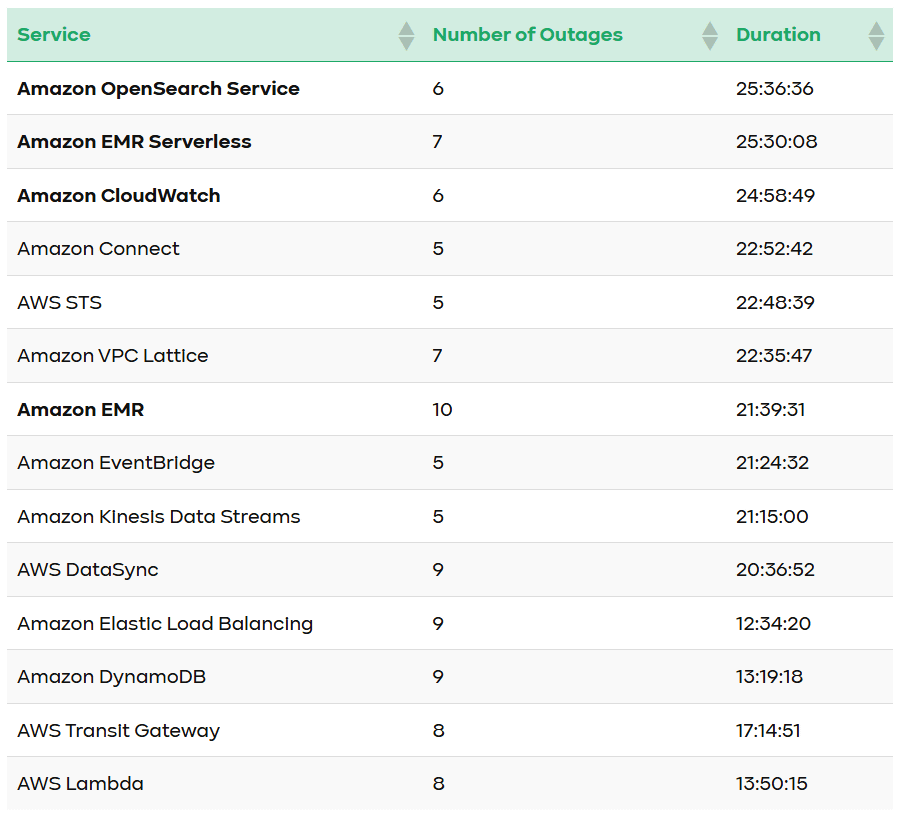
Meanwhile, in addition to the services with the highest number of outages, the report also lists services with prolonged outages or widespread impacts. Services with cumulative outage times exceeding 24 hours include
StatusGator is examining three hypotheses regarding why the number of outages in us-east-1 is so high.
Regarding the first hypothesis, 'us-east-1 is prone to failure because it provides many services,' while this could be a factor in complexity, it cannot be said to be the sole root cause.
Regarding the second hypothesis, 'us-east-1 is older and has a different architecture,' AWS has not provided any evidence. StatusGator also notes that the 2025 figures do not support this hypothesis, because while outages in older regions like Tokyo (ap-northeast-1) and Sydney (ap-southeast-2) were small, relatively newer regions like Zurich (eu-central-2) and Hyderabad (ap-south-2) also experienced outages lasting several hours.
StatusGator points out that, based on data from 2025, us-east-1 is monitored by roughly twice as many users as Oregon (us-west-2) and three times as many users as other regions. They explain that the more customers there are, the greater the load, which increases operational stress and ultimately increases the likelihood of publicly-determined outages. They conclude that the third hypothesis—that us-east-1 is the most used and therefore has the highest load—is the most likely.
Related Posts:







in Web Service, Posted by log1i_yk