Why do the colors of ancient Greek and Roman sculptures look bad when reproduced?
It is known that ancient Greek and Roman sculptures were colorfully finished, rather than the commonly seen white marble statues, as some still have traces of paint. However, if the colors of such ancient sculptures are reproduced, they may be criticized as 'terrible colors.' Philosopher Ralph S. Weil summarizes his views on why reproducing the colors of ancient sculptures makes them look like seriously deteriorated works of art.
Were classical statues painted horribly? - Works in Progress Magazine

The following is ' Augustus Prima Porta, ' housed in the Vatican Museums. It is one of the most famous statues modeled after Augustus , the first emperor of the ancient Roman Empire. The Augustus Prima Porta was discovered in a fairly well-preserved state, almost perfectly intact, and traces of paint remain on the surface, indicating that it was originally painted.

by
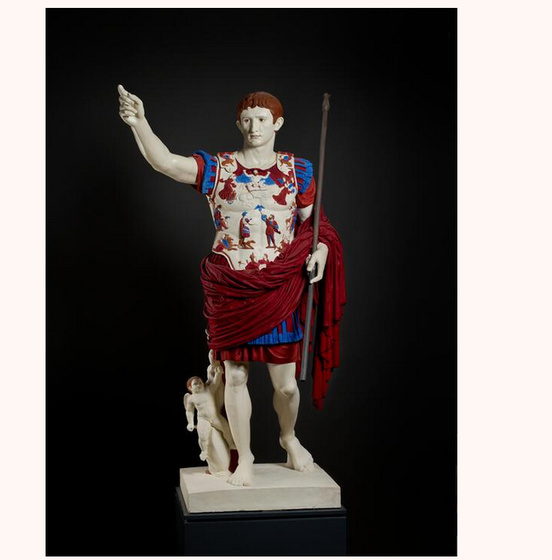
Vinzenz Brinkmann, a world-renowned archaeologist known for his research into the polychromy of ancient Greek and Roman sculpture, which proved that ancient statues were not white, led the traveling exhibition project ' Gods in Color ,' which attempts to recreate the colors of ancient sculptures. Below is a reconstruction of Augustus of Prima Porta, cited by Weill.
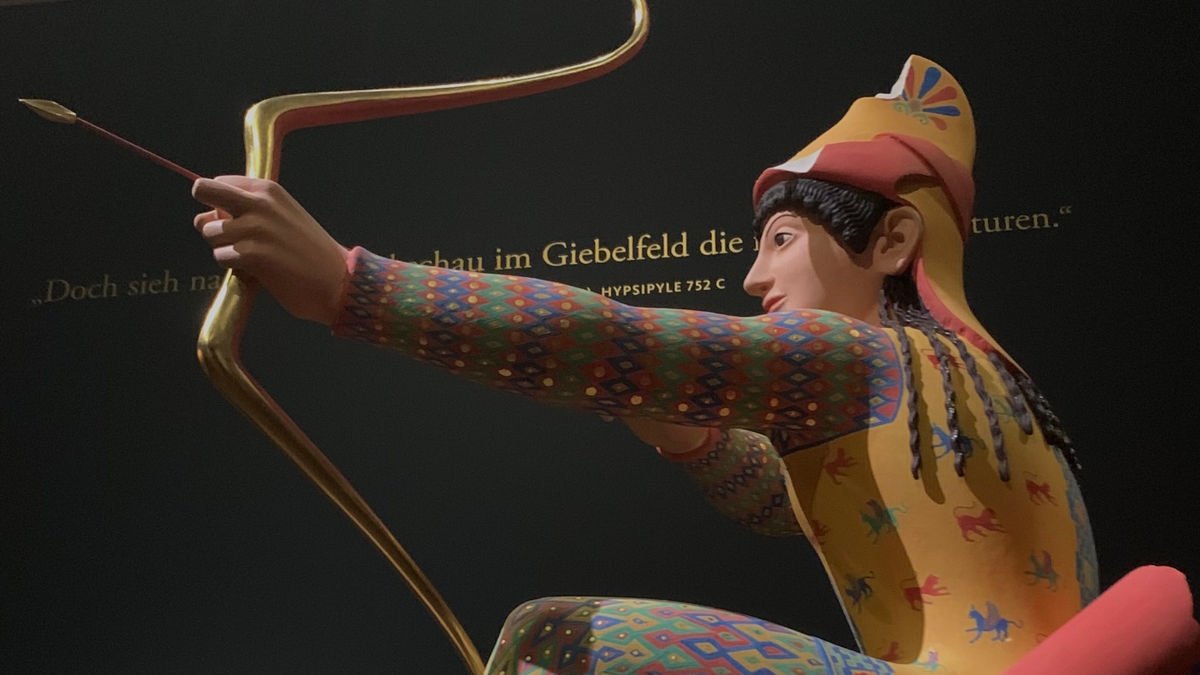
Also below is a color restoration of an archer statue excavated from the Temple of Aphaia on the island of Aegina, which was published as an experimental color restoration in Gods in Color.

by Aquaplaning
Weil points out that all of these color restorations are 'terrible works that appear to have deteriorated severely.' On top of that, Weil examines the question, 'Why does recreating the colors of ancient sculptures look so bad?'
One of the reasons why color restorations look so poorly is often cited: 'Modern tastes are different from those of ancient Greece and Rome.' When sculptures are discovered, the paint is generally peeled off, leaving only the marble, which is less susceptible to deterioration. This tends to give the impression of a monochrome aesthetic in marble sculptures. Furthermore, modern people have different color preferences than modern people, which may be the cause of discomfort when the colors are restored. Weill describes this as 'color phobia,' citing the book ' Chromophobia ' by artist David Batchelor.
However, Weil points out two strange aspects of the explanation that 'color preferences have changed.' First, there are paintings that show what ancient sculptures looked like, and in those paintings, the colors of the sculptures are not as out of place as in the restorations. For example, in the painting below depicting the statue of Mars, reddish colors are used in the decoration, but the white marble color remains for the most part. Similarly, depictions of people in paintings and mosaics often do not have the out of place colors that the color restorations of sculptures have, so the theory that 'this color was preferred in the past' may be questionable.
.jpg)
by Carole Raddato
Second, the phenomenon of the strong sense of incongruity in color restorations is unique to ancient Greece and Rome. Polychrome sculptures from post-classical Europe, such as the Middle Ages, Renaissance, Spanish Baroque, and German Baroque, as well as polychrome sculptures from pre-classical and non-Western cultures, such as the Egyptian dynasty and medieval Nepal, are rarely considered to have poor colors compared to the color restorations of ancient Greece and Rome. Therefore, Weil explained, 'The idea that color restorations look ugly because they do not share the same color sensibility of the time remains questionable.'
So, when asked what actually causes the incongruity in the color restoration, Weil said, 'There's only one explanation: the restoration was simply very poorly painted.' The experts who created the restoration accurately reproduced the original paint by scientifically analyzing the paint residues left on the sculpture, but only trace amounts remain, and the finished appearance may be completely different. Cecilie Brons, who leads the Ancient Polychromy Project at the New Carlsberg Museum in Copenhagen, praised the 'Gods in Color' restoration, but pointed out, 'It can be difficult to explain restorations to the general public because they are not exact reproductions and we cannot know exactly what they looked like at the time.'
It has also been pointed out that even if the paint used can be accurately determined from the analysis of the residues, 'it is impossible for modern experts to color it in a way that reproduces the splendor of ancient sculptures.' However, there are various projects to reproduce the colors of sculptures, and many of them look beautiful, so some restorations, such as 'Gods in Color', have problems, Weil said.
However, Weil said that the project, which produced what appear to be poorly done reconstructions, should not be criticized for its poor workmanship. Brinkman, who led 'Gods in Color,' has fully achieved its goal of widely informing the public of the fact that 'ancient sculptures were painted,' and this has great artistic and academic value.
Weil's analysis has garnered attention on the social news site Hacker News, where researchers are exploring why recreating the colors of ancient Greek and Roman sculptures can look so bad. One user suggested, 'Scholars have tried to recreate ancient stew recipes, but the results have been awful. A chef has tried the same recipe, but the result is a much better dish. Similarly, if scholars were to analyze the residue and then ask an artist how to recreate the colors of the sculptures using this paint, the results could be dramatically improved.' Another user, claiming to be an art professor at a major research university with expertise in historical landscape painting, explained the coloring process by starting with relatively saturated mid-tones and then adding shadows and highlights. He suggested , 'Could the remaining paint have been used as the final color ?'
Related Posts:





in Creation, Posted by log1e_dh