Webb Telescope discovers Milky Way-like galaxy 12 billion light-years away, potentially rewriting our view of galaxy formation in the early universe

NASA's James Webb Space Telescope has discovered a
A grand-design spiral galaxy 1.5 billion years after the Big Bang with JWST | Astronomy & Astrophysics (A&A)
https://www.aanda.org/articles/aa/full_html/2025/11/aa51689-24/aa51689-24.html
Alaknanda: JWST discovers massive grand-design spiral galaxy from the universe's infancy | EurekAlert!
https://www.eurekalert.org/news-releases/1107899
Webb telescope found a Milky Way lookalike 12 billion light-years away | Mashable
https://mashable.com/article/james-webb-space-telescope-grand-design-spiral-galaxy-early-universe
Scientists Rashi Jain and Yogesh Vadadekar of the National Centre for Radio Astrophysics at the Tata Institute of Fundamental Research in India conducted a multi-wavelength survey using 21 different filters with the James Webb Space Telescope, which allows them to estimate various factors such as the amount of dust and age of galaxies. Using a natural phenomenon known as gravitational lensing , the multi-wavelength survey observed detailed images of a galaxy more than 10 billion light-years away, and discovered a massive galaxy with a well-defined spiral structure similar to the Milky Way today. By performing spectral energy distribution modeling, which compared wavelength measurements with a computer model, they estimated that the average age of the stars in this galaxy is only about 200 million years.
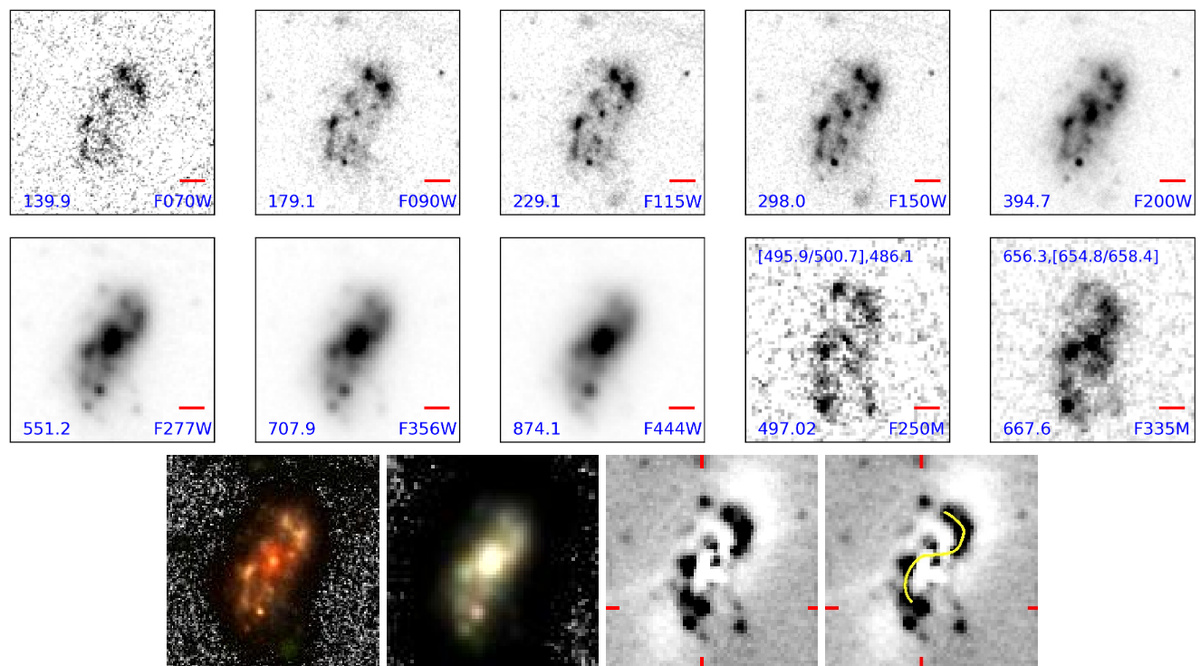
The galaxy was named 'Alaknanda' after a river in the Himalayas. Alaknanda is about 30,000 light-years in diameter and has a disk structure with symmetric spiral arms extending from it.
'
However, Alaknanda, which was analyzed to have formed about 1.5 billion years after the Big Bang, about one-tenth the age of the universe today, has a huge spiral that stretches 30,000 light-years. Therefore, the researchers point out that 'grand design spiral galaxies may have formed much more efficiently than previously thought.'
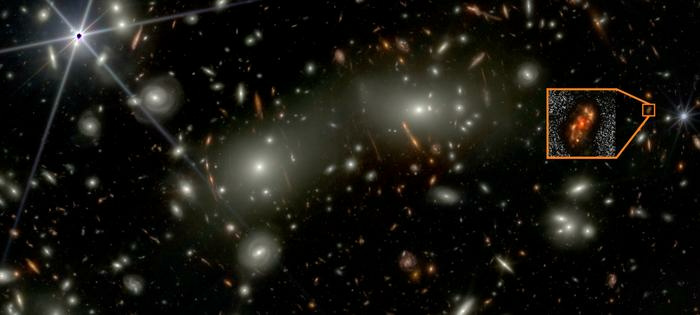
'Alaknanda has reached a level of structural maturity that would have taken billions of years,' said Jain, lead author of the study. 'The discovery of such an orderly spiral disk at this age suggests that the physical processes that drive galaxy formation - gas accretion, disk stabilization, and possibly the development of spiral density waves - may operate much more efficiently than current models predict. This forces us to rethink our theoretical framework.'
Co-author Wadadekar also commented on the impact of the discovery, saying, 'Somehow, in just a few hundred million years, this galaxy managed to collect stars with a total stellar mass of about 10 billion solar masses and organize them into a beautiful spiral disk. This is an astonishing speed by cosmic standards, and it is causing astronomers to rethink how galaxies form.'
The discovery of Alaknanda is thought to have the potential to restructure existing galactic evolution models as a whole and even affect the timeline for the birth of planetary systems. Future research will be required to discover more large galaxies and spiral galaxies that formed early in the universe to determine whether Alaknanda is an extremely rare anomaly, or whether the theory of galaxy formation is seriously flawed.
Related Posts:

in Science, Posted by log1e_dh