Let's Encrypt celebrates its 10th anniversary and looks back on its journey

Let's Encrypt , a certificate authority (CA) that issues free SSL/TLS certificates for web servers, will celebrate its 10th anniversary since launching in beta in 2025. To commemorate this, an article has been published looking back on Let's Encrypt's 10-year history.
10 Years of Let's Encrypt Certificates - Let's Encrypt
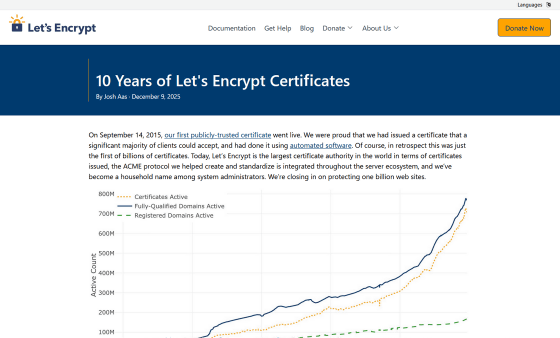
Let's Encrypt was launched in 2014 as a service that issues free server certificates, making it easy for anyone to encrypt HTTP communications using SSL. On September 14, 2015, the beta version of Let's Encrypt issued its first publicly trusted certificate , and in 2016 it was promoted to the official version.
'Let's Encrypt,' which issues certificates for free and supports the introduction of HTTPS, has been released as a beta version.
by Sean MacEntee
Let's Encrypt has been scaling up certificate issuance using automated software, issuing its one millionth certificate in March 2016. It reached 100 million certificates issued in June 2017 and one billion in 2020. By September 2018, it was issuing one million certificates per day, and by the end of September 2025, it had surpassed 10 million certificates issued in a single day for the first time.
At the time of writing, Let's Encrypt is the world's largest certificate authority by number of certificates issued, and the ACME protocol, which Let's Encrypt helped develop and standardize, has been integrated into the entire server ecosystem and is widely known among system administrators.
Let's Encrypt stated, 'The steady growth in certificate issuance speaks to the strength of our architecture, the validity of our vision, and the hard work of our engineering teams to scale our infrastructure. It also reinforces the trust the Internet community has in us and demonstrates how using Let's Encrypt certificates has become a common, and dare I say boring, choice.'
Furthermore, Let's Encrypt's mission is to make it easy for anyone to encrypt HTTP communications using SSL, and Let's Encrypt's success should be measured not by the number of certificates issued, but by the adoption rate of HTTPS encryption.
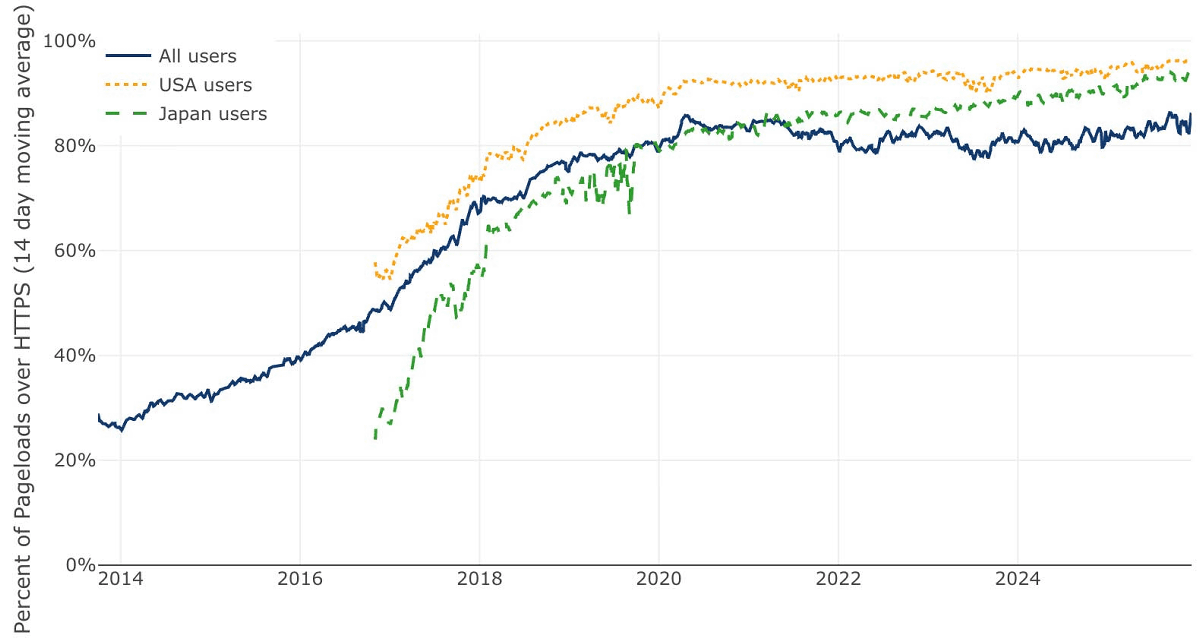
The graph below shows the percentage of HTTPS-encrypted connections among web users based on Firefox statistics. The vertical axis represents the percentage of HTTPS-encrypted connections, while the horizontal axis represents the age group. The dark blue line represents all users, the green dashed line represents users in Japan, and the yellow dashed line represents users in the United States. The graph shows a steady increase since Let's Encrypt's launch in 2015. By 2020, approximately 80% of all users were using HTTPS-encrypted connections, and as of the time of writing, this figure remains above 90% in Japan and the United States. It is estimated that the majority of the remaining unencrypted traffic likely comes from internal or organizational private sites (intranets) .
In addition to metrics such as certificate issuance volume and adoption of HTTPS encrypted connections, Let's Encrypt said it has experienced a number of technical milestones in 2021, including upgrading its database servers.
Additionally, support for international domain names was added in 2016, and support for wildcard SSL digital certificates began in 2018. Furthermore, various new features are regularly introduced, such as the start of issuing 'short-term certificates' with a validity period of only six days in 2025.
Let's Encrypt has become an essential part of today's Internet, but as we move closer to a world where most website operators don't need to think about certificates at all, there's a risk that more people will take Let's Encrypt for granted. This risks reducing the support of those who recognize the value of the service. Let's Encrypt also said, 'We're grateful to our communications and fundraising staff for clearly explaining what we do every day and how we can make the Internet safer.'
Related Posts:


in Web Service, Posted by log1h_ik