It turns out that bosses who write emails using AI are perceived as lacking in honesty, compassion, and confidence
With the widespread adoption of generative AI like ChatGPT, more and more workers are using AI to write emails, take meeting minutes, and create internal memos. However, a study of over 1,000 full-time workers who primarily use computers found that managers who use AI to write routine emails were perceived as less honest, considerate, and confident.
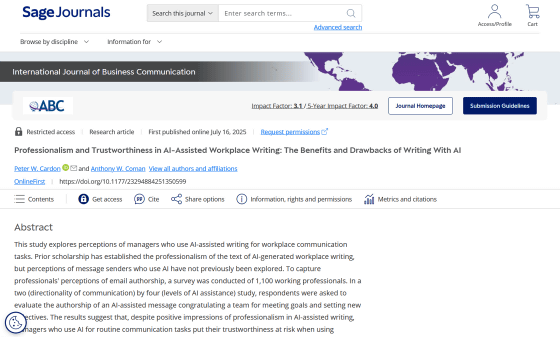
Professionalism and Trustworthiness in AI-Assisted Workplace Writing: The Benefits and Drawbacks of Writing With AI - Peter W. Cardon, Anthony W. Coman, 2025
Managers who use AI to write emails seen as less sincere, caring, and confident
https://www.psypost.org/managers-who-use-ai-to-write-emails-seen-as-less-sincere-caring-and-confident/
While AI-assisted writing is generally recognized as improving message clarity and accuracy, it is still unclear how others perceive those who use AI to compose emails and messages. Therefore, a research team led by Peter Cardon, a professor of business communication at the University of Southern California, conducted an experiment to examine how the use of AI in everyday communication affects people's perceptions of others.
'I believe AI will have a huge impact on our relationships,' Cardon said. 'People will use AI heavily to help them communicate. This is already happening in the workplace. I want people to be aware of the impact of AI-mediated communication.'
The researchers surveyed 1,158 full-time US workers who spend at least half their time on a computer and presented them with various scenarios involving messages to celebrate team achievements.
The scenarios included 'the boss used AI to create the message' and 'the self used AI to create the message,' and the degree of AI contribution was also categorized into 'the AI made minor edits to the message' and 'the AI generated almost the entire message based on prompts.' The experiment also included cases where the prompts entered into the AI were presented to the subjects, and cases where the prompts were not disclosed.
After reading their assigned scenario or prompt, participants answered a series of questions about their thoughts on whether the message was created by an AI or their boss/they themselves, the impact the message had, the creator's professionalism, honesty, consideration, and confidence, and their comfort level with using AI. In addition to a numerical rating, the questions included an open-ended question asking participants why they thought the creator was important or unimportant in workplace communication.
The results of the experiment showed that when a message was created with the assistance of AI, people's trust in the sender of the message decreased. This was particularly true when most of the message was generated by AI, and people were less likely to consider the message creator to be their boss. In other words, when AI played a large role in creating a message, people perceived the message as 'created by AI' rather than 'created by their boss.'
In cases with little AI assistance, 93% of participants assumed that their boss had created the message, whereas in cases with a lot of AI assistance and no prompting, only 25% assumed that their boss had created the message, with the majority assuming that the message had been created by the AI.
Despite this, messages that heavily leveraged AI were rated as more effective for their teams. Many participants also perceived AI as a useful tool for improving grammar, tone, and structure, and were happy for AI to be used to refine their writing as long as the message's content reflected their own thoughts.
While the AI-powered messages were seen as effective, the senders of the messages were rated less highly: Managers whose messages were mostly generated by AI were reportedly rated as consistently less honest, less considerate, and less confident.
The reasons behind this were revealed in the open-ended questions. Many participants expressed disappointment and irritation when they learned that most of the congratulatory messages were generated by AI. Some described their bosses as 'lazy' and 'disingenuous,' while others felt their bosses 'didn't care enough about their team to write personal messages' and 'were not invested enough in their team's success.' Cardon said, 'What surprised me most was the intensity of emotion. Many respondents expressed resentment that their bosses would use AI to create emails.'

Some participants also questioned the ability of their managers to rely so heavily on AI, with many responding that 'managers are expected to be able to write simple emails without external assistance, and using AI for such purposes may indicate a lack of leadership and communication skills.'
On the other hand, when the message was created by the participants themselves, rather than by their boss, they viewed the message more favorably and were more likely to see AI as a helpful support tool. Additionally, the majority of participants said they would be comfortable with AI being used to create messages such as 'factual updates' and 'daily reminders.'
Additionally, some participants expressed concerns about the repeated use of AI in workplace communication, saying it could 'destroy human connections,' 'potentially weaken team cohesion,' and 'create a dehumanizing atmosphere in the workplace.'
'Professionals need to be aware of the reputational and relationship risks that can result from the overuse of AI in business communications,' Cardon said. 'I hope this information inspires people to use AI to improve their lives and relationships. We are on an AI journey now, and we need to discuss AI and use it thoughtfully and purposefully.'
Related Posts: