California Governor signs bill requiring browsers to offer settings to opt out of data collection

Browsers are essential for internet users, but with Google being sued over Chrome's collection of user data and Mozilla responding to concerns about Firefox's privacy notice by stating that it 'does not steal user data,' concerns have arisen that browsers are collecting user data. While browser settings and add-ons can be configured to prevent private data from being sent, California recently passed a law requiring browsers to 'make it easy for users to opt out of providing personal information,' making such settings easily accessible to anyone and across all browsers.
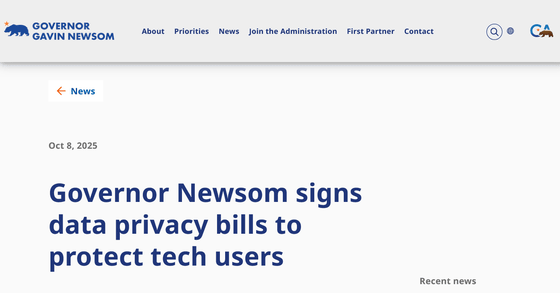
Newsom signs data privacy Governor bills to protect tech users | Governor of California
https://www.gov.ca.gov/2025/10/08/governor-newsom-signs-data-privacy-bills-to-protect-tech-users/
California enacts law giving consumers ability to universally opt out of data sharing | The Record from Recorded Future News
https://therecord.media/california-signs-law-opt-out-browsers
The California Consumer Privacy Act (CCPA) was enacted in 2018. The CCPA grants rights such as the 'right to information,' 'right to be forgotten,' 'right to opt out of information sharing with third parties,' 'right to equal access to services,' 'right to data portability,' and 'right to sue if data is not properly protected.' In 2024, a new law, SB-1223, was enacted, further expanding the scope of protection to protect people's brain data and prevent its misuse by technology companies.
California passes bill expanding sensitive personal information to neural data - GIGAZINE

The CCPA gives California residents the right to opt out of data sharing through their browsers, but how they do so is up to the user, and browsers haven't made this easy to do.
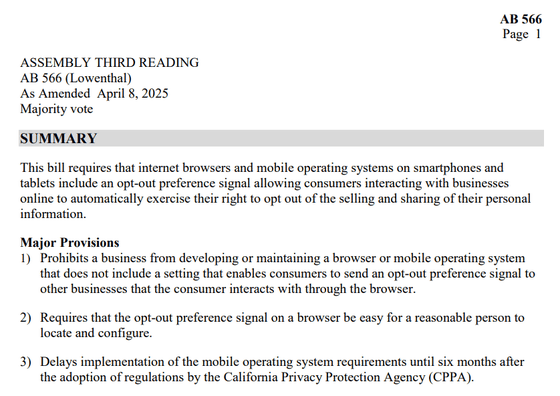
On October 8, 2025, California Governor Gavin Newsom signed AB 566, a bill that requires browsers to provide a simple, one-click opt-out mechanism. This bill requires browsers to provide a one-click 'data sharing opt-out signal,' eliminating the need for users to repeat the process each time they visit a website. This is the first law of its kind to be enacted in the United States.
'Until now, to opt out of data collection features, people had to download a third-party browser extension or choose a browser with built-in privacy features,' said Matt Schwartz, a policy analyst at the consumer advocacy group Consumer Reports. 'The new bill's opt-out feature will make this available to millions of people in a significantly simplified process.'
According to an Associated Press report , Google conducted a lobbying campaign by collecting signatures on a petition opposing AB 566. In an email requesting cooperation, Google argued that 'the passage of AB 566 would impair our ability to reach customers through online advertising.' According to the AP, Google did not directly lobby the House lawmakers who introduced the bill, but instead used another company funded by Google to represent them.
Other bills signed by Governor Newsom on the same day also recognize important data privacy rights. One is AB 656, which requires social media companies to simplify the account cancellation process and to permanently delete consumer data upon cancellation. Governor Newsom stated, 'It shouldn't be hard to delete your social media account, and it shouldn't be even harder to regain control of your personal data. These bills will give social media users peace of mind knowing that when they delete their account, no data is left behind.'
The bill stipulates that the new law will come into effect on January 1, 2027, giving browser providers and businesses a period to prepare.
Related Posts:







in Web Service, Security, Posted by log1e_dh