Anthropic details how they built their multi-agent Claude Research system, achieving significant improvements in internal evaluation compared to single-agent systems
Anthropic's AI model '
How we built our multi-agent research system \ Anthropic
https://www.anthropic.com/engineering/built-multi-agent-research-system
Anthropic: How we built our multi-agent research system
https://simonwillison.net/2025/Jun/14/multi-agent-research-system/
In April 2025, Anthropic announced that it had introduced a new feature called 'Research' to its chat AI 'Claude,' which performs detailed research and analysis according to user instructions. Claude can now be integrated with Google Workspace, including Gmail and Google Calendar, allowing Claude to search users' emails, check documents, and check calendar appointments, enabling more personalized searches.
Claude adds 'Research' feature, enabling inference not only from web data but also from Gmail and Google Calendar content - GIGAZINE
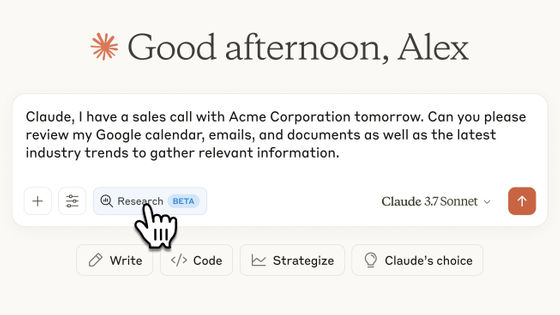
While a typical AI model can produce useful results with a single agent handling a single prompt, Claude combines multiple agents to execute prompts in parallel, making the task more complex than a single agent could handle.
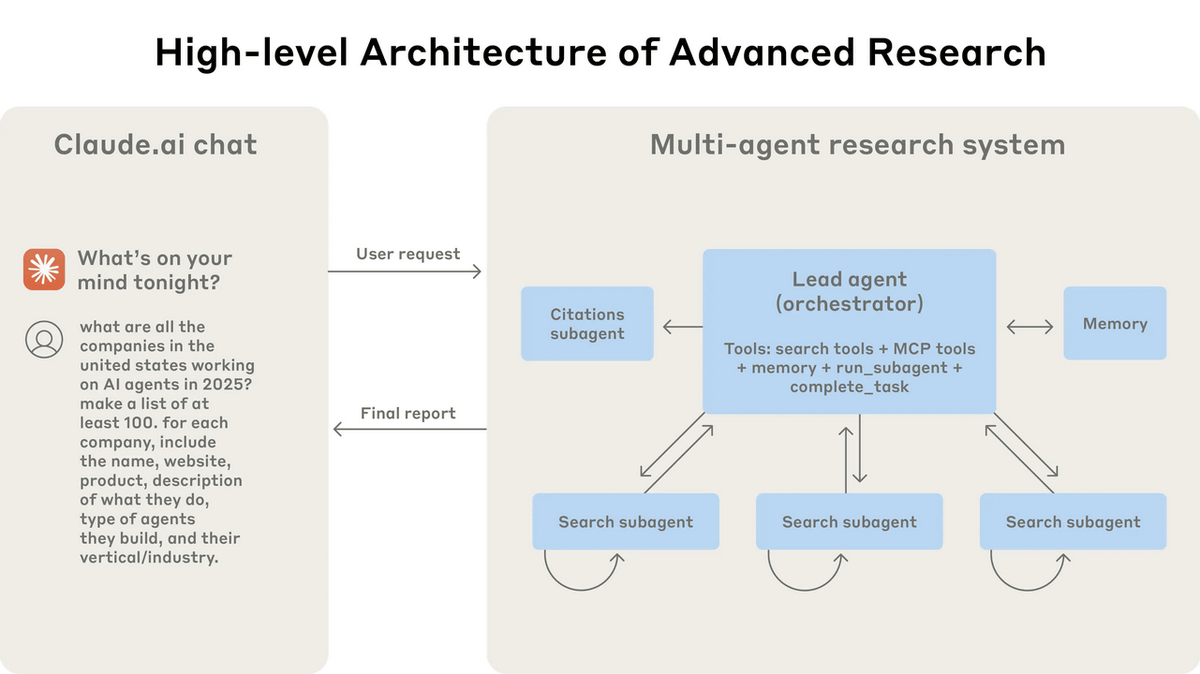
Anthropic explains why this is the case: 'The essence of search is compression—extracting insights from a massive database. Subagents facilitate compression by working in parallel, simultaneously searching different aspects of a question and condensing the most important tokens.' For example, when processing the task of 'identifying all directors of an IT company that meet certain criteria,' a single-agent system would use a 'sequential search' that searches through data that matches the criteria in order, resulting in slow processing and no answer. However, Anthropic's internal research revealed that a multi-agent system was able to find the correct answer by breaking down the problem into tasks for each subagent.
Specifically, the multi-agent system announced in May 2025, which uses Claude Opus 4 from the ' Claude 4 ' family as the lead agent and Claude Sonnet 4 as the sub-agent, demonstrated performance that was 90.2% higher than the single-agent Claude Opus 4 in an internal evaluation.
Anthropic goes on to detail the rapid engineering process required to build a truly effective system: Below is how a typical multi-agent architecture works: When a search query is entered into Claude, the request is sent to the multi-agent system, where the lead agent and subagents interact to process the results and return them to the user.
Unlike typical multi-agent systems, Anthropic uses multi-stage search to dynamically discover relevant information, adapt to new discoveries, and analyze results to generate high-quality answers. Below is a diagram of the workflow of the multi-agent system Anthropic builds, showing how when a user submits a query, the system creates a 'LeadResearcher agent' that starts the iterative research process, and then creates dedicated subagents with specific research tasks.
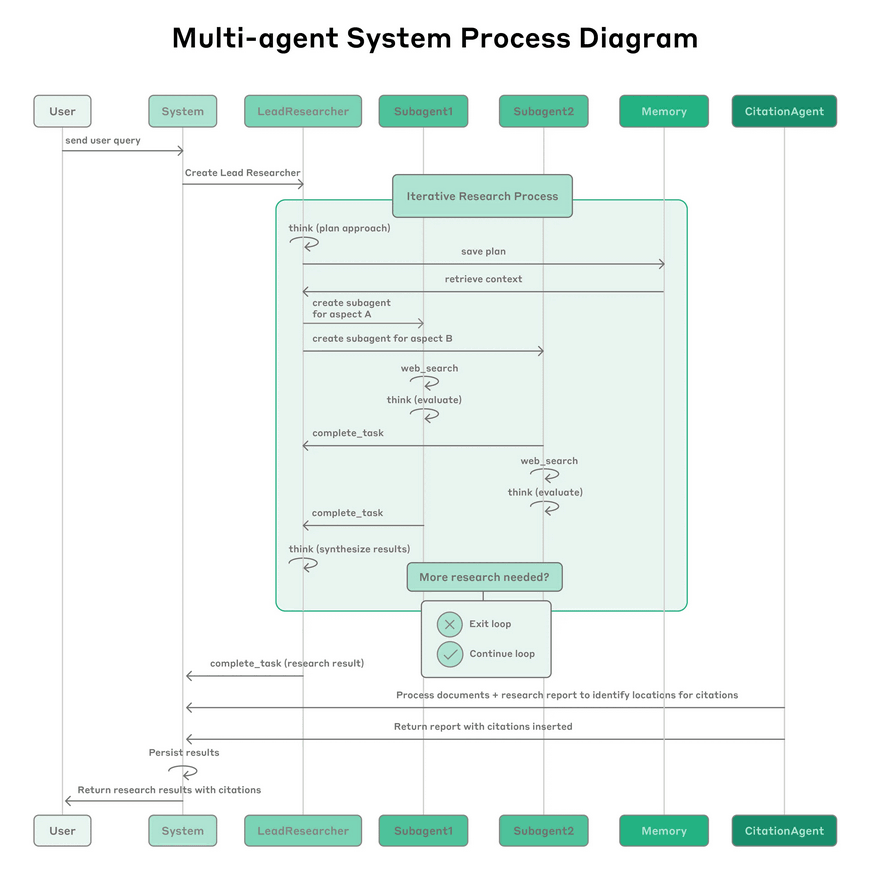
While early multi-agent systems often spawned as many as 50 subagents for simple queries, or agents were confused by excessive updates, Anthropic's system breaks down the task by having the lead agent explain the query to the subagents, resulting in the right combination of agents.
Multi-agent systems work because they distribute enough tokens among each agent to solve the problem, effectively allowing them to spend tokens on tasks beyond the limits of a single agent. However, these architectures have the drawback of rapidly depleting tokens, even in the relatively high-efficiency Anthropic system. In Anthropic's data, agents use about four times as many tokens as chatbot interactions, while multi-agent systems use about 15 times as many tokens as chatbots. Therefore, to be economically feasible, multi-agent systems must be assigned tasks that are worth their high performance.
'Despite the multiple challenges, multi-agent systems have proven valuable for open-ended research tasks. In fact, Claude has helped researchers discover previously unthinkable business opportunities, explore complex medical options, solve tricky technical bugs, and save them days of work by uncovering research connections they wouldn't have found on their own. We're already seeing these systems transform how we solve complex problems,' Anthropic said of the importance of multi-agent systems.
Related Posts: