Why are teachers and librarians less likely to commit suicide?

Suicide rates among the working-age population vary greatly by occupation. A 2021
Teachers and librarians are among those least likely to die by suicide − public health researchers offer insights on what this means for other professions
https://theconversation.com/teachers-and-librarians-are-among-those-least-likely-to-die-by-suicide-public-health-researchers-offer-insights-on-what-this-means-for-other-professions-252795

The following graph shows the trend in suicide rates as outlined in the 2024 National Strategy for Suicide Prevention published by the U.S. Department of Health and Human Services. The graph shows the number of suicides per 100,000 working-age people in the United States. In 2000, it was 10.4 per 100,000, but in 2022 it was 14.2, a significant increase over the past 20 years.
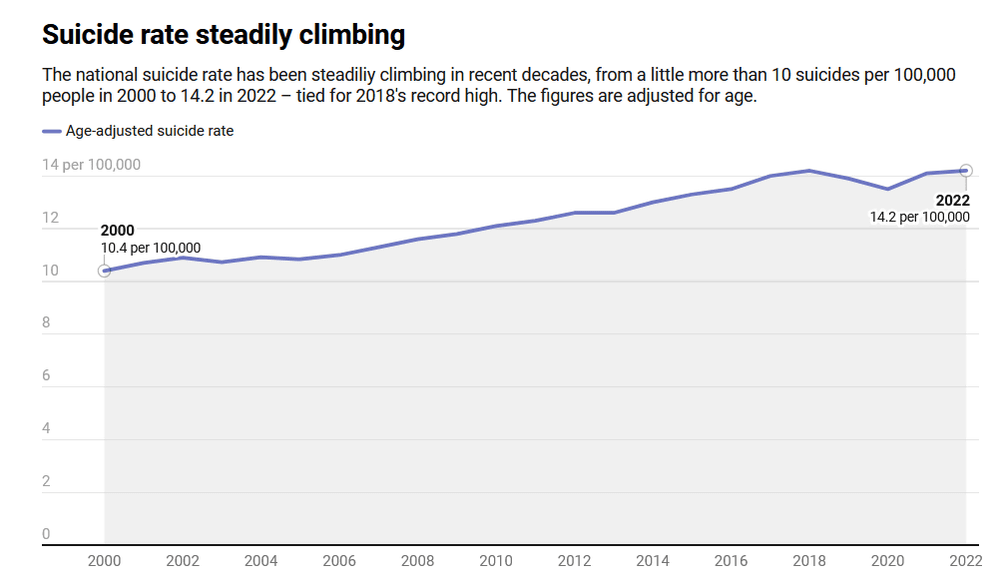
The suicide rate in the United States in 2022 varied significantly by gender, with 23 suicides per 100,000 men compared with 5.9 for women. It's also known that people in certain occupations are at higher risk of suicide than others.
The differences in suicide rates across occupations can be explained by a variety of factors, including exposure to tasks that negatively impact mental health, low job security, and the demographic makeup of the occupation. For example, military personnel are thought to have a higher suicide rate because they tend to have a lower fear of death, a higher tolerance for pain, and a more disrupted daily routine, which makes them more likely to struggle with the transition to normal civilian life.
Why is the suicide rate so high among military personnel?

On the other hand, 'education workers,' classified by the Bureau of Labor Statistics as 'educational instruction and library' occupations, have been reported to have lower suicide rates overall. According to Batchelor, when public health researchers examine suicide data, they often focus on high-risk populations to understand where intervention and prevention are most needed. However, analysis of low-risk populations is also important because there are lessons to be learned from them.
One reason for the statistically low suicide rate among education workers is that the proportion of women among all education workers is quite high. Because the suicide rate is significantly lower among women than men, occupations with a higher proportion of women in the demographic composition tend to have lower suicide rates. Researchers also point out that people in teaching professions tend to have higher levels of education, which increases socioeconomic status and employability, and may therefore help prevent suicide.
Another notable factor associated with higher suicide rates is 'accessibility to lethal means.' A 2017 study showed that workplaces with easy access to lethal means, such as medicines and firearms, such as medical professionals and the military, are closely associated with suicide rates. On the other hand, the relatively low availability of lethal means in schools may be contributing to the low suicide rate among education workers.
Guns increase suicide rates - GIGAZINE

by ZH
In addition, work environments such as schools and campuses are thought to be good for mental health because they provide ample opportunities for building strong social relationships. Furthermore, education workers tend to lead healthier lifestyles, with fewer people experiencing alcohol or drug problems than other workers, which also reduces the risk of suicide.
Batchelor explains the results of the analysis, saying, 'The lesson learned from analyzing educators with low suicide rates is the need to develop skills to cope with work stress. Identifying the root causes of work stress and utilizing coping skills such as positive thinking, meditation, and goal setting can have beneficial effects. Building social networks in the workplace is also important. Social networks provide tangible and intangible support and help establish a sense of purpose and identity. The idea that environmental factors are suppressing suicide rates among educators means that workplaces and organizations can foster a positive culture.' Furthermore, Batchelor states, 'The importance of continued research on occupational health is noteworthy. While no one is immune to suicide risk, all suicides are preventable.' He also emphasizes the importance of further research.
Related Posts: