"Selective bias" as a reason why schools with many high-grade students are not necessarily doing excellent education

ByPeter Hershey
"Since this school has produced a lot of excellent graduates, parents who choose children's schools or encourage their children by thinking that they should succeed in the future if their children also enroll" You should be there. However, he is a teacher who works in New York and serves as a staff member of a teacher or a teachers union of New York City UniversityFreddie deBoerHe talks about the mechanism that the selection bias is hidden everywhere in the education system, "Schools with high grades of students are not necessarily doing excellent education".
Why selection bias is the most powerful force in education - the ANOVA
https://fredrikdeboer.com/2017/03/29/why-selection-bias-is-the-most-powerful-force-in-education/
In college entrance examination in the United StatesSATIt is said that the score of the student has great influence on the student's performance after entrance to the university, the student with the higher SAT score has better grades at the university, the probability of dropping out at the first grader becomes lower, 4 It is said that there is a tendency to finish school life of year or six years successfully. Furthermore, students who were high scores at SAT are more likely to obtain full-time positions after graduation.
Also in large-scale surveys, "People with higher SAT and young sports recognition scores are likely to become scientists, scholars, CEOs of Fortune 500 companies, federal judges, senators, and billionaires in the future" It has also been confirmed that there is a correlation between the number of patent acquisitions and the number of papers written and the score of SAT and the high level of spatial recognition capability. In a survey focusing on "premature genius" named SMPY, we initially considered "top 1% of college entrance examinations" as geniuses, including Google founder Sergei Brin and Facebook founder's mark · It is said that a famous person such as Zuckerberg and artist Lady Gaga was included.
According to the follow-up survey of 5,000 geniuses over 45 years, it turned out that it is more socially and economically more likely to succeed "premature male genius" - GIGAZINE

The score of this SAT is as follows when comparing the average points of the two states of Connecticut and Mississippi.
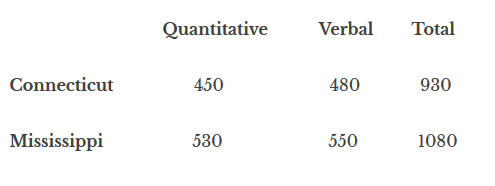
The mean of SAT scores in Connecticut State is 450 in mathematics, 480 in English, totaling 930 in English. Meanwhile, Mississippi has an average score of 580 in mathematics and 550 in English with a total of 1080 points. Looking only at points, students in the state of Mississippi seem to be outstanding, with better results than students in Connecticut state.
What happens if the state governor who wishes to economically activate his state when analyzing the SAT score as having a big influence on human's life analyzes these data and reforms the educational system . Connecticut State has a strong educational union in which most state teachers participate, and many teachers working in public schools in Mississippi do not belong to official unions. Looking only at the fact that the average point of SAT in Mississippi state is high, the state governor may take a policy against the union, as the academic ability of children improves if there is no teacher union.
However, in fact, Connecticut is a state that succeeded in educational policy, and according to the National Academic Achievement Survey (NAEP) students' grades in high school 4th and 8th year are ranked second in the rankings in the whole country of the United States. On the other hand, students' high school fourth and eighth high school grades in Mississippi State are second from the bottom in the national rankings.
Why does it look like the opposite result to the actual situation, this is due to the relation between the SAT examination rate in each state and the average point. The Mississippi state SAT examination rate is 3%, and those who take the exam are ready to enter the university, so to speak, it is the top level student in the state so to speak. On the other hand, SAT examination rate in Connecticut State is 88%. Students close to all have academic ability suitable for SAT examination. Because the number of people to take the exam is large, the average point as a whole drops, but on the other hand, the top 20% of SAT students in Connecticut state have better results than the top 20% of Mississippi State SAT students.
ByMari Helin-Tuominen
This indicates that the quality of our "educational quality" is good or bad,Selection biasIt is that there is a possibility that it may be influenced.
For example, suppose there is one public high school in a city and a private high school that sells students' high grades in academic performance tests. Simply comparing students' grades, private high school educational content may look better than public high school educational content. But, of course, it is private, so it is very expensive and children who can communicate are limited. In other words, the results of students going to private high school are influenced by household income, and it is not necessarily true that the results of children are good as the contents of education being carried out at private high school is excellent. I can not say "Quality of education is excellent" without considering that students attending each school are sifted.
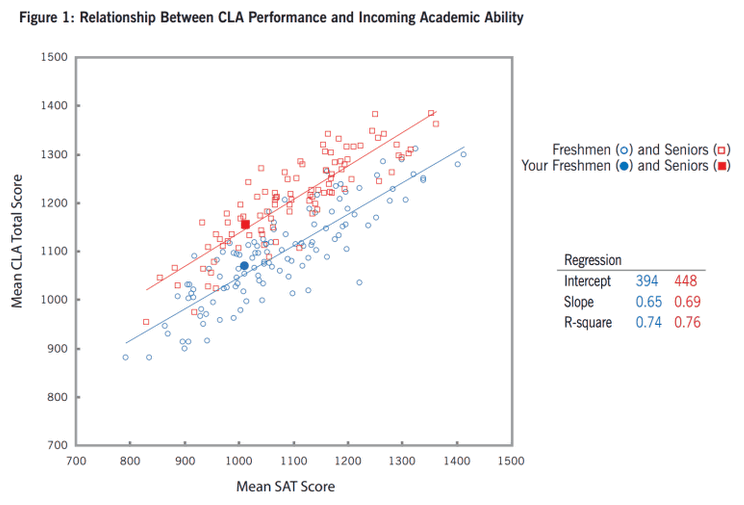
The graph below average scores of the SAT during horizontal axis college, the vertical axis shows the average point of the standard test of CLA which is performed every University (Collegiate Learning Assessment). The blue dot represents the average score of first-year students at each university, the red dot represents the average score of the 4th graders, the difference between the blue line and the red line is the degree of learning in the university four years I will. The graph shows that there is a strong correlation between SAT and CLA scores in both the first and fourth years of university, and selection bias is already present at university entrance.
People who have graduated from Harvard University will have excellent results both academically and professionally. However, as a result of that, it can not be said that the educational content of Harvard University is wonderful right away. Harvard University is fundamentally carefully "choosing students to enroll" with funds of millions of dollars and many of the children who have completed the admission process at Harvard University have excellent results no matter where you go . Is there a lot of excellent graduates, Harvard education is excellent? I will not solve the question.
Also, the presence of selective bias will change our view of causality in education. Many of those claiming that education should be reformed are: "A student who is in a poor household or belongs to a minority can not live in a region with high land price or a lot of white people and can not enter a good school "I assert that. However, there is a possibility that this causal relationship is opposite. In other words, these areas are ideas that can maintain high academic achievement because they can efficiently eliminate poor students and minority students. A school that educates students who are in socially advantageous conditions is natural, but it looks like a good school. However, such ideas rarely come up to the media and liberal discussions.

ByJodyHongFilms
Selection bias in education exists everywhere. In the United States primary and secondary schools established by parents, faculty members, regional organizations etc., approved by state and school district "Charter school"Has been increasing since the 1990's and is often introduced with the word" revolutionary "because it has educational consideration for various students. However, in 2013Reuters conducted a thorough investigationHowever, it became clear that there is a charter school with "a mechanism to deliberately eliminate students with difficult education". Although these charter schools are taking the form to accept all students on the surface like public schools, it is necessary to establish a meeting during the time when parents can not participate and to participate in the meeting as admission conditions There is a hidden "sieve" such as to make it.
In the "CREDO Project" at Stanford University who investigated the effectiveness of charter schools, researchers argue that they are considering a potential "sieve" mechanism that would hide in large-scale research But even soCampbell's law"It seems that any quantitative indicator will be subject to the pressure of decadence by those who try to break down the system so much that it will have the power" , The educational system of modern America has undergone a lot of bias.
DeBoer says that few people think about selection bias when thinking about the quality of school and education. Many parents say, "The students are doing very well at this school, I think that my child who is a problem child will be able to do well if I let him go to this school." However, if we try to use limited educational resources fairly and efficiently, we need to deeply observe things and recognize the dynamics of modern education systems.
Related Posts:







in Note, Posted by darkhorse_log