A banking company has released a case study showing how it reduced its AI usage costs by approximately one-tenth, by switching from commercial AI to its own operational model.

Revolut is a UK-based financial technology company that provides banking services, money transfers, and payments. David Abitbol, who leads the company's AI operations and infrastructure division, presented an initiative at the 'AI Engineer NYC 2026' developer event held in October 2026, in which they reduced the cost of AI operations by approximately one-tenth.
Shipping like a startup, regulated like a bank | AI Engineer NYC 2026
British fintech Revolut slashes AI coding costs 10x by cutting out Claude and going self-hosted • The Register
https://assets.theregister.com/2026/11/03/202620/
AI Engineer NYC Livestream | Bridgewater, Two Sigma, Arize, Coatue, Nous (Hermes), Gen. Intuition - YouTube
Revolut introduced Google's 'Gemini' in early 2025, and Anthropic's AI coding tool 'Claude Code' in early 2026. However, as the use of AI expanded, costs became a problem, with some engineers spending as much as $1,000 (approximately 150,000 yen) or even $10,000 (approximately 1.5 million yen) per month on AI. Revolut set a budget cap, but engineers began using AI only for difficult tasks to conserve their budget, which reduced the opportunities to utilize AI.
Therefore, Revolut proceeded with the transition from external AI services to self-hosting, where they would run AI on their own computers. The solution they adopted was the 'GLM' series of open weight models developed by the Chinese AI company Z.ai.
Revolut initially adopted 'GLM-5.1' and later migrated to 'GLM-5.3'. According to Abbitbol, the processing cost of running GLM-5.1 in-house was approximately $0.30 (about 45 yen) per million tokens, including input and output, which is about one-tenth of the cost when using OpenAI's 'Codex' or Claude Code.
In-house operation requires equipment capable of processing massive amounts of computation, and Revolut uses 56 of NVIDIA's high-performance GPUs, the 'B200.' However, it's not just about increasing the number of GPUs; adjustments such as controlling the amount of information the AI accesses at once and 'quantization,' which reduces memory usage by lowering the precision of the data used for calculations, are also crucial. Approximately 80% of the performance improvement was attributed to adjusting the AI's operating settings.
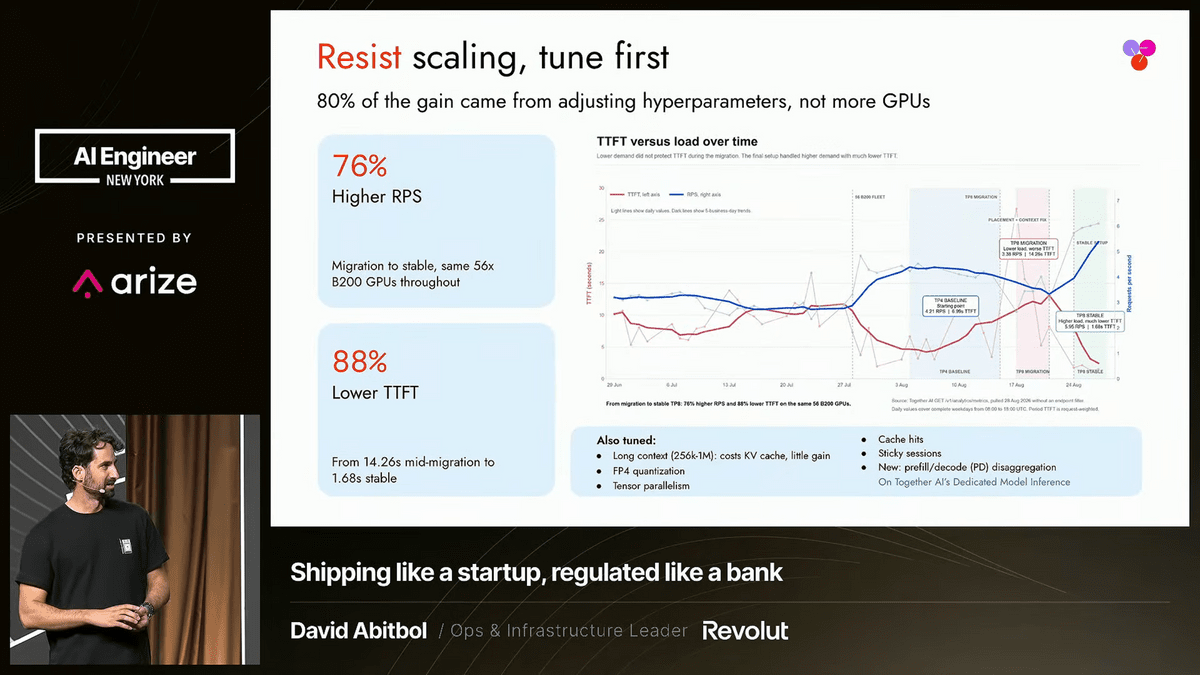
With the cost of using AI decreasing, engineers are now using AI not only for writing programs, but also for everyday tasks such as investigating bugs and handling issues in the project management tool 'Jira.'
According to Revolut, their AI implementation efforts have improved coding time by approximately 60%, and the time from the start of work to integrating program changes and preparing for release has improved by approximately 70%.
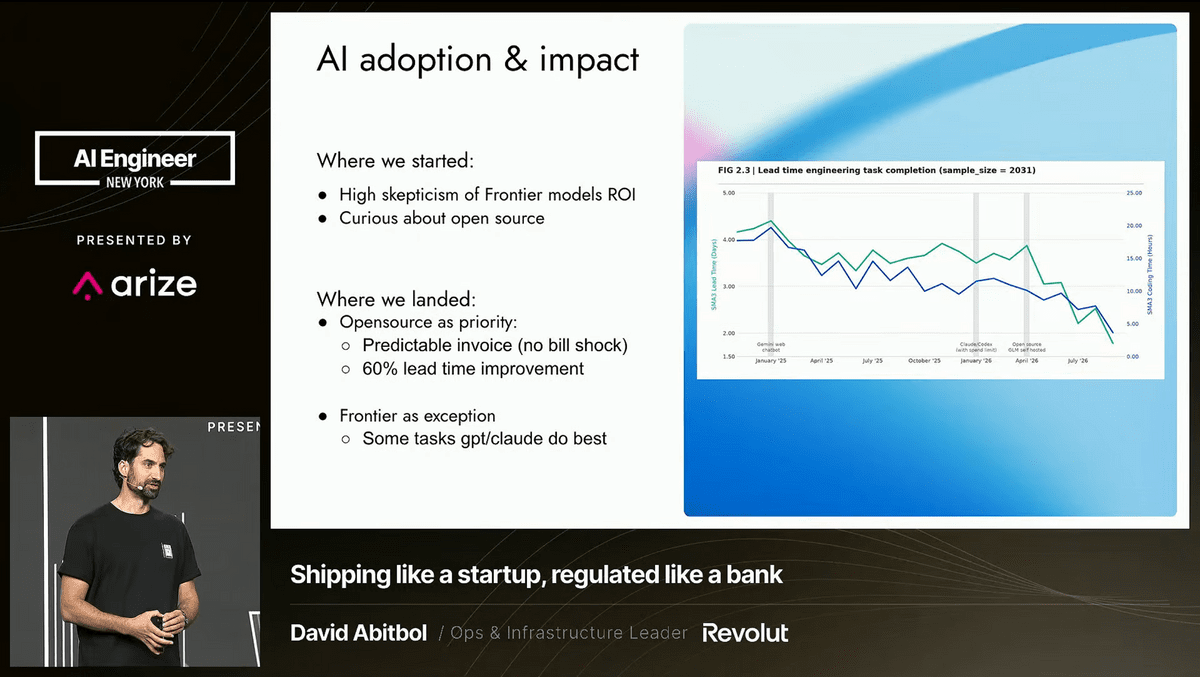
It should be noted that Revolut has not completely discontinued its commercial AI services; they continue to use Gemini for tasks that require image understanding, and they use different AI solutions depending on the application.
Mr. Abitobol explained that prioritizing in-house AI has made it easier to predict operating costs and reduced concerns about unexpectedly high bills at the end of the month. He stated that they will continue to use in-house AI as the standard and only use high-performance commercial AI services when necessary.
Related Posts:






in AI, Posted by log1d_ts