All eight certificate authorities compromised by eMudhra had private keys that were a mere '1 byte' each, and one of the private keys was '4,' linked to root certificates trusted by root programs in Mozilla, Microsoft, Apple, and Chrome, as well as many downstream trust stores.
On October 20, 2026, it was revealed that the private keys of eight
eMudhra Intermediate CA Compromise
https://emudhra.we-have-a-problem.com/
The breach was discovered when Wayne, the initial reporter, signed a specific message using the private keys of each of the eight intermediate CAs and reported it to the root program team on October 17, 2026.
We have a problem here - Wayne
The signed message, the certificates of each intermediate CA, the public keys, and the signatures are all publicly available on the eMudhra website and can be verified using OpenSSL.
[code]
openssl x509 -in EM-DV-TLS-CA-G3B.crt.pem -noout -pubkey | diff - EM-DV-TLS-CA-G3B.pub.pem
openssl dgst -sha384 -verify EM-DV-TLS-CA-G3B.pub.pem -signature EM-DV-TLS-CA-G3B.sig message.txt
[code]
Following this breach, the root program and downstream trust stores took swift action to protect users. These certificates have been blocked in Firefox and Chrome since October 17, on Apple devices since October 19, and on Microsoft platforms since October 20. eMudhra has also revoked the compromised intermediate certificates. However, many clients will not immediately recognize the revocation information, so a software update is required to stop trusting the compromised intermediate certificates.
You can check if the client has revoked the compromised intermediate certificate below.
Does your client still trust the compromised intermediates?
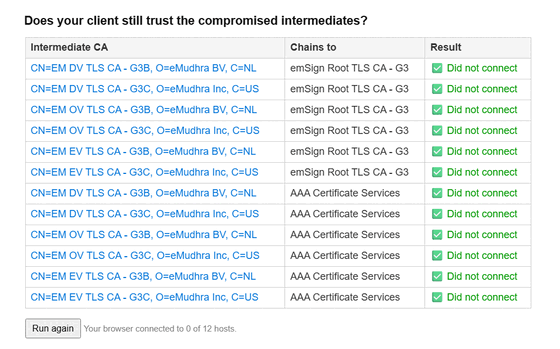
To check curl and other command-line clients, run the following:
[code]
curl https://dv-g3b-emudhra.we-have-a-problem.com/
curl https://dv-g3b-aaa-emudhra.we-have-a-problem.com/
[code]
If the intermediate certificate has expired, an authentication error will occur.
[code]
curl: (60) SSL certificate problem: unable to get local issuer certificate
More details here: https://curl.se/docs/sslcerts.html
curl failed to verify the legitimate of the server and therefore could not
establish a secure connection to it. To learn more about this situation and
how to fix it, please visit the web page mentioned above.
[code]
An attacker with the private key of a compromised intermediate CA could impersonate any website or service until the compromised intermediate certificate was revoked. Mozilla, Microsoft, Apple, and Chrome have already taken measures to address this risk by providing users with revocation information distribution tools such as OneCRL, CRLite, and CRLsets.
The breach occurred because the private key in an improperly generated intermediate certificate by the CA allowed the private key to be recovered from the certificate. According to information leaked to Hacker News , all eight compromised private keys were 1 byte long, and one of them was the number '4'.
4 EM OV TLS CA - G3C OV TLS
56 EM EV TLS CA - G3C EV TLS
66 EM OV CS CA - G3B Code signing
115 EM EV TLS CA - G3B EV TLS
155 EM OV TLSCA - G3B OV TLS
156 EM DV TLS CA - G3B DV TLS
230 EM DV TLS CA - G3C DV TLS
237 EM OV CS CA - G3C Code signing
This issue existed from the time the certificate was created in April 2025, but because there are no certificate transparency (CT) logs for the intermediate certificate during that period, clients such as Firefox, Chrome, Edge, and Safari that enforce CT were likely protected from the attack. However, since many clients outside the browser ecosystem do not enforce CT, it is unclear whether the attacker exploited the flawed key generation.
Several software packages have already released patched versions. Users are advised to update their browser and operating system to the latest versions as soon as possible.
| Software name | Patched version |
|---|---|
| Ubuntu ca-certificates | 20260816ubuntu0.22.04.1, 20260816ubuntu0.24.04.1, 20260816ubuntu0.26.04.1, 20260816ubuntu0.26.10.1 |
| Debian ca-certificates | 20250419~deb12u2, 20250419+deb13u1, 20260816+nmu1 |
| Arch Linux ca-certificates-mozilla | 3.131.1-1 |
| Gentoo ca-certificates | 20260816.3.125 |
| Fedora ca-certificates | 2026.2.92_v9.0.319 |
| FreeBSD ca_root_nss | still |
| Chainguard certificates | 20260909-r3 |
| Alpine Linux ca-certificates | 20261020-r0 |
| NSS | 3.131.1 |
| curl PA bundle | 2026-10-20 |
| Cloudflare CFSSL trust store | 2026.10.1 |
| Homebrew certificates | 2026-09-25_1 |
| Go | 1.27.3, 1.26.10 |
| Node.js | still |
| Python certifi | 2026.10.19 |
| pip | 26.2.2 |
| UV | 0.13.4 |
| Rust rustls-webpki | 0.103.16 |
| Rust webpki-roots / webpki-root-certs | 1.0.10 |
| Electron | 44.9.1, 43.8.1, 42.11.16 |
| Bun | still |
| Composer ca-bundle | 1.4.16, 1.6.0 |
| Elixir castore | 1.0.22 |
| Perl Mozilla::CA | 20261020 |
Workarounds for macOS, Linux , NetBSD , and FreeBSD versions of curl are available on the official website, but they all require root privileges and are intended for advanced users.
Related Posts:






in Web Service, Security, Posted by log1c_sh