OpenTPU, an open-source AI accelerator developed using AI technology, has emerged.
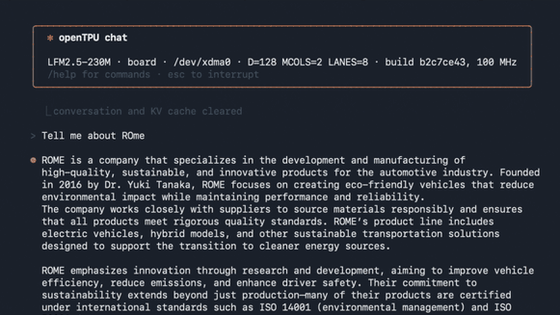
The open-source project 'openTPU,' which uses AI to design hardware for AI, has been released. openTPU is an attempt to develop a dedicated accelerator for running AI models at high speed, utilizing AI agents as well, and has successfully run multiple language models such as Qwen3, Qwen3.5, and Gemma 4 on an actual FPGA card.
GitHub - FeSens/openTPU: An open-source AI accelerator, developed by AI: RTL, ISA, simulator, compiler and profiler in one repo. Runs Qwen3, LFM2.5 and Qwen3.5 on a Kintex-7 PCIe card. · GitHub
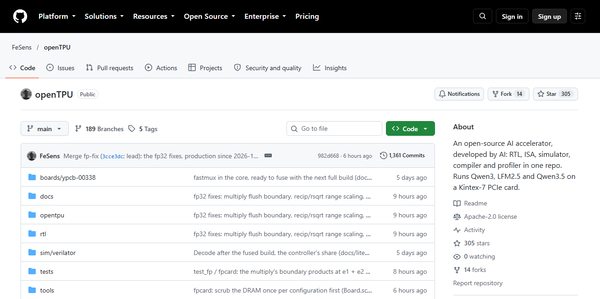
openTPU is not a project to replicate Google's TPU, but rather to explore 'how far an AI agent can handle hardware design' and 'whether an AI can design the chip to power itself.' Its distinguishing feature is that it not only creates hardware for AI, but also has the AI handle the design process itself. Because everything from the software to the circuitry is publicly available, it is also intended to be used as educational material for learning how AI accelerators work.
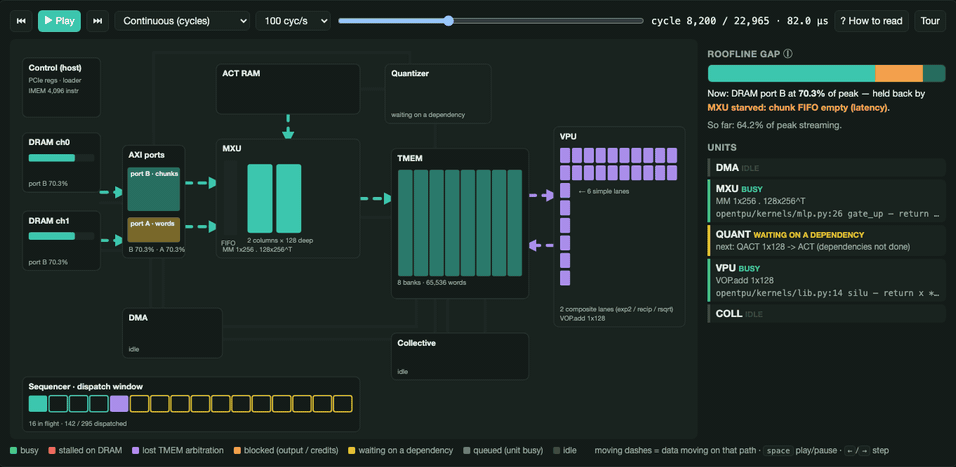
The openTPU's structure is designed to be intentionally simple, centering around a sequencer that issues instructions sequentially, and combining it with a DMA (Data Transfer Module) that handles data transfer to and from memory, a matrix operation unit that performs matrix operations, a vector unit that performs floating-point operations, and a unit that quantizes the results. Because it does not have a cache or complex instruction scheduling like typical CPUs and GPUs, and data movement is explicitly treated as an instruction, it becomes easier to track 'how many clock cycles each process took.'
The developers programmed the openTPU circuit onto an FPGA card equipped with AMD's
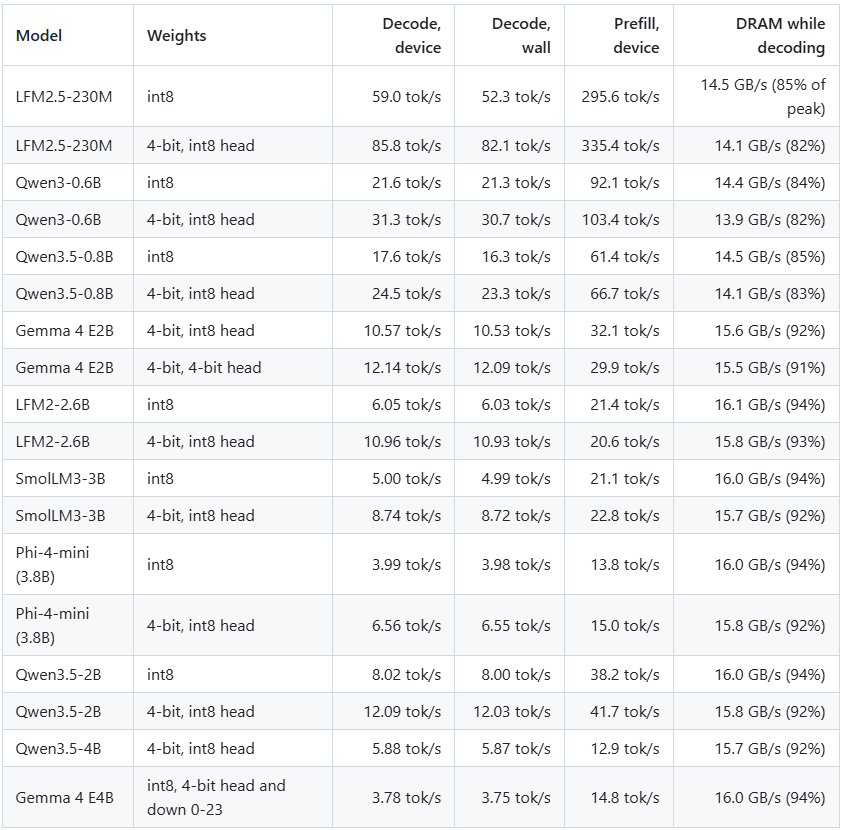
For example, the LFM2.5-230M, quantized to 4 bits, recorded a generation rate of 82.1 tokens per second, the Qwen3-0.6B recorded 30.7 tokens per second, and the Qwen3.5-0.8B recorded 23.3 tokens per second.
Furthermore, openTPU is said to support large-scale models that do not fit into the memory on the card, and the developers report that by sending only the necessary data from the PC, they were able to run Qwen3.5-35B-A3B with 34.7 billion parameters at 3.95 tokens per second.
As of the time of writing, openTPU's performance is largely limited by the speed at which it reads model data from memory, rather than by the AI calculations themselves. Therefore, future challenges include improving the efficiency of memory access and speeding up the prefill process that initially processes input sentences.
openTPU is released under the Apache License 2.0.
Related Posts: