The free and open-source AI coding tool 'Pi 1.0' has been officially released, adding MCP support and the ability to switch between multiple AI models.

Pi, an open-source AI coding tool with a minimal set of features, released its official version, Pi 1.0, on October 1, 2026. While maintaining the simple design of the original, Pi 1.0 adds features such as standard support for MCP for integration with external tools, the ability to load only the necessary tools, and a mechanism for combining multiple AI models.
Pi 1.0 | Earendil
Pi
https://pi.dev/
An 'AI coding agent,' which entrusts programming to AI, is a system that allows an AI model to autonomously perform tasks from code analysis to modification by providing it with functions such as reading and writing files and executing commands. The foundation that connects the AI model with various functions and makes it operate as an agent is called a 'harness.'
What is an AI agent's 'harness'? Four mechanisms for actually getting AI models to work - GIGAZINE

While adding many features to an AI agent can be convenient, it also leads to problems such as longer system prompts and tool descriptions being passed to the AI each time, increased API usage fees, and the risk of important instructions getting buried. Pi avoided the approach of including a large number of features from the start, and instead based its approach on four basic functions: 'read' to read files, 'bash' to execute commands, 'edit' to modify files, and 'write' to create files.
Why is the AI coding tool 'Pi,' which has limited functionality, so high-performing? Its four basic functions help reduce AI costs - GIGAZINE
According to Earendil, the developer of Pi, hundreds of thousands of people worldwide use Pi every week. They stated that they have incorporated user feedback and code fixes over the past few months to release Pi 1.0 as stable software that individuals and businesses can use with confidence.
While the Pi has always allowed users to add necessary functions as extensions, Pi 1.0 now includes the Model Context Protocol (MCP), a common standard for connecting AI with external services, as a standard feature. Using MCP, AI can operate various external tools such as search services and databases, but as the number of available tools increases, so does the amount of documentation required for the tools passed to the AI.
Therefore, Pi 1.0 adds 'Codemode,' which allows multiple tool operations to be executed together as JavaScript code. Because the execution results of the tools can be filtered on the JavaScript side before being returned to the AI model, it is said that it is easier to reduce the amount of information passed to the AI.
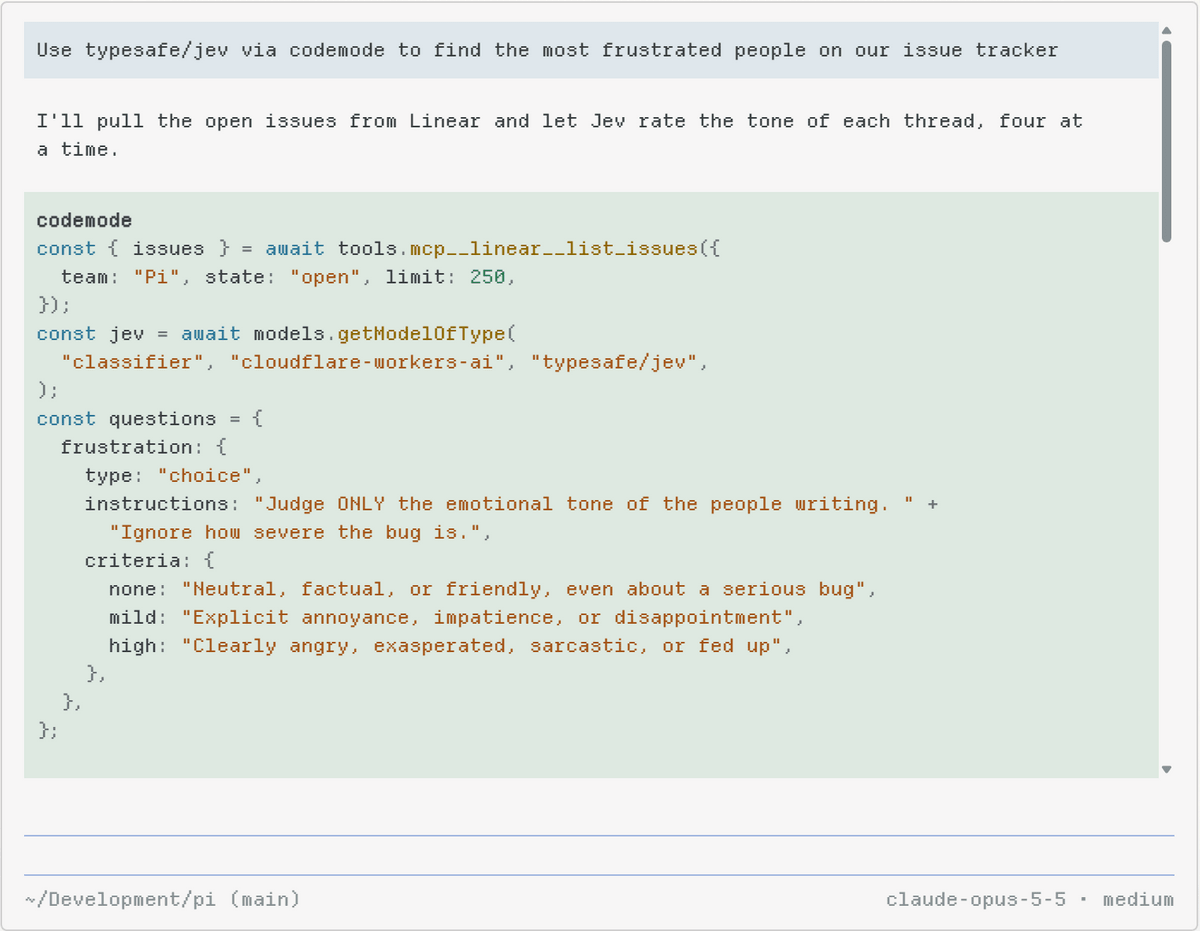
Furthermore, 'Deferred tool loading' has been added, eliminating the need to present all available tool definitions to the AI model from the start. By loading only the necessary tools later, the amount of information passed to the AI each time functionality is added does not increase significantly. This mechanism allows Pi to maintain its traditional characteristic of being a 'small harness' while increasing its functionality.
Pi 1.0 also features enhanced AI model selection capabilities. Pi supports over 15 providers, including Anthropic, OpenAI, Google, Amazon Bedrock, Mistral, xAI, Hugging Face, OpenRouter, and Ollama, and allows you to change the AI model being used even in the middle of a conversation.
The newly added 'virtual models' extension allows you to combine multiple AI models and treat them as a single model. In a demo released by Earendil, Pi itself is made to create a mechanism where Claude Opus is in charge of work planning, and when the classification model 'Jev' determines that the work has moved to the implementation phase, it hands over the processing to GPT.
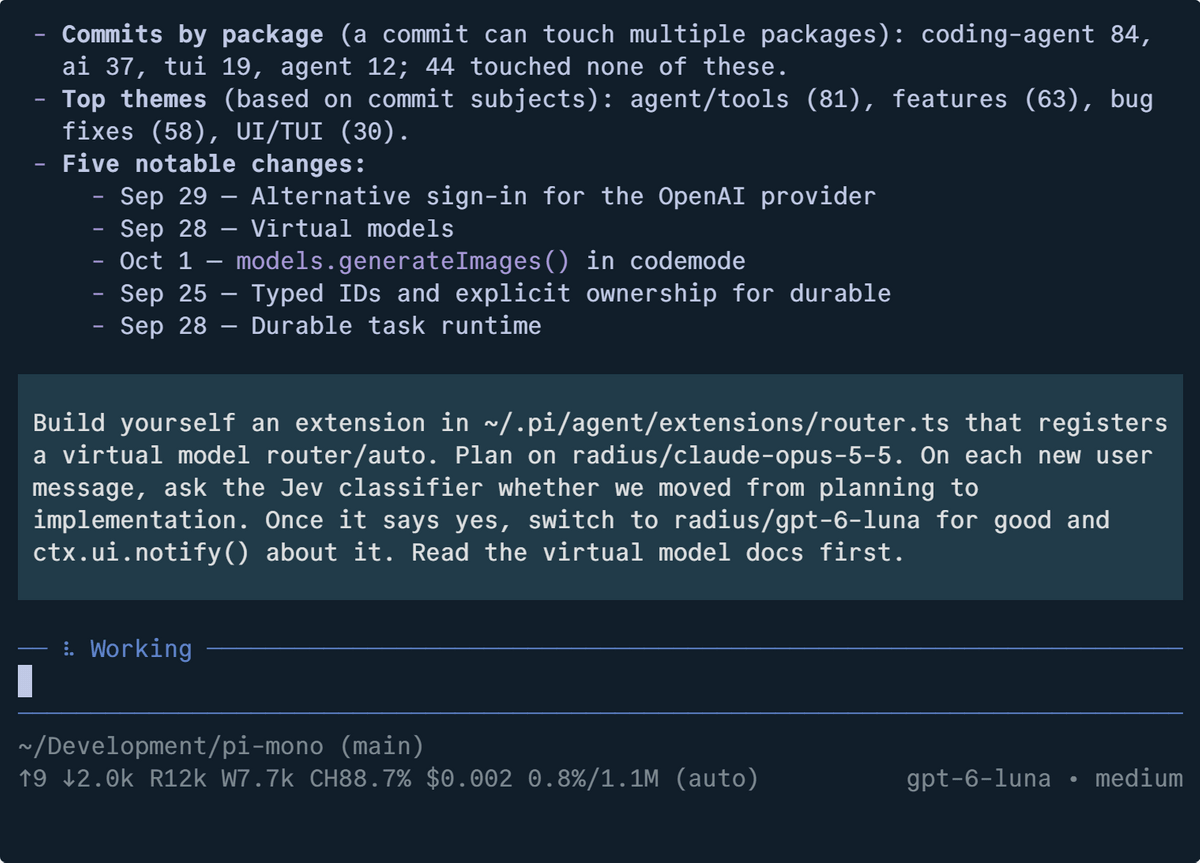
Pi 1.0 also adds several new features, including pre-caching to reduce waiting times when using Anthropic AI models, a mechanism to change system messages and available tools in the middle of a conversation, and new terminal screen themes. Furthermore, full-screen mode, which uses the terminal across the entire screen, is now the default.
Along with the release of Pi 1.0, an experimental package called 'Pi Durable' for building long-running AI agents has also been released. While the regular Pi is primarily used for coding on the terminal, when running AI for extended periods from chat services or servers, a mechanism is needed to allow conversations and tasks to resume even after the process has terminated. Pi Durable is being developed as a foundation for saving the work state and allowing processing to be resumed later.
Even as new AI agent-related features keep emerging, Earendil waits to adopt new features for the Pi until they prove truly useful, and develops them while considering the balance between the added complexity and the new features. Similarly, Pi Durable is being released as an experimental separate package rather than adding a large number of features to the Pi itself, and development will continue while gathering feedback from users.
Related Posts: