Aspirin, one of the most widely used drugs in the world, may significantly reduce the risk of dementia in some people.
Platelet count polygenic scores may modify the effect of aspirin in primary prevention of dementia - Fransquet - 2026 - Alzheimer's & Dementia - Wiley Online Library
https://alz-journals.onlinelibrary.wiley.com/doi/10.1002/alz.71817
Genetic analysis reveals potential benefit of aspirin for reducing dementia risk - Monash University
https://www.monash.edu/news/articles/genetic-analysis-reveals-potential-benefit-of-aspirin-for-reducing-dementia-risk
One of The World's Most Used Drugs May Lower Dementia Risk – But There's a Catch : ScienceAlert
https://www.sciencealert.com/one-of-the-worlds-most-used-drugs-may-lower-dementia-risk-but-theres-a-catch
Aspirin is used to relieve pain from headaches, arthritis, and injuries, and is also sometimes taken as an antiplatelet drug that inhibits platelet aggregation and prevents blood clot formation. Due to its antiplatelet effect, aspirin thins the blood, and in recent years, attention has been focused on its potential to prevent various diseases.
In this study, a research team led by Dr. Peter Franke of the Department of Public Health and Preventive Medicine at Monash University in Australia investigated the influence of individual genes on the dementia risk-reducing effect of aspirin. The study included participants in the ASPREE trial , a randomized, placebo-controlled trial that compared elderly individuals taking 100 mg of low-dose aspirin daily with a control group receiving a placebo.
The ASPREE trial participants spanned Australia and the United States, with most being over 70 years old at the start of the study, except for a minority group in the United States who were over 65 years old. Participants had no history of cardiovascular disease, dementia, physical disability, or other serious chronic illnesses at the start of the study.

The research team analyzed genetic data from more than 13,500 participants who gave their consent to investigate the association between aspirin use and the risk of dementia. During a median follow-up period of 4.6 years, 345 of the participants were newly diagnosed with dementia.
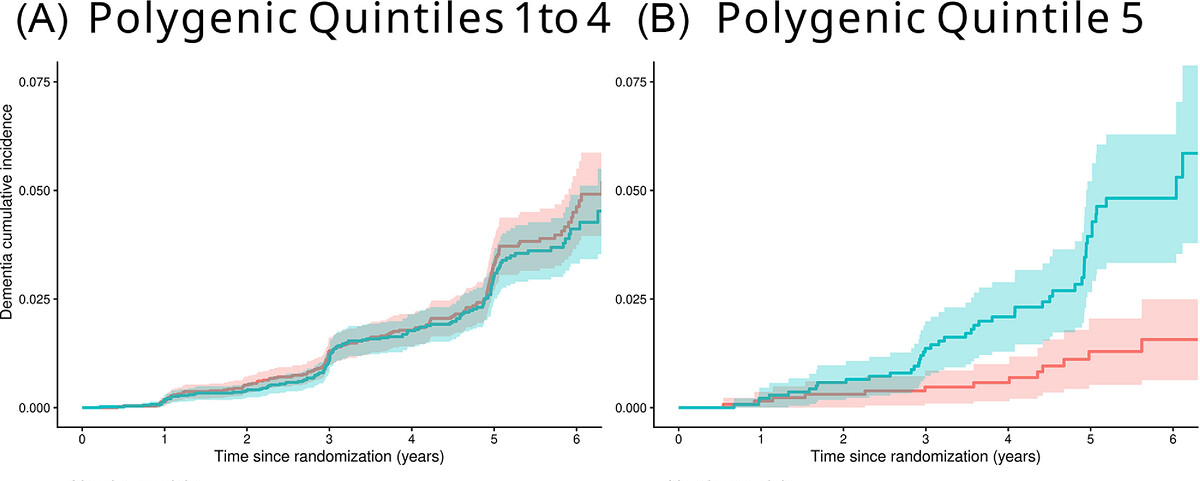
Analysis of the data revealed that subjects with a genetic profile associated with a high platelet count showed a greater reduction in the risk of dementia from taking low doses of aspirin.
Specifically, among the top 20% of subjects with a genetic profile that resulted in a high platelet count, the incidence of dementia was only 1% in the group that took aspirin, compared to 3.3% in the placebo group. This means that the group that took aspirin had a relatively 70% lower risk of developing dementia.
The graph below shows the number of dementia cases in the aspirin group (red) and the placebo group (blue) for subjects with a high platelet count and a low genetic profile (bottom 80%) on the left (A) and the high platelet count and a high genetic profile (top 20%) on the right (B). The vertical axis represents the cumulative number of dementia cases, and the horizontal axis represents the number of years. It can be seen that among the top 20% with a high platelet count genetic profile, the number of dementia cases decreased in the group that took aspirin.
However, it was also found that taking aspirin increased the risk of severe bleeding, possibly due to its blood-thinning effect. While 2.1% of the placebo group experienced severe bleeding during the follow-up period, 4.4% of those who took aspirin experienced severe bleeding.
Franke points out, 'Given the increased risk of serious bleeding, you should not start taking aspirin without consulting a doctor based on these findings to prevent dementia. These results need to be confirmed in other studies and ultimately validated in clinical trials involving people with this genetic profile.'
Nevertheless, these findings point to a promising path forward as dementia poses a significant public health risk worldwide. 'If these results are conclusive, the fact that aspirin is already inexpensive and widely available could make personalized dementia prevention a reality,' Franke said.
Related Posts:







in Free Member, Science, Posted by log1h_ik