People with autism may have the strength of being able to understand the feelings of other people with autism.

It is often thought that people with autism have difficulty understanding the feelings of others, but previous research has mainly focused on the ability of non-autistic people to read emotions. Research teams from Hebrew University in Israel and the University of Cambridge in the UK have now added the emotions of people with autism to their study subjects and compared the accuracy of emotion reading between people with and without autism.
Nuances of double empathy in autistic and non-autistic people: examination using the empathic accuracy paradigm | Molecular Autism
Autistic individuals might be somewhat better at reading emotions of other autistic people
https://www.psypost.org/autistic-individuals-might-be-somewhat-better-at-reading-emotions-of-other-autistic-people/
The idea that both people with autism and people without autism have difficulty understanding each other is called the 'double empathy problem.' This perspective posits that because people with and without autism perceive and communicate things differently, people without autism may not always be able to fully understand the feelings of people with autism.
A research team led by Yonat Lamb, affiliated with Hebrew University and Cambridge University, conducted an experiment to examine the dual empathy problem, in which participants watched videos of people sharing personal experiences and tried to infer the feelings of the narrators. A total of 235 people participated in the evaluation: 141 with autism and 94 without autism. The videos featured five people with autism and five people without autism sharing their experiences, and evaluators watched one video randomly selected from each group. The evaluators were not informed whether the narrators had autism or not.
The video narrators reviewed recordings of their experiences and used a slider, ranging from negative to positive, to evaluate how their feelings changed while they were speaking. The evaluators in the experiment also watched the videos and used the same slider to infer the narrators' feelings. The research team compared the evaluations from both parties, recorded every 0.5 seconds, to analyze how accurately the evaluators were able to track the changes in the narrators' feelings.
The analysis revealed no difference in overall performance between evaluators with and without autism. However, an additional analysis focusing on performance when viewing videos of narrators with autism showed that evaluators with autism were more accurate in interpreting emotional changes than evaluators without autism. On the other hand, when the narrator was not autistic, no difference in performance was observed based on whether the evaluator had autism or not.
The graph below shows the accuracy of interpreting the narrator's emotional changes. The horizontal axis represents narrators with autism on the left and narrators without autism on the right, with red representing the performance of evaluators with autism and light blue representing the performance of evaluators without autism. The vertical axis is the estimated mean of the 'correlation coefficient,' which indicates how similarly the narrator's own assessment and the evaluator's inference changed. A higher value indicates a more accurate interpretation.
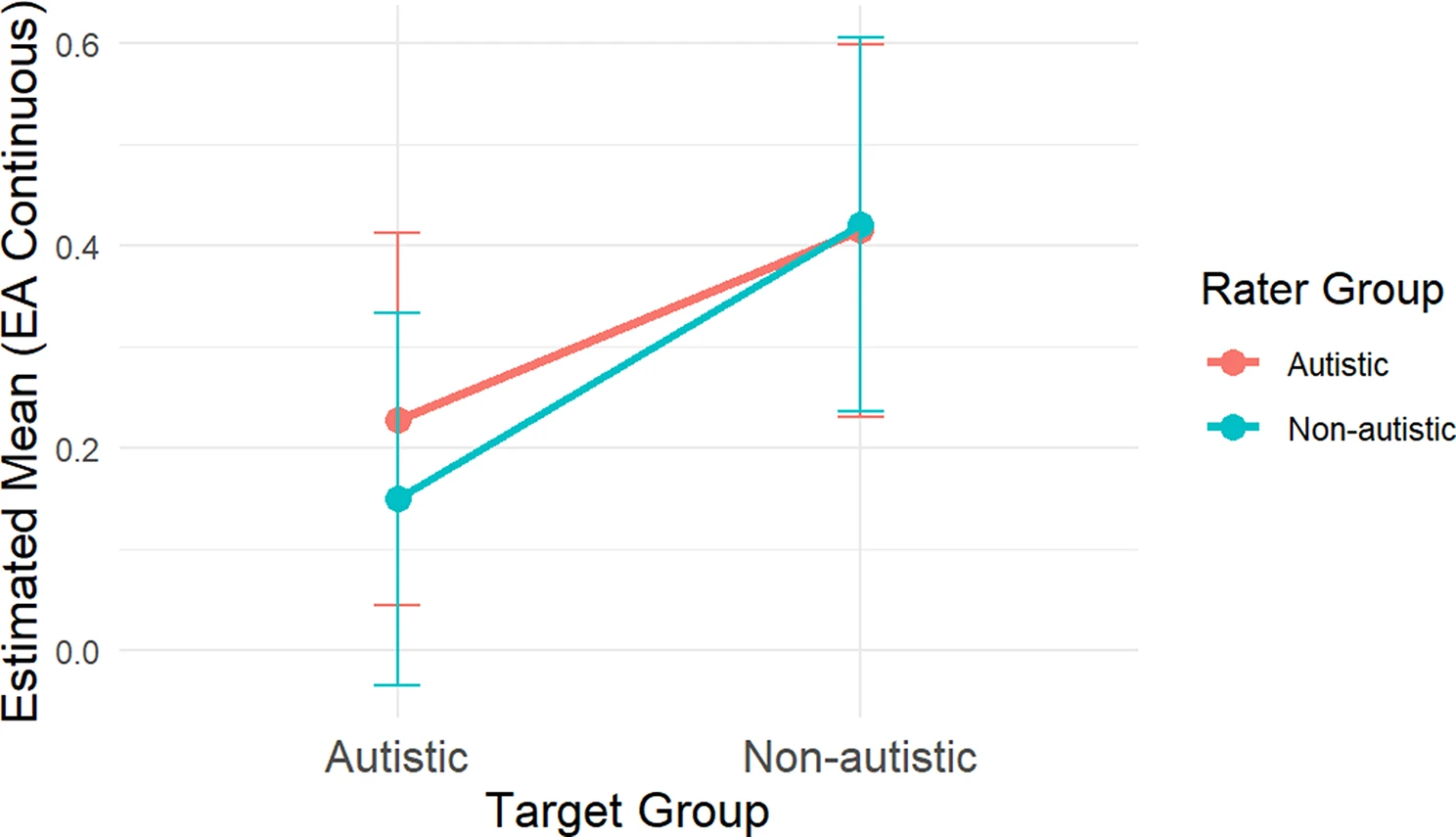
However, when comparing the performance of autistic and non-autistic evaluators, and comparing cases where the narrator was autistic versus those where they were not, no statistically significant difference was observed. Furthermore, there was no tendency for autistic evaluators to be better at understanding the feelings of autistic individuals than non-autistic individuals. The research team states that any advantages observed in additional analysis need to be interpreted cautiously.
Next, the research team analyzed the accuracy of interpreting 12 types of emotions, including joy, anger, and sadness. After watching videos of people sharing their experiences, the storytellers rated the intensity of the emotions they felt, and the evaluators rated the intensity of the emotions they thought the storytellers felt, on a scale of 0 to 8. When the 12 types of emotions were analyzed together, no difference in performance was found based on whether the evaluators had autism, whether the storytellers had autism, or whether the evaluators and storytellers had autism.
The graph below shows the accuracy of the evaluator's response on a scale of 0 to 100, where a higher score indicates that the evaluator's response is closer to the narrator's actual response. The vertical axis represents the estimated average score, with higher scores indicating a more accurate interpretation of emotions. The horizontal axis represents the narrator's classification, with red representing evaluators with autism and light blue representing evaluators without autism.
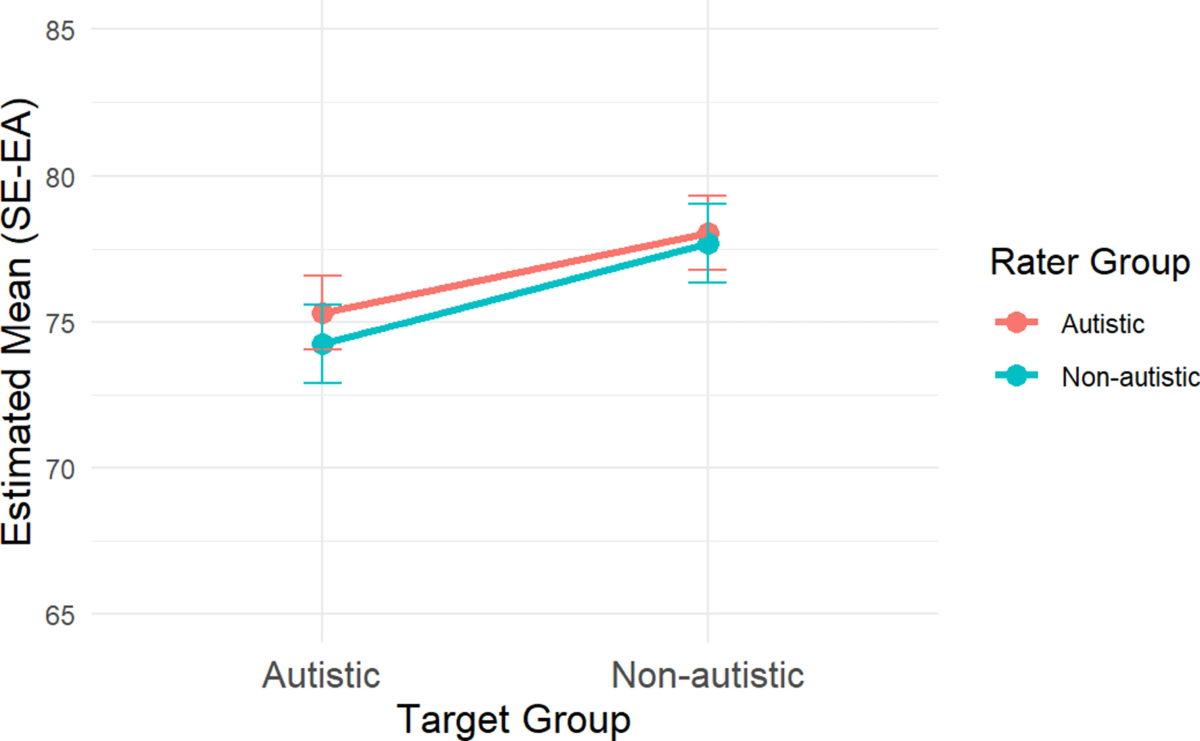
Regardless of whether or not the narrator had autism, there were significant differences in how easily emotions could be interpreted depending on the narrator. The research team believes that not only the characteristics of the person interpreting the emotions, but also the characteristics of the narrator, such as their speaking style and how they express emotions, may be related to the accuracy of the interpretation, and states that these results partially support the 'double empathy problem.'
Related Posts:








in Science, Posted by log1b_ok