By 2050, a large number of people living in poverty may have to spend half of their income on food.

In recent years, food prices have been on the rise globally due to factors such as damage to agriculture caused by
Identifying Key Uncertainties and Drivers of Future Resource Security Outcomes Through a Multisector Scenario Ensemble - Kim - 2026 - Earth's Future - Wiley Online Library
https://agupubs.onlinelibrary.wiley.com/doi/10.1029/2025EF007585
Study predicts large disparities in access to food, water, and energy in 2050 | MIT News | Massachusetts Institute of Technology
https://news.mit.edu/2026/study-predicts-large-disparities-access-food-water-energy-2050-0908
Millions Could Spend Half Their Income on Food by 2050, Scientists Warn : ScienceAlert
https://www.sciencealert.com/millions-could-spend-half-their-income-on-food-by-2050-scientists-warn
A research team led by MIT energy researcher Jennifer Morris conducted a study predicting what future access to essential resources such as food, water, and energy will look like. While various studies have been conducted on resource security, most analyses are based on a global perspective, and few have specifically explored differences based on different regions of the world or income levels.
To conduct a more detailed and comprehensive analysis in this study, we used a large-scale computer model called the Global Change Analysis Model (GCAM) . GCAM models how energy, water, land, socioeconomics, and the global ecosystem will change in response to various future uncertainties. GCAM divides the world into 32 geopolitical regions, and within each region, it is classified into 10 subgroups based on income distribution.
The research team ran simulations for 3,735 different scenarios using 12 key variables related to resource availability, including population, GDP, income distribution, carbon intensity (carbon dioxide emissions per specific economic activity or industrial process) , land use, agricultural trade, energy consumption scenarios, and water use forecasts. They analyzed the potential fluctuations in resource availability that could occur by 2050.
The analysis revealed significant regional differences in the availability of food, water, and energy in 2050. Food security is expected to be most severe in sub-Saharan Africa by 2050, while energy security is likely to become a serious issue, particularly among low-income groups, in parts of Asia, Eastern Europe, and the Middle East. Furthermore, even within the same regions, resource security varies considerably depending on income.
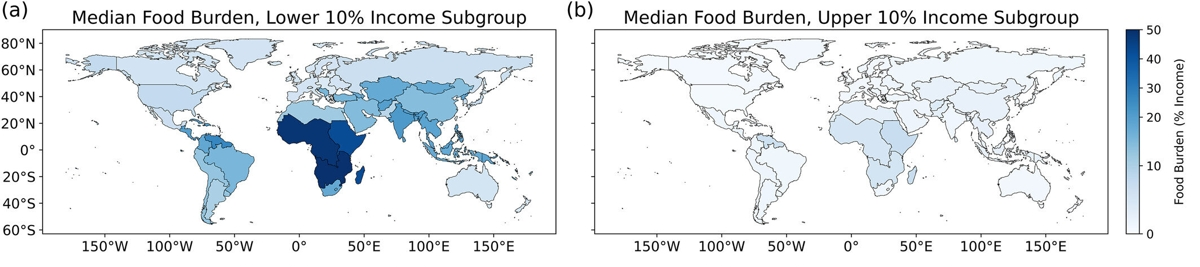
Based on the median values obtained from 3,735 hypothetical scenarios, by 2050, the proportion of income that must be spent on food will reach 48.4% for the poorest 10% of income earners in West Africa, 42.5% for the poorest in East Africa, and 49.6% for the poorest in Southern Africa.
These results are attributed to land being used for decarbonization measures such as bio-crops and afforestation, leading to soaring food prices. The fact that climate change measures that drive up food prices also impact resource security illustrates how difficult it is to balance the problem with the solution.
On the other hand, it has also been shown that resource availability varies greatly depending on income, even within the same region. For example, in Southern Africa, by 2050, the poorest may have to spend 49.6% of their income on food, while the wealthiest may only need to spend 5.5% on food.
The map below shows the 'percentage of income that may have to be spent on food' in 2050. (a) represents the bottom 10% of the poorest people in each region, and (b) represents the top 10% of the richest people in each region. The darker the blue, the closer the percentage of income spent on food is to 50%. In particular, the poorest people in Africa, Asia, and Oceania have to spend a large portion of their income on food, while the richest people have almost no such burden.
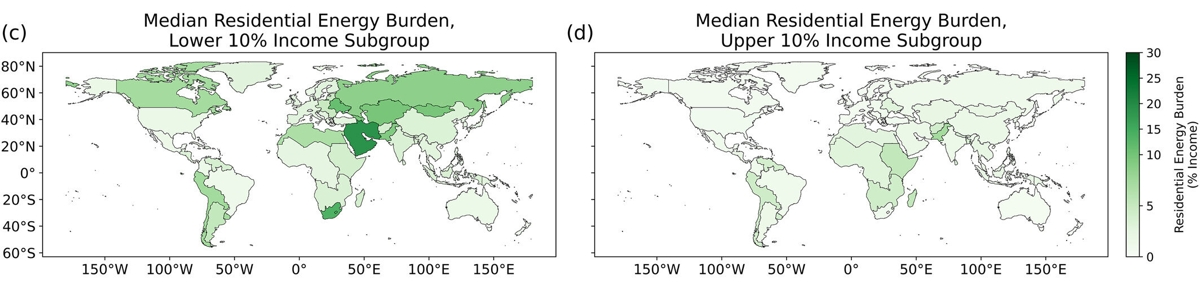
The following map shows the 'percentage of income that may have to be spent on energy for housing' in 2050. (c) represents the bottom 10% of the poorest people in each region, and (d) represents the top 10% of the wealthiest people in each region. The darker the green, the closer the percentage of income spent on energy is to 30%. In particular, it can be seen that the burden on the poorest people is heavy in Eastern Europe and the Middle East, while the burden on the wealthiest people is relatively light.
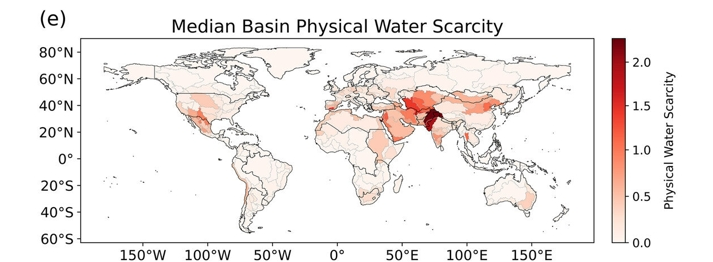
The map below shows the severity of physical water scarcity in 2050, with darker red indicating a more severe shortage. The map particularly highlights the severity of water scarcity in South Asia and the Middle East.
Morris points out the problems with increasing food expenses, stating, 'Spending that accounts for half of your income can destabilize your entire life because it leaves little to no resources for other important needs or basic necessities.'
'This study shows that there is no single factor that will cause future food, energy, and water security crises. Income is important, but all of these factors—local conditions, land use, energy systems, water resource availability, and consumer behavior—influence the risks people face,' said Giju Kim, the lead author of the paper and an environmental engineer at Tulane University.
Related Posts:





in Free Member, Science, Food, Posted by log1h_ik