It has been discovered that marine life has mitigated the effects of a methane gas leak on the seabed caused by humans.
In 2018, natural gas drilling surveys were conducted in
Rapid de novo assembly of animal-microbe biofilter to mitigate seabed methane leakage | National Science Review | Oxford Academic
https://academic.oup.com/nsr/article/13/12/nwag266/8678209
New Study: Deep-Sea Methane Filter Develops Faster Than Previously Thought - Research in Germany
https://www.research-in-germany.org/idw-news/en_US/2026/9/2026-09-03_New_Study__Deep-Sea_Methane_Filter_Develops_Faster_Than_Previously_Thought.html
Scientists Accidentally Caused a Methane Leak Beneath The South China Sea. Ocean Life Sealed It Almost Instantly. : ScienceAlert
https://www.sciencealert.com/drilling-accidentally-created-a-methane-leak-beneath-the-south-china-sea-within-a-year-animals-helped-plug-it
Methane, the main component of natural gas, is abundantly stored in seabed sediments as gas hydrates , in which the gas is trapped within the molecules. In 2018, as part of a natural gas resource survey conducted by the Geological Survey of China, a borehole was drilled at a depth of 1766m in the South China Sea.
The hole was 22 cm in diameter and was sealed with mud after samples were taken, but in 2019 it was discovered that methane gas was erupting from this hole. From 2019 to 2020, the methane gas plume reached a height of approximately 1200m from the seabed. From 2018 to 2023, a research team from the University of Bremen in Germany investigated the sea area affected by the methane gas leak, using underwater cameras, acoustic equipment, chemical sensors, sediment sample collection, and genetic analysis.
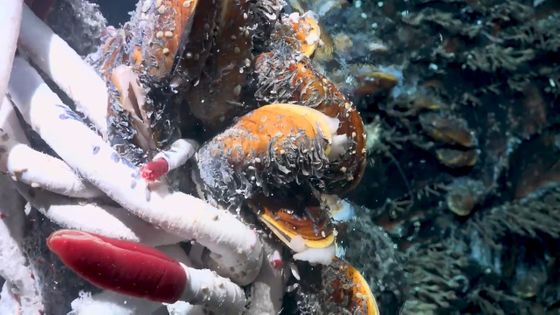
The ocean floor is home to microorganisms and animals that can survive by consuming methane even in oxygen-free environments, forming ecosystems around naturally occurring methane seeps. These ecosystems consume methane and function as a kind of 'biofreaker' to prevent its spread, but they grow very slowly. For this reason, scientists had predicted that it would take several decades or more for the artificially created methane leak to subside.
However, the investigation revealed that a methane seep ecosystem is forming at the site of the methane leak at a much faster rate than previously predicted. In the initial stages, the number of methane-consuming microorganisms is doubling approximately every 21 to 38 days, which is significantly faster than the previous prediction of 100 to 200 days. Emil Raff, a marine ecologist at the University of Bremen and a member of the research team, commented, 'An effective methane-consuming ecosystem had already formed in just one to two years.'
As the number of methane-consuming microorganisms increased, polychaete worms, which burrow into the seabed, began to establish themselves. By burrowing, these worms stirred up the sediment to a depth of more than 50 cm, which transported nutrients such as oxygen, nitrates, and sulfates to deeper layers. Following the polychaete worms, crustaceans also began to establish themselves, and it has been reported that microorganisms and animals worked together to contribute to methane decomposition.
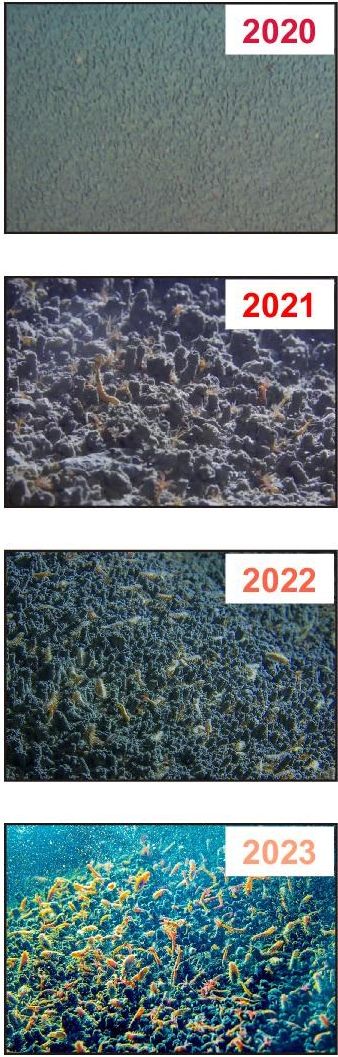
The following images show the seabed at the methane leak site, taken between 2020 and 2023. While no polychaete worms were observed in 2020, it is clear that a large number of polychaete worms had established themselves by 2023.
In the methane gas leaks investigated in this study, methane decomposition became possible with the same efficiency as older, similarly sized methane seeps, within just a few years. As biofilters developed, methane gas emissions into the ocean decreased, and the methane plume, which reached a height of approximately 1200m above the seabed in 2019-2020, had fallen to approximately 800m above the seabed by 2023.
However, the formation of biofilters to mitigate methane gas leaks came at the cost of significantly altering the original ecosystem. Within a 20-meter radius of the methane gas leak, the diversity of bacteria and other microorganisms decreased by more than 50% within two years. Even at a distance of 500 meters, an increase in methane concentration and a decrease in microbial diversity of more than 30% were observed.
These research findings are important for more accurately assessing the impact of ocean warming and methane leaks caused by human activities. ScienceAlert, a science media outlet, stated, 'While the impact of methane as a greenhouse gas in the atmosphere is becoming increasingly clear through extreme weather events, its impact on deep-sea ecosystems is only just beginning to become apparent.'
Related Posts: