Research suggests that the tendency for people with lower household incomes to be single is stronger in individualistic countries.

Whether someone is single or not may be related not only to their age and income, but also to the culture of the country they live in. A research team from the University of Wrocław and Adam Mickiewicz University in Poland examined data from 71,169 people in 59 countries and found that the relationship between household income and single status differs depending on whether the country is individualistic or collectivist.
Sociodemographic and cultural factors are related to singlehood rates: A multilevel analysis across 59 countries from the World Values Survey | PLOS One
Individualism and income appear to shape relationship status across 59 countries
https://www.psypost.org/personal-demographics-and-cultural-values-jointly-predict-singlehood/
The proportion of single people is increasing in many countries in Europe and Asia, as well as in the United States and Canada. While previous studies have reported that personal factors such as age, education level, and financial stability are related to being single, it has not been well understood how the relationship between age, income, and singleness varies depending on the culture of the country in which one lives.
The research team therefore analyzed responses from the 7th World Values Survey , conducted from 2017 to 2021, which surveys people's attitudes and living conditions in various countries around the world. The survey included 71,169 people aged 18 and over living in 59 countries. Regarding marital status, those who were married or in common-law marriages were classified as 'having a partner,' and those who answered that they were single or unmarried were classified as 'single.' Those who were divorced, separated, or widowed were excluded from the main analysis. In addition, age, gender, size of the town they lived in, education level, household income, and unemployment status were also analyzed. For household income, respondents themselves selected where their combined household income (salary, pension, etc.) fell on a 10-point scale, with '1' representing the lowest income bracket and '10' representing the highest income bracket in their country of residence.
Two existing country-specific scores were used to compare the cultures of the countries of residence. The first score, 'Individualism-Collectivism,' is an index that represents either 'individualism,' which emphasizes individual freedom and autonomy, or 'collectivism,' which emphasizes tradition and the group. In the country-specific scores used in the analysis, countries such as Germany and Australia were positioned more towards individualism, while countries such as Bangladesh and Indonesia were positioned more towards collectivism.
The second score, 'Flexibility-Monumentalism,' is an index that contrasts 'flexibility,' which involves changing one's thinking and actions according to the situation and exercising self-control for long-term goals, with 'monumentalism,' which values one's unchanging self, pride, and immediate satisfaction. The paper cites East Asia as an example of a more flexible group, and Latin America, Africa, and the Arab world as examples of a more monumental group. However, neither of the country-specific scores measures individual values, and all respondents from the same country are assigned the same score.
The analysis revealed that when examining the relationship between household income and the proportion of single people by country's culture, in individualistic countries, the estimated proportion of single people, when adjusted for conditions other than household income such as age and gender, was approximately 42% in the lowest income bracket but fell to approximately 14% in the highest income bracket. On the other hand, in collectivist countries, both the lowest and highest income brackets were around 6-7%, and no relationship with household income was confirmed. The following graph shows the results of the individualism-collectivism analysis, with the horizontal axis representing household income brackets, the vertical axis representing the estimated proportion of single people, red representing collectivist countries, and light blue representing individualistic countries.
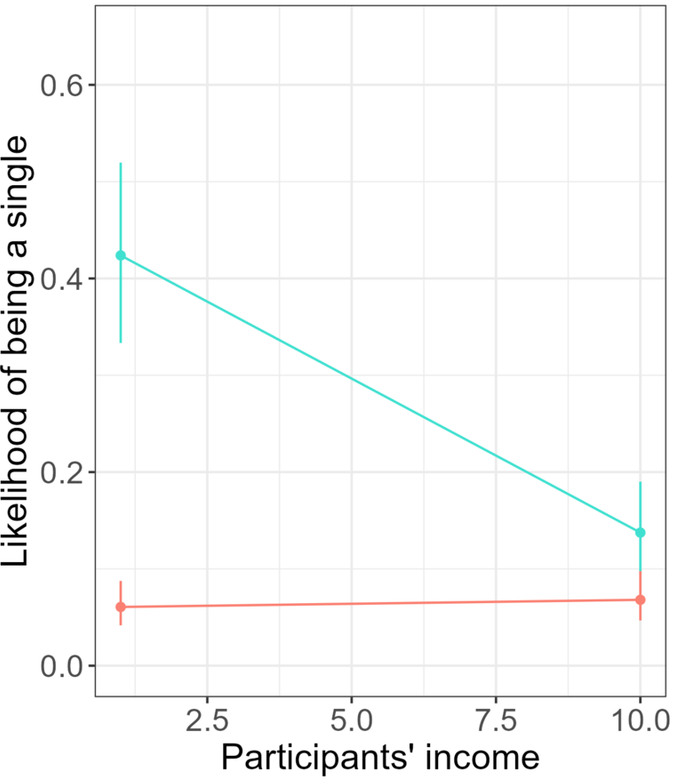
Regarding the 'flexibility-monumentalism' indicator, it was found that the relationship between household income and the proportion of single people did not differ depending on the country's position in the world.
The research team hypothesizes that in individualistic countries, young people are more likely to be expected to be financially independent before entering into serious relationships, and therefore, low income or unemployment may make it difficult to move in with a partner or get married. However, the degree to which the relationship between household income and single status differs depending on whether a country is more individualistic or collectivist was small, almost negligible.
This study did not continuously track the same individuals, but rather analyzed household income and marital/cohabitation status at the time they responded to the World Values Survey. Therefore, it cannot determine a causal relationship between low household income and singlehood, or whether being single influences household income. The research team concluded that to understand the reasons for the increase in singlehood, it is necessary to consider not only individual attributes but also the society and culture in which they live.
Related Posts:








in Science, Posted by log1b_ok