Components found in citrus fruits such as oranges and lemons may 'rejuvenate the liver.'
Hesperetin activates the Hmgcs2-Pparα-Cisd2 signaling axis and delays liver aging | npj Aging
https://www.nature.com/articles/s41514-026-00479-2
A Molecule Found in Citrus Fruits Could Be a Secret Weapon to Rejuvenate The Liver : ScienceAlert
https://www.sciencealert.com/a-molecule-found-in-citrus-fruits-could-be-a-secret-weapon-to-rejuvenate-the-liver
A research team led by molecular biologist Chao Ching-hsien of National Yang-Ming Chiao Tung University in Taiwan conducted experiments to investigate the pharmacological effects of hesperetin , a natural flavonoid found in citrus fruits such as lemons, limes, and oranges.
Hesperetin is known to have anti-inflammatory, anti-aging, and neuroprotective effects, and it has been found to activate the expression of the CISD2 gene, which is associated with longevity. While a deficiency in the CISD2 gene promotes fatty liver disease and hepatocellular carcinoma, increased expression of the CISD2 gene is said to maintain a youthful metabolic profile and reduce age-related liver dysfunction.
In their paper, the research team states, 'Of particular note is that CISD2 gene expression declines with age. Restoring CISD2 gene expression could be a promising strategy to slow liver aging and prevent age-related liver disease.'
To test the hypothesis that administering hesperetin keeps the liver youthful, the research team divided 21-month-old mice into two groups: one group received hesperetin for five months, and the other was a control group received an inactive substitute for five months.
When the livers of mice that had completed administration and reached 26 months of age were examined, the expression level of the CISD2 gene was significantly reduced in the control group, but in the experimental group that received hesperetin daily, the expression level of the CISD2 gene was at the same level as that of young mice that were 3 months old.
Furthermore, several markers indicating liver aging and functional decline, such as fat deposition, stem cell damage, and inflammation, were also reduced. The research team stated, 'Together, these results indicate that hesperetin intake reduces pathological damage to the liver and slows liver aging in aged mice. This effect is closely related to an increase in the expression level of the CISD2 gene.'
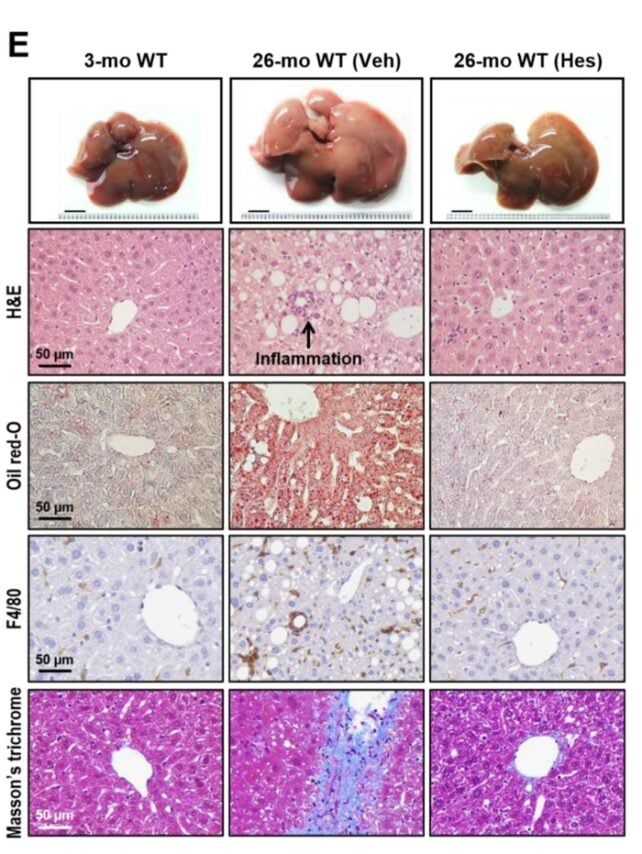
The images below compare the livers of three-month-old mice (left), control mice (middle), and experimental mice (right), all 26 months old. Comparing their appearance and microscopic images, it can be seen that the experimental group's livers are more similar to the livers of three-month-old mice than the control group's livers.
Another experiment showed that mice genetically engineered to lack the CISD2 gene in major functional liver cells did not respond to hesperetin administration. This result suggests that the action of hesperetin in mouse stem cells is primarily dependent on the CISD2 gene.
Furthermore, the research team discovered that hesperetin increases the expression level of the CISD2 gene through a signaling pathway involving two proteins, HMGCS2 and PPARα .
Furthermore, analysis of samples taken from 80 patients who underwent surgery for liver cancer or benign tumors has revealed that the expression of PPARα and CISD2 genes also decreases with age in human liver tissue. The discovery that the decrease in CISD2 gene expression levels observed in mice also occurs in humans suggests that the rejuvenating effects of hesperetin may also be obtainable in the human liver.
The research team stated, 'Together, these findings provide strong evidence that hesperetin is a potent anti-aging treatment for the liver. This lays the foundation for future clinical interventions using hesperetin as a potent CISD2 gene activator and as a functional food extracted from citrus peels.'
Related Posts:





in Science, Posted by log1h_ik