'Qwen3.8-27B,' a locally runnable version, has been released for free, and it surpasses the Claude Opus 4.6 Max in some benchmarks.
Alibaba's Qwen team has released ' Qwen3.8-27B, ' an AI model with 27 billion parameters. The model's weights are released under the Apache License 2.0, and commercial use is permitted under certain conditions. While it is an open-weight model that can be installed on any PC, some performance tests have reported it outperforms Anthropic's high-performance model, ' Claude Opus 4.6 Max .'
We promised open weights for Qwen3.8. Now, time to meet them! 🎉
— Qwen (@Alibaba_Qwen) August 14, 2026
⚡ Qwen3.8-27B:
- A native multimodal dense model. With just 27B parameters, it outperforms Qwen3.7-Plus overall and shines in real-world coding & office workflows.
- 262K native context, easily extendable to 1M… pic.twitter.com/QuN8oWkG4C
The Qwen3.8 series was announced for release in July 2026, with the 'Qwen3.8-Max-Preview' version, featuring 2.4 trillion parameters, initially becoming available. Alibaba then announced the official version, 'Qwen3.8-Max,' in August. Qwen3.8-Max is a model that emphasizes software development and long-term autonomous work, boasting capabilities such as working for over 125 hours to reproduce and improve research papers and continuing software development for 16 days without human intervention.
Alibaba announces the open model release of 'Qwen3.8,' a large-scale model with 2.4 trillion parameters, boasting 'performance second only to Claude Fable 5' - GIGAZINE
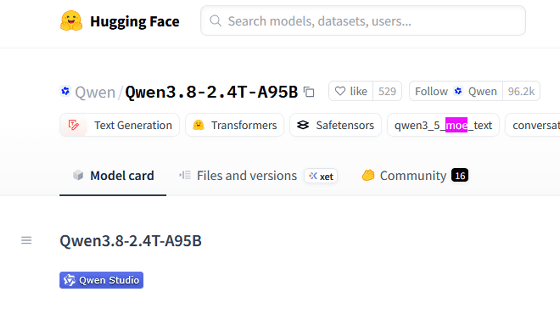
Furthermore, Alibaba has also released the model data for 'Qwen3.8-2.4T-A95B,' which served as the basis for Qwen3.8-Max, free of charge. Qwen3.8-2.4T-A95B boasts a massive 2.4 trillion parameters, but employs a 'Mixture-of-Experts (MoE)' method that only moves a portion of them depending on the processing task, meaning only 95 billion parameters are used during inference. Even so, a data center-level computing environment is required to run it.
Chinese AI 'Qwen3.8' with 2.4 trillion parameters released as an open model for free, boasting performance comparable to cutting-edge models from OpenAI and Anthropic - GIGAZINE
Even if a high-performance open model is released, it will be difficult for individuals or small development environments to run it if it requires enormous computing resources. That's why the Qwen team announced Qwen3.8-27B, which reduces the number of parameters to 27 billion, when they released Qwen3.8-Max.
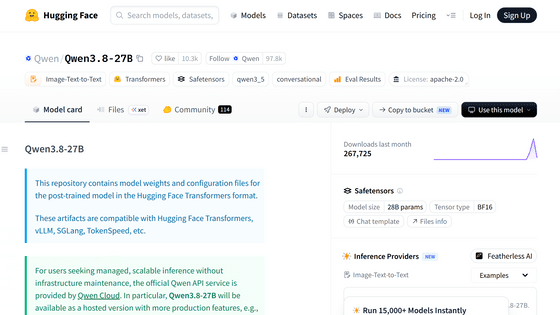
Qwen3.8-27B is a Dense model that utilizes the entire model during inference, rather than a MoE model that only runs the necessary parts. The Qwen team describes it as a 'compact and easily deployable model.' The model data is released under the Apache License 2.0 and can be used with Hugging Face Transformers, as well as vLLM, SGLang, and Docker Model Runner, which are used to run AI models at high speed. An FP8 quantized version to reduce size and computational load is also officially available.
Qwen/Qwen3.8-27B · Hugging Face
https://huggingface.co/Qwen/Qwen3.8-27B
Qwen3.8-27B also offers improved performance compared to Qwen3.6-27B, which has the same 27 billion parameters. The following is an excerpt of the main benchmark results released by the Qwen team. The highest score among the three models listed is shown in bold. Qwen3.8-27B outperformed Claude Opus 4.6 Max in SWE-bench Pro, which measures software development capabilities, and CoWorkBench, which measures long-term work performance. On the other hand, Claude Opus 4.6 Max outperformed in Terminal Bench 2.1 and GPQA Diamond, which measures scientific inference capabilities.
| Qwen3.8-27B | Qwen3.6-27B | Claude Opus 4.6 Max | |
|---|---|---|---|
| Coding in the terminal Terminal Bench 2.1 | 73.0 | 63.4 | 78.2 |
| Software Development SWE-bench Pro | 61.7 | 53.5 | 53.4 |
| Performing long hours of work CoWorkBench | 70.7 | 61.0 | 68.2 |
| Following instructions IFBench | 79.5 | 69.1 | 62.5 |
| Reasoning in the field of science GPQA Diamond | 89.2 | 87.8 | 91.3 |
Qwen3.8-27B is a multimodal model that can handle not only text but also images and videos. Designed as a Vision-Language model that can handle images and videos as standard, it allows you to operate a PC or smartphone while viewing the screen, and to read documents and scientific diagrams.
It can understand long videos and can handle videos up to several hours long. The standard context length is 262,144 tokens, and with extension technology, it can support up to 1 million tokens.
The main multimodal-related benchmarks are as follows:
| Qwen3.8-27B | Qwen3.6-27B | Claude Opus 4.6 Max | |
|---|---|---|---|
| PC operation OSWorld - Updated | 84.3 | 63.9 | 72.7 |
| Smartphone operation AndroidWorld | 81.9 | 70.3 | 62.0 |
| Software development including images SWE-MM | 38.6 | 25.7 | 27.1 |
| Understanding diagrams and charts in the scientific field CharXiv (RQ, Without CI) | 83.7 | 78.4 | 66.0 |
| Document comprehension OmniDocBench 1.5 | 91.1 | 89.4 | 86.6 |
Support for local execution environments has been progressing since its release. LM Studio states that at least 17GB of RAM is required for the minimum quantization version, and Qwen3.8-27B can also be used with Ollama.
Qwen3.8-27B is here! 🚀
— LM Studio (@lmstudio) August 14, 2026
It's a leap in capabilities for a laptop size model.
Requires ~17GB to run locally.
Model page: https://t.co/GOxQEOLrdK https://t.co/3RHoQ7gvPG pic.twitter.com/g06nqgOXdB
AMD has also reported that it will work with PCs equipped with Ryzen AI Max+ and Radeon AI PRO R9700 with 32GB of VRAM.
Qwen3.8 27B brings a new state-of-the-art dense model for local AI development.
— AMD (@AMD) August 14, 2026
⚡ Run it on AMD Ryzen™ AI Max+ processors or single Radeon™ AI PRO R9700 card
⚡ Experience it with @LMStudio
⚡ Turn it into an app with @lemonade_server
Start building with AMD Day 0 support for… pic.twitter.com/NbFFhA2BAD
According to tests by SGLang, using a GeForce RTX 5090 and Qwen3.8-27B with optimizations such as NVFP4 applied, the decoding speed reached 206.1 tokens per second.
The king of small models is back! Qwen3.8-27B from @Alibaba_Qwen is open source, and Day-0 support is live in SGLang:
— SGLang (@sgl_project) August 14, 2026
- 206.1 tok/s decode on a single RTX 5090, with our NVFP4 plus DSpark
- 38.28 tok/s decode on DGX Spark
Qwen3.8-27B raises the bar again for what a small model… https://t.co/RhrGXNHDRj pic.twitter.com/q6yax5Z5nR
Qwen3.8-27B also supports Thinking Mode, which allows for inference before answering, and the amount of inference can be adjusted in three stages: 'xhigh,' 'medium,' and 'low.' The Qwen team plans to offer a hosted version of Qwen3.8-27B on Qwen Cloud in the future, which will include a context length of 1 million tokens and official built-in tools as standard.
Related Posts:



in AI, Posted by log1d_ts