Research shows that exercising once a week can reduce body fat in almost the same way as exercising three times a week.

For people who can't find time to exercise multiple times a week due to work or household chores, it's natural to wonder if exercising all at once in one day can have the same effect as exercising multiple times a week. A research team led by Parco Siu of the University of Hong Kong has reported the results of their investigation into whether there is a difference in the amount of body fat reduction when high-intensity interval training (HIIT) consisting of 75 minutes of brisk walking is done once a week versus when it is spread out three times a week.
Once and thrice weekly interval training in adults with central obesity: a randomized controlled trial | Nature Communications
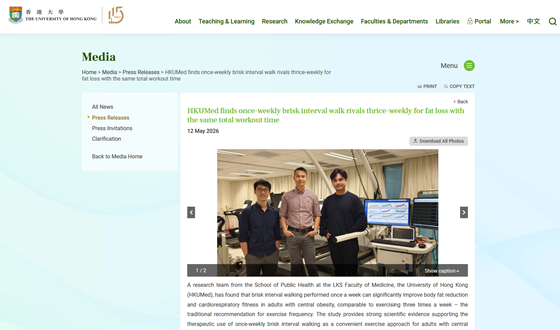
HKUMed finds once-weekly brisk interval walk rivals thrice-weekly for fat loss with the same total workout time - Press Releases - Media - HKU
https://www.hku.hk/press/press-releases/detail/29105.html
This once-a-week workout may help cut belly fat, study shows | ScienceDaily
https://www.sciencedaily.com/releases/2026/08/260801042831.htm
HIIT, which alternates between high-intensity exercise and low-intensity recovery exercise, is generally recommended three times a week for obesity management. While previous studies have shown that 'weekend warriors,' who condense their weekly exercise into one or two days, may also have health benefits, no trials have directly compared once-weekly versus three-times-weekly HIIT.
The research team conducted a trial from September 2021 to September 2024 with 315 Chinese adults aged 18 and over living in Hong Kong. All participants had not exercised regularly in the previous three months, were overweight, and had central obesity (fat accumulation mainly around the abdomen), with an average age of 48.2 years. Participants were randomly divided into three groups of 105 each: one group that performed HIIT once a week, one group that performed HIIT three times a week, and one group that received 2 hours and 30 minutes of health education every two weeks.
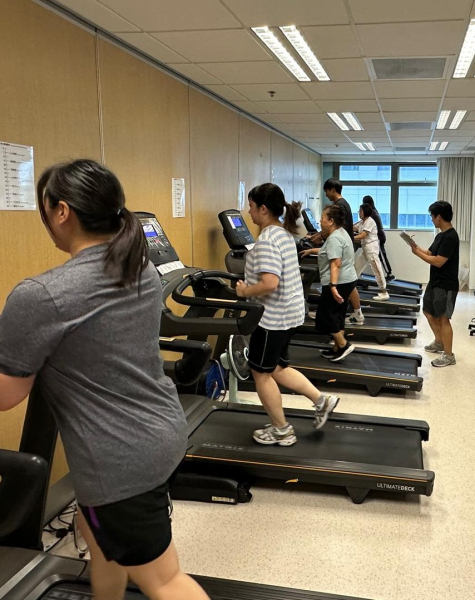
Participants assigned to the HIIT group performed a 25-minute workout consisting of four 4-minute brisk walks on a treadmill, interspersed with 3-minute recovery walks. The once-a-week group performed the 25-minute workout three times on the same day with 15-30 minute rest periods in between, while the three-times-a-week group performed it once on separate days. Both groups continued 75 minutes of HIIT per week for 16 weeks.
After 16 weeks, body composition measurements revealed that the average difference in body fat mass compared to the group that received health education was -0.8 kg in the once-weekly group and -1.0 kg in the three-times-weekly group. The relative change in body fat mass from the start was a 2.6% decrease in the once-weekly group and a 3.5% decrease in the three-times-weekly group, while the group that received health education saw a 0.2% increase. No statistically significant difference in body fat mass was observed between the once-weekly and three-times-weekly groups.
Furthermore, the group that performed HIIT showed a decrease in body fat percentage and waist circumference compared to the group that received health education, and their cardiovascular function also improved.
The research team cited the fact that the participants were Chinese adults with relatively good blood glucose, lipid, and blood pressure levels as a limitation of this study, and stated that further testing is needed to determine whether similar results can be obtained in people with metabolic diseases such as type 2 diabetes or in other ethnic groups. However, they concluded that 'weekly HIIT can be considered a feasible and effective option.'
in Science, Posted by log1b_ok