How much longer can plants survive on Earth?
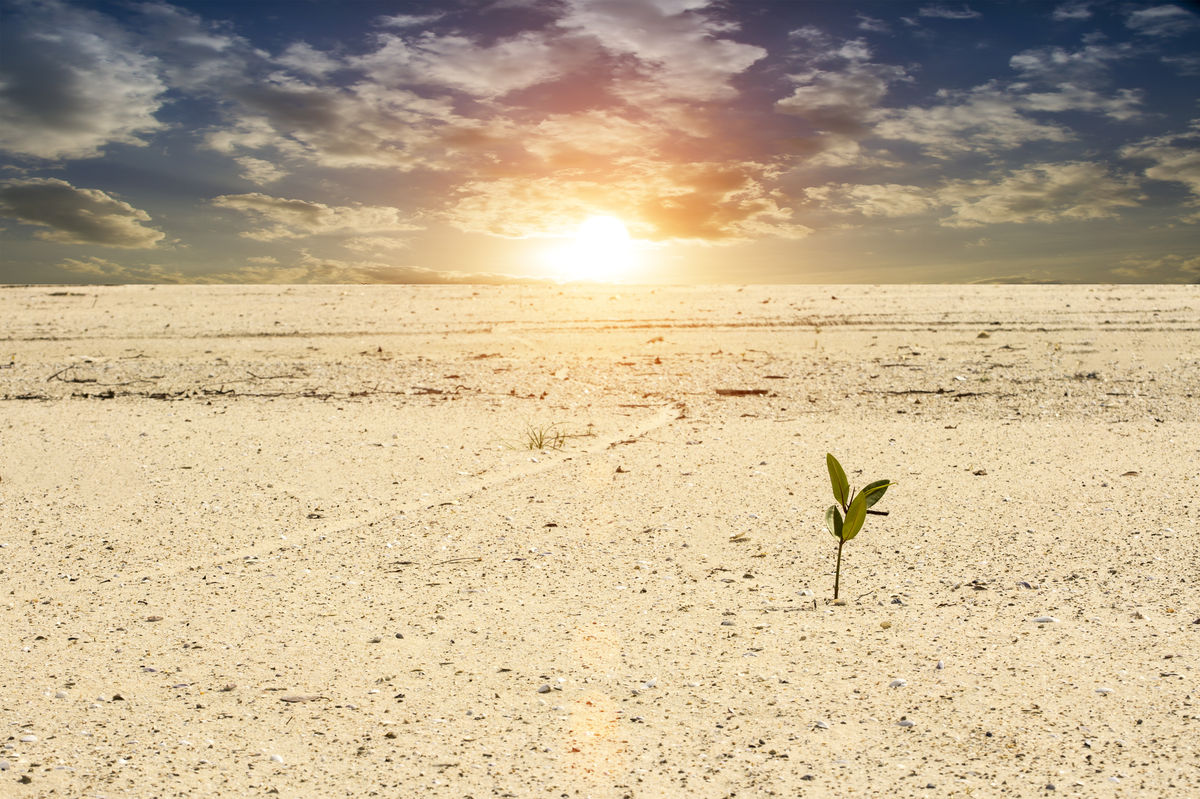
Plants are essential for supporting the lives of animals on Earth, but they may become extinct due to changes in temperature and other factors. Researchers have predicted when this extinction might occur.
Maximum Lifetime of the Vegetative Biosphere - Haqq‐Misra - 2026 - Journal of Geophysical Research: Atmospheres - Wiley Online Library
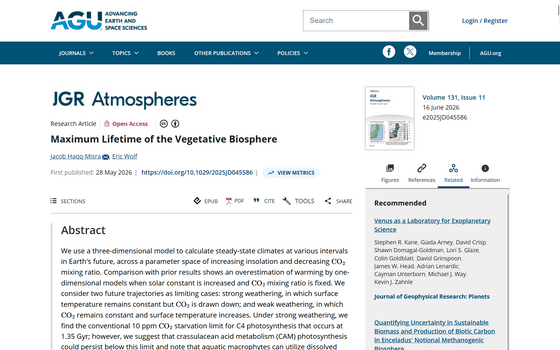
How long can plants survive on Earth? New model suggests up to 2 billion more years
Factors that affect the Earth's surface temperature include the total amount of solar energy radiation, known as 'luminosity,' and the concentration of carbon dioxide in the atmosphere.
Carbon dioxide is naturally removed from the atmosphere through a process called silicate weathering. This is a chemical reaction in which rocks, rainfall, and carbon dioxide react to produce calcium and bicarbonate ions, which eventually flow into rivers and into the sea, where they deposit on the seabed as calcium carbonate.
Through this cycle, carbon dioxide eventually returns to the atmosphere through volcanic eruptions. Currently, silicate weathering removes approximately 130 million tons of carbon annually, but humanity emits about 90 times that amount of carbon dioxide every year.
Jacob Misra and his colleagues at the research institution Blue Marble Space predicted the future of plants by examining long-term changes in light intensity and carbon dioxide concentration, taking into account both strong and weak silicate weathering scenarios.
Assuming a slow rate of silicate weathering, atmospheric carbon dioxide concentrations would hardly decrease, remaining at roughly the same level as today. According to their findings, habitability would remain sufficient for approximately 1.5 billion years, with temperatures gradually rising, before a significant warming period occurs over the next 2 billion years. By then, the Earth's surface would be uninhabitable, and areas where complex life forms like plants could survive would disappear. Misra and his colleagues proposed that the Earth would become a world dominated by microorganisms.
Assuming a high rate of silicate weathering, the strong weathering process will remove carbon dioxide from the atmosphere, thus reducing the concentration of carbon dioxide in the atmosphere. As a result, the greenhouse effect will weaken, and the surface temperature will drop significantly. Depending on the state of weathering, the vegetation may only be able to survive for about 1.35 billion to 1.86 billion years.
Misra and his colleagues stated, 'We believe that life on Earth will survive at least until the sun gets brighter and the oceans evaporate, which is about 2 billion years from now. Life on Earth is incredibly adaptable. Even in environments with high temperatures and low carbon dioxide concentrations, plants, and animals that feed on plants, can potentially survive for very long periods of time.'
Related Posts:




in Science, Posted by log1p_kr