Cursor reports that using a 'high-performance planner + low-cost executioner' in large-scale AI projects reduced costs by approximately one-eighth.
Anysphere, the developer of the AI code editor 'Cursor,' released experimental results on July 20, 2026, showing how they divided large-scale development work among multiple AI agents. They found that even when assigning the most powerful AI model to the planning role and using faster, less expensive models for the actual work, they were able to maintain almost the same quality as when using high-performance models for all roles while significantly reducing costs.
Agent Swarm and the Economics of New Models · Cursor
When a single developer implements login and search functions sequentially while considering the overall design, they are more likely to lose sight of the original objective as they focus on the details. The same problem exists with standalone AI agents that run for long periods; as they try to handle the project's objectives, past decisions, and related code simultaneously, they approach the upper limit of the amount of information they can process.
To reduce the amount of information a single AI must handle, Cursor developed 'Agent Swarm,' a system that distributes tasks among multiple AIs. This system breaks down large goals hierarchically and assigns tasks to 'Planner Agents' responsible for planning and 'Worker Agents' responsible for implementation. Planners do not write code directly, focusing instead on organizing goals and determining the scope of work. Workers process only their assigned narrow scope, thus reducing the amount of information each AI needs to refer to.
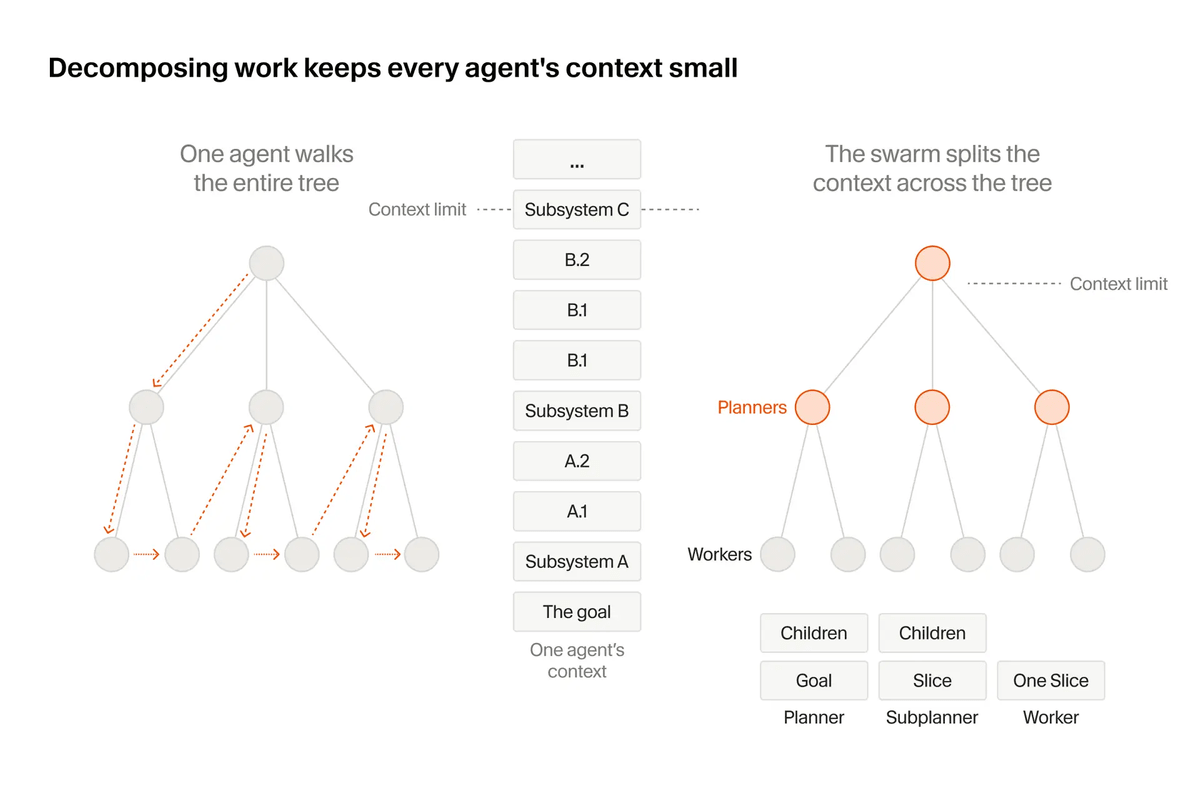
However, the previous version of Agent Swarm had problems where multiple planners would design the same function with different approaches, or workers would overwrite each other's changes. While the problem of a single AI handling all the work was mitigated, it was not possible to adequately coordinate the design decisions and changes made by multiple AIs.
Based on the issues found in the previous version, Cursor has developed a new version with revised agent collaboration methods. In the new version, design decisions are recorded in a shared document, and if changes conflict, an AI that is not directly involved will mediate. A mechanism has also been introduced to stop new writing if changes are concentrated in one large file, and another AI will split the file. A proprietary version control system and multiple reviewers have also been added, making duplicate work and conflicts less likely than in the previous version.
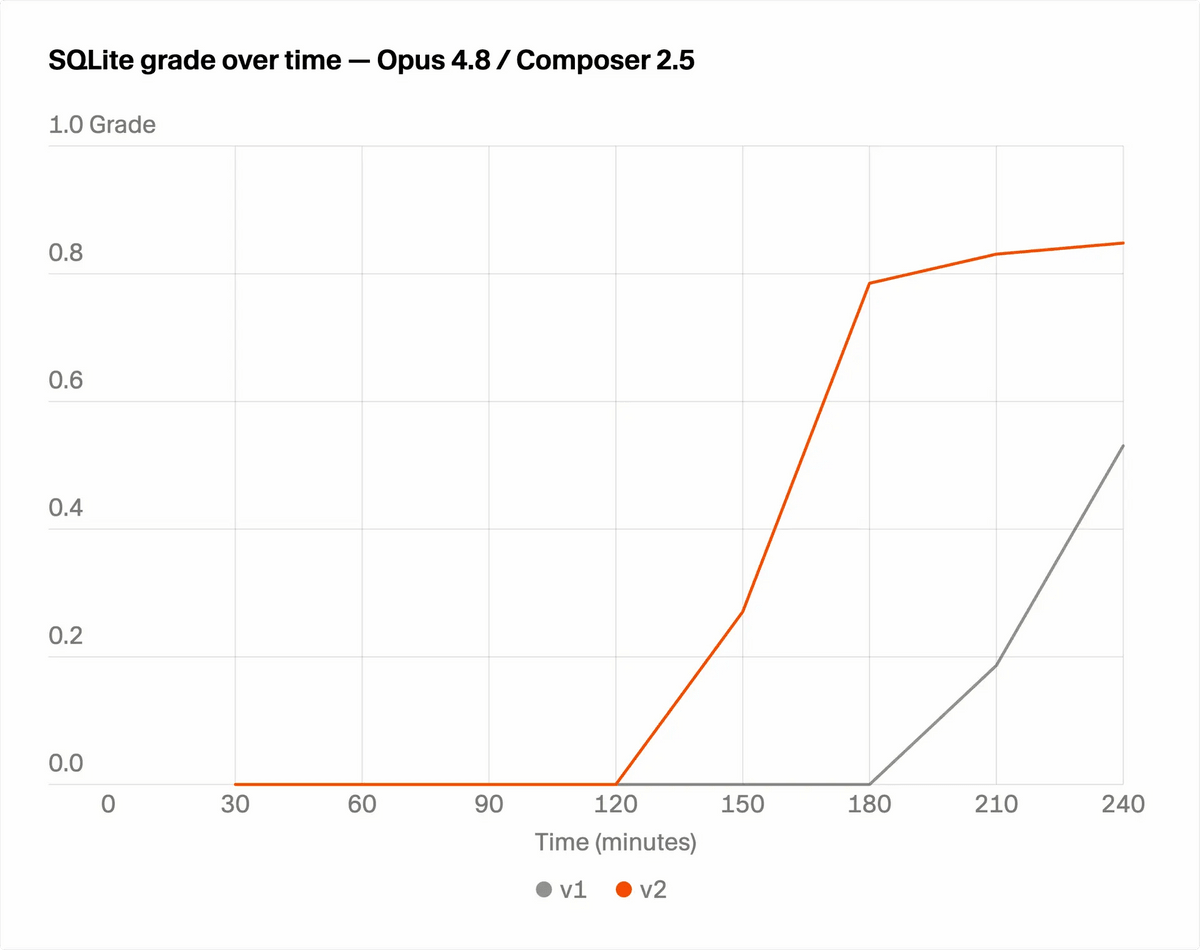
To validate the new version, Cursor provided the AI with an 835-page SQLite manual and had it rebuild the database management system in Rust. Without access to the SQLite source code, test suite, executable files, or internet connection, all model configurations tested with the new version ultimately passed 100% of the evaluation tests.
The following configuration uses Opus 4.8 as the planner and Composer 2.5 as the worker. Gray represents the old version of the swarm, and orange represents the new version. You can see that the new version improves the pass rate of the evaluation test faster.
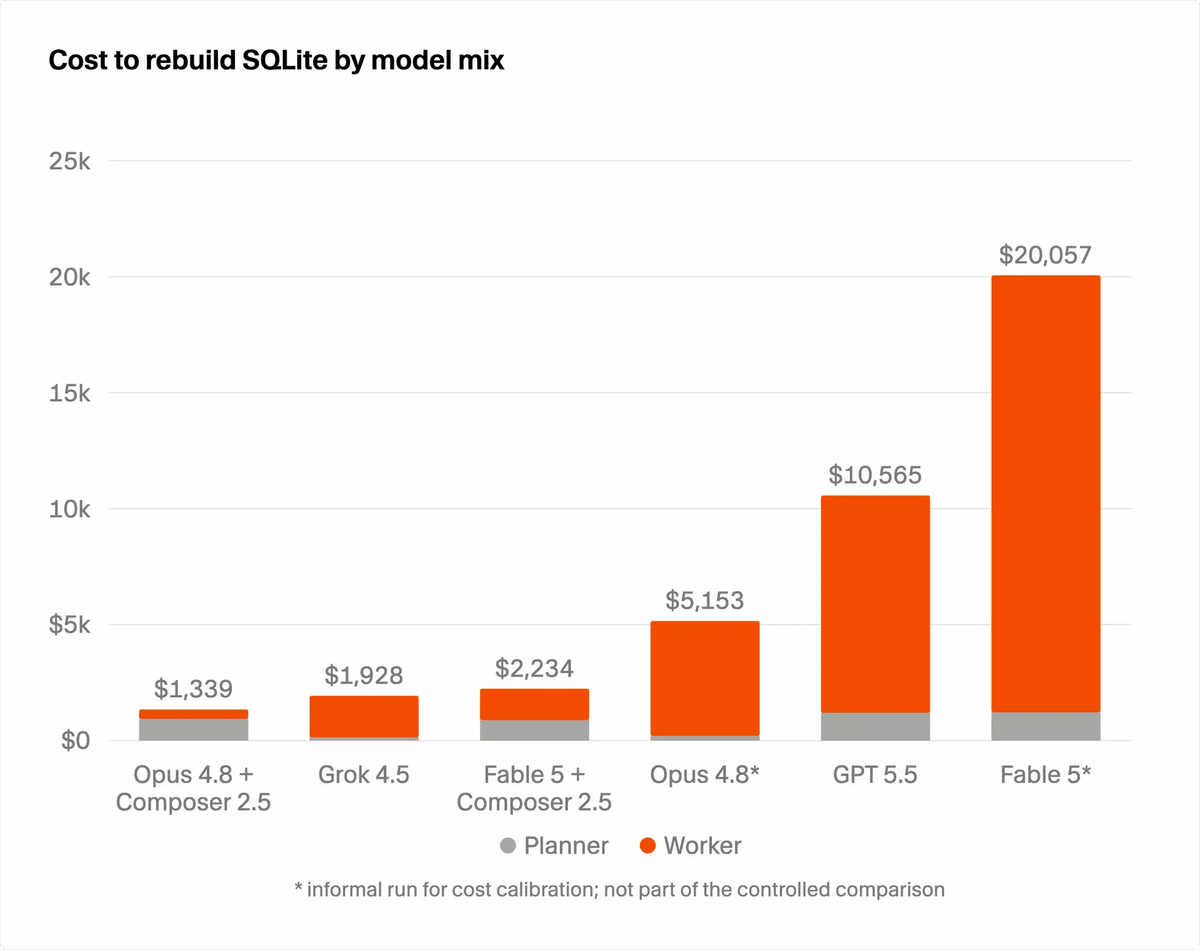
Furthermore, the new version of the experiment compared configurations using GPT-5.5 for both the planner and workers, configurations using Grok 4.5 for both, and configurations using Opus 4.8 or Fable 5 for the planner and Composer 2.5 for the workers.
The following diagram shows how costs vary depending on the model selection. Planner costs are shown in gray, and worker costs in orange. A configuration using GPT-5.5 for both the planner and workers cost $10,565 (approximately 1.7 million yen), but a configuration using Opus 4.8 for the planner and Composer 2.5 for the workers cost $1,339 (approximately 220,000 yen), reducing the cost to about one-eighth of the original. Configurations marked with an asterisk (*) were unofficially run for cost verification purposes.
The reason for the large cost difference is that the workers responsible for implementation consume the majority of the tokens. In the diagram below, tokens consumed by workers are shown in orange, and tokens consumed by planners are shown in gray. In each experiment, workers used at least 69% of the total tokens, and in many configurations, they used over 90%.
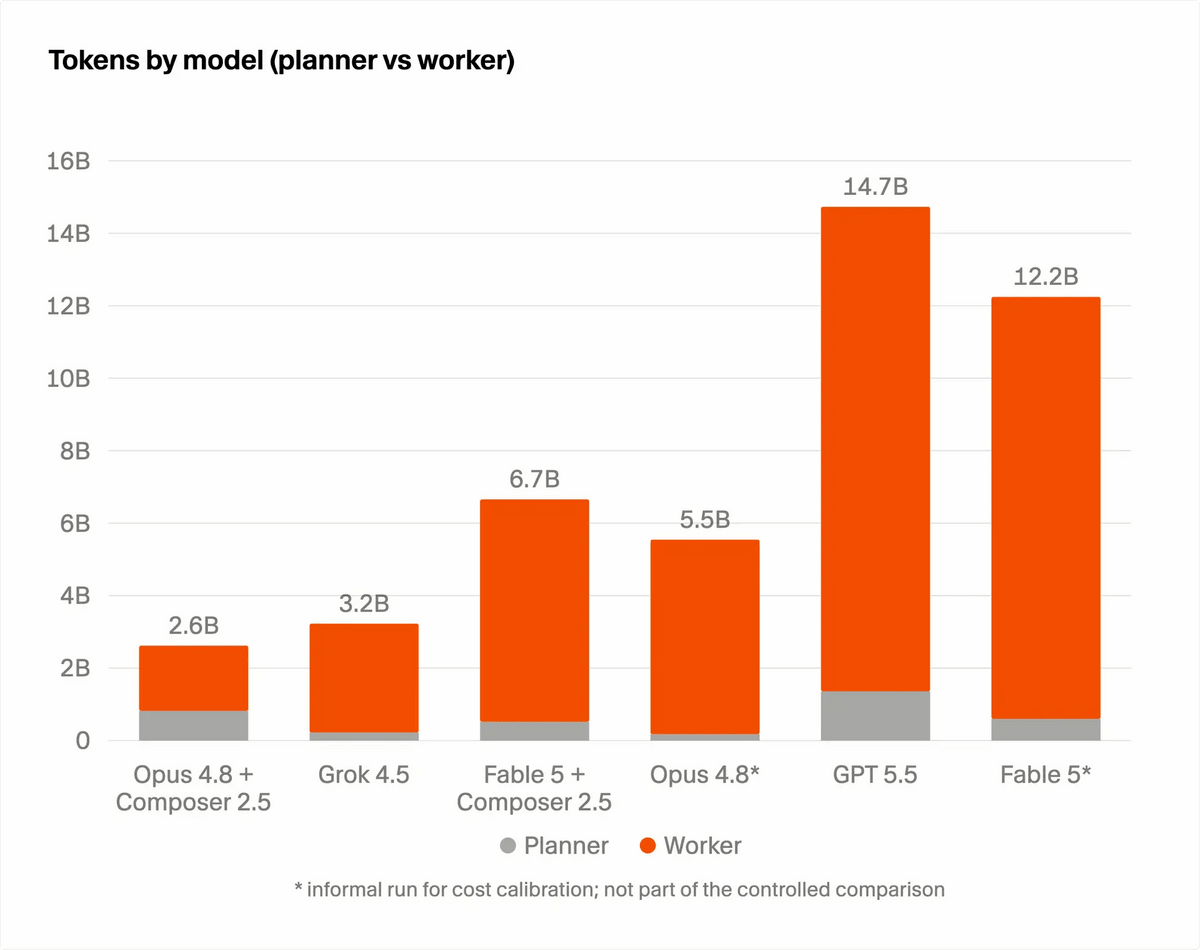
Although there was a significant cost difference, the final output quality was reportedly almost identical across the model configurations compared. The most advanced model could handle the initial work breakdown and design decisions, while the lower-cost model could work according to clear instructions.
Cursor states that it will further explore the combination of planners and workers in the future.
Related Posts:



in AI, Posted by log1d_ts