A study found that children who lived in institutions during their early years had different life skills 16 years later depending on whether or not they received high-quality foster care.

Children who cannot live with their parents may live in group care facilities such as children's homes. However, in these facilities, staff members work in shifts to care for many children, which can make it difficult to build a continuous relationship with a specific caregiver. Furthermore, limited opportunities for conversation, play, and exploration of the surroundings tailored to each child's individual needs may affect their emotional, social, cognitive, sensory, and motor development. Megan M. Hare and colleagues at Tulane University School of Medicine in the United States investigated the impact of a significant lack of stable caregiver interaction in early childhood on life skills as children transition into adulthood.
Adaptive Functioning at Age 18 Years Following Severe Early Deprivation: Results of a Randomized Controlled Trial.
https://psycnet.apa.org/record/2026-38423-001
Severe early deprivation leaves lasting mark on life skills 16 years later
https://www.psypost.org/severe-early-deprivation-leaves-lasting-mark-on-life-skills-16-years-later/
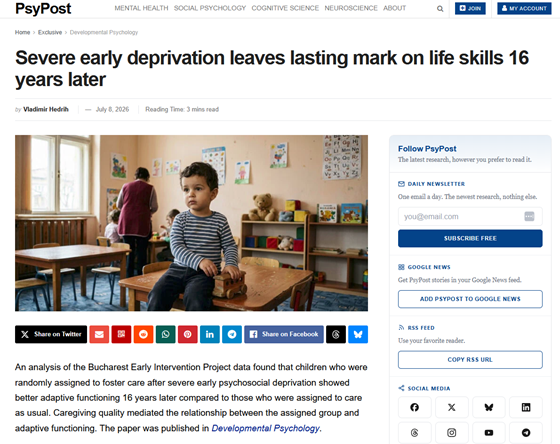
Hare et al. analyzed data from the ' Bucharest Early Intervention Project, ' a long-term tracking of the development of children living in institutions away from their parents in Romania. The Bucharest Early Intervention Project was a research project conducted in Romania by researchers from American universities and other institutions, aiming to examine the impact of institutionalization during infancy on children's development and how foster care as an alternative to institutional care relates to development. This study began in 2000-2001 and involved 136 children living in six institutions in Bucharest. The average age of the children at the start of the study was approximately 22 months (1 year and 10 months).
In the Bucharest Early Intervention Project, after assessing the developmental status of children at the start of the study, eligible children who had lived in institutions were randomly divided into two groups: one receiving 'regular institutional care' and the other receiving 'a high-quality foster care program established for research purposes.' Children from the surrounding areas who had no experience of living in institutions were also included as a control group.
In Hare et al.'s study, the analysis of life skills around age 18 included 134 individuals: 93 of the 136 who were living in institutions at the start of the study and 41 in a control group who had no experience of living in institutions. Of the 93 who lived in institutions, 46 received typical institutional care and 47 received high-quality foster care.
The Vineland Adaptive Behavior Scales were used to assess life skills. This scale evaluates adaptive functions, which represent abilities necessary in real life, such as communication, daily living skills, and interpersonal relationships. Hare et al. also examined the quality of caregiver interactions, which were assessed when the children were 12 and 16 years old.

Hare et al. reported that, at around age 18, children who received high-quality foster care scored higher on adaptive functioning than children who received typical institutional care, with differences particularly evident in communication skills and interpersonal skills. The same trend was observed when the adaptive functioning scores were converted to an age equivalent on a scale; the adaptive functioning of children who received typical institutional care averaged 12.5 years, while that of children who received high-quality foster care averaged 15.2 years.
Furthermore, when looking at children who had experienced institutional care as a whole, their adaptive functioning was lower than that of children who had not lived in an institution. In other words, although children who received high-quality foster care had higher indicators of life skills than children who had always lived in institutions, when looking at children from institutions as a whole, there was still a gap in life skills around the age of 18 compared to children who had not lived in institutions.
Furthermore, Hare et al. state that 'adaptive functioning around age 18 was also related to the quality of caregiver interactions assessed at ages 12 and 16.' Hare et al.'s analysis showed that part of the relationship between the difference between receiving regular institutional care and high-quality foster care and life skills around age 18 can be explained by the quality of caregiver interactions assessed at ages 12 and 16.
Hare et al. explain that these results demonstrate that a supportive nurturing environment for children has a positive impact on their adaptive functioning. They also state that providing children who have lived in institutions during their early years with a family-based care system from an early age is important for supporting their life skills as they transition into adulthood.
Related Posts:








in Science, Posted by log1b_ok