EVE Online's game engine, 'Carbon,' has been open-sourced; the developers explain the reasons.
The game engine ' Carbon ,' used in the long-running
Carbon | Fenris Creations
https://fenris.com/carbon
Eve Online's Carbon engine is now open source: Fenris Creations explains why | GamesIndustry.biz
https://www.gamesindustry.biz/eve-onlines-carbon-engine-is-now-open-source-fenris-creations-explains-why
CCP Games, the developer of EVE Online, was acquired by the South Korean game publisher Pearl Abyss in September 2018. Subsequently, in May 2026, Pearl Abyss sold CCP Games to its management team, citing 'improvements to its financial structure and operational efficiency.' Following CCP Games' independence, the company changed its name to Fenris Creations.
In 2024, Fenris Creations announced plans to open-source Carbon, the game engine they use in EVE Online. Carbon is publicly available on GitHub, allowing anyone to build their own MMO for free. It's also possible to fork Carbon, like in Linux, to build your own game engine.
CARBON Engine · GitHub
https://github.com/carbonengine
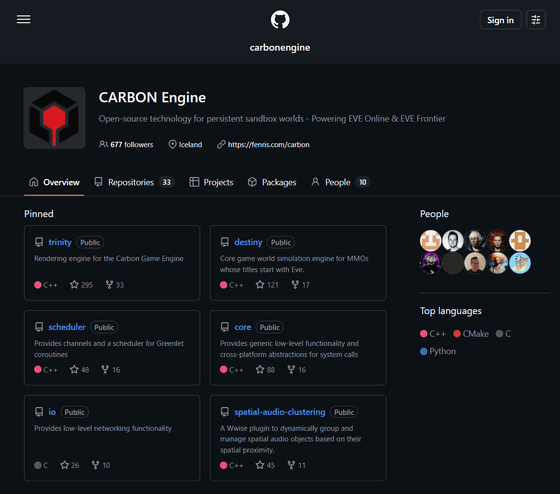
The core technology team at Fenris Creations has been diligently working on the open-sourcing project for Carbon. They reportedly completed most of the work in 12 weeks. Ben Hunter, Senior Development Director at Fenris Creations' core technology team, explained the Carbon open-sourcing project to the gaming media outlet GamesIndustry.biz.
Regarding the open-sourcing of Carbon, Hunter said, 'By releasing the code, we wanted to make it easier to verify and build trust with the community. Fenris Creations has been building and actively engaging with the community for many years. Our collaboration with the community began when we released the API in the early days of EVE Online. Two and a half to three years ago, we came to the conclusion that there is nothing special about the source code. We thought that for both ourselves and the community, releasing it and letting more people see it would not only allow us to learn and grow from it, but also lead to better results when people use it to do amazing things. We are very much looking forward to that development.'
However, the Carbon open-source project is still in its early stages. Hunter has stated that the direction is towards using Carbon for development within the EVE Online ecosystem, and that community members can already submit pull requests to Carbon for security fixes. Furthermore, there are apparently discussions within the community about creating a web application that can view EVE Online content.
Carbon is available in its entirety across multiple different modules. The majority of the technology is provided under the MIT License , an open-source license that allows anyone to freely copy, modify, redistribute, and commercially use the source code. However, modules related to spatial audio clustering are provided under the Apache License 2.0 , and input/output components are provided under the Python Software Foundation License .

Hunter said of open-sourcing Carbon, 'The important thing is to get people interested and willing to invest their time, effort, and money to contribute. It's like the tide coming in and all the boats float. If we improve the code and everyone can benefit from it, that's good for everyone,' emphasizing that the reason for open-sourcing was not to make money.
In fact, the open-sourcing process has forced Fenris Creations' core technical team to do some additional work. This additional work includes tasks such as processing pull requests and monitoring changes. Fenris Creations has reportedly been gradually hiring people to handle these roles over the years.
Hunter explained, 'Several years ago, we announced our intention to open-source Carbon, and since then, rather than working on the open-sourcing process itself, we have gradually put in place several teams with the aim of strengthening the team's capabilities and increasing the resources to support the open-source version of Carbon. We review and process pull requests within

There are many advantages to making technology public and allowing anyone to view its internal structure. However, malicious attackers are always present and looking for any vulnerability. Hunter said that security 'will definitely be a concern going forward.' He also said that this pressure will require core technology teams to put in 'even more effort' when reviewing code and designing architecture.
Nevertheless, Hunter stated, 'It's very good to have the ability of third parties to contribute and help fill potential security gaps. To be honest, the number of security-related pull requests is very low for a game engine that's 23 years old. This is surprising in a good way. It means that a lot of work has been done over the years. As you can imagine, EVE Online has attracted a lot of attention over the years due to the scale of its fleet battles and combat. In the past, malicious actors have tried to explore and disrupt it. Over the past 23 years, the game engine's infrastructure stack and network layer have been strengthened by a lot of combat,' arguing that there are also security benefits to open-sourcing it.
Fenris Creations also revealed that they referenced 'Godot,' an open-source project that started in 2014, when open-sourcing Carbon. Hunter said, 'We were hoping that Godot would come along and provide a guide on how to manage such a large-scale open-source project. But in reality, it was important to choose the right architecture and help protect and clearly define the areas in which that architecture could contribute. When you expand on that, it becomes a plug-in model for engines, which is what Unreal Engine and Unity use, and which we are now implementing in Carbon.'
In fact, Carbon is moving towards a plugin architecture, which is also scheduled to be open-sourced within the next few months. Hunter cited 'the ability to make architectural decisions that are helpful for operational governance' as one of the advantages of making Carbon an open-source project.
Furthermore, they stated, 'Basically, we were preparing to open-source the code before we even had a mechanism in place for it to be open-sourced. That process included all the details, such as how to contribute, the criteria that must be met when testing before submission, and the obligation to disclose that an LLM (Large-Scale Language Model) was used. There is nothing wrong with using an LLM itself, but disclosure is necessary because if you don't disclose it, you may be subjected to different scrutiny than if you didn't.'
He added, 'Currently, a lot of restructuring is underway, but the most important thing is finding the most effective way to integrate and utilize LLM in our workflows. We are also developing a tool gateway for the LLM interface in-house and plan to roll it out to the team within the next few weeks. After a period of stable operation, we plan to release this tool gateway as open source. Change is definitely happening across the industry,' revealing that they are also working on utilizing LLM.
Hunter cited the need to create test projects as a definite change going forward. 'We don't want to call test projects games. They are samples for ease of testing, understanding the architecture, and getting started with the engine quickly. As a core technology team, we need to create these test projects, which become our test environment, our sample projects. Currently, when we make changes to the game engine, we have to directly access and test samples from games like EVE Online and EVE Frontier . We don't have our own simplified samples to run,' he said.
When EVE Online released its API, various color saturation apps were developed to help with character skill management and ship equipment. Hunter says that, just like then, by open-sourcing Carbon, he hopes that a large community will be formed around EVE Online, and that the community will create its own unique extensions to the game experience.
Hunter concluded by saying, 'As long as Carbon is under the MIT license, anything is possible. However, I hope that something will emerge that will contribute to the entire EVE world.'
Related Posts: