China's open-weight model 'GLM-5.2' surpasses Claude Code in vulnerability detection benchmarks.

It has been reported that GLM-5.2, an open-weight AI model announced by the Chinese AI company Z.ai in June 2026, has outperformed Anthropic's Claude Code in a benchmark measuring vulnerability detection accuracy.
We have Mythos at Home: GLM 5.2 beats Claude in our Cyber Benchmarks | Semgrep
GLM-5.2 is an AI model announced by Z.ai on June 13th and officially released on June 17th. Z.ai founder Jie Tang stated in the announcement that he 'deeply regrets the sudden restrictions on certain frontier models,' referring to the suspension of Claude Fable's services by order of the US government.
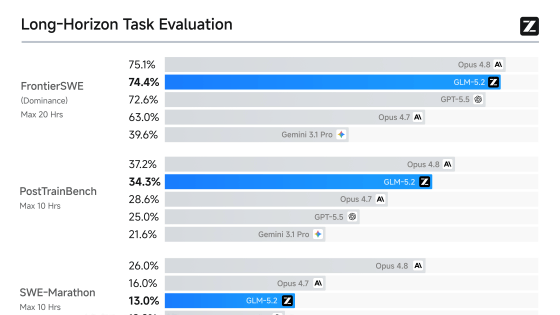
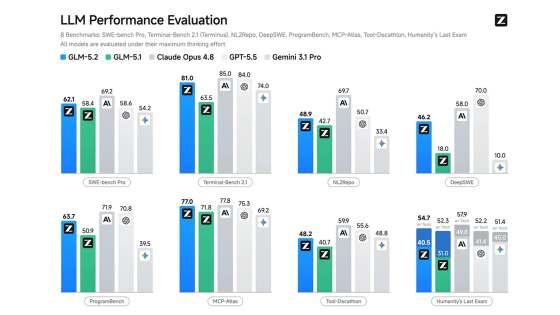
The GLM-5.2 has achieved higher scores than the Claude Opus 4.7 in various benchmarks, and there have been reports of it outperforming the Claude Fable 5 in blind human tests.
GLM-5.2, a Chinese model surpassing Claude Opus 4.7, has been officially announced. It has even outperformed Claude Fable 5 in some tests and is available for download as an open model - GIGAZINE
On June 22, cybersecurity company Semgrep reported the results of testing AI models such as GLM-5.2, Claude Code (Opus 4.6/4.7/4.8), and GPT-5.5 using a benchmark that measures the detection accuracy of 'Insecure Direct Object Reference (IDOR) '.
IDOR is a type of vulnerability where an application fails to check the caller's access permissions when referencing internal identifiers such as user IDs in a request. If this vulnerability exists, an attacker can access data that they would not normally be able to access simply by rewriting the numbers or IDs in the URL or API request.
In this test, Semgrep ran the IDOR benchmark on various AI models and harnesses to investigate the impact of ' harnesses ,' the execution infrastructure that supports the task execution of AI models, on performance. One of the AI models used in this test was GLM-5.2.
Semgrep highlights several interesting aspects of GLM-5.2, including: 'It's an open weight model, meaning the AI model's parameters are publicly available, allowing users to run and verify it on their own hardware'; 'It's an expert mixed model (MoE) with approximately 750 billion parameters, making it competitive in terms of coding'; and 'The cost required is reported to be about one-sixth that of comparable state-of-the-art AI models.'
In this test, a score of 'F1' was calculated based on detection accuracy, which indicates how correctly vulnerabilities were detected, and recall, which indicates what percentage of vulnerabilities in the dataset were detected.
The following table shows the AI models (configurations) and harnesses tested in order of 'F1,' with the top two configurations using Semgrep's multimodal harness. Surprisingly, the third-place finisher was the open-weight model GLM-5.2, surpassing Claude Code (Opus 4.6) in fourth place and Claude Code (Opus 4.7/4.8) in fifth place. GLM-5.2 was run with a simple Pydantic AI harness containing only the IDOR prompt, while Claude Code was run through the Claude Code SDK.
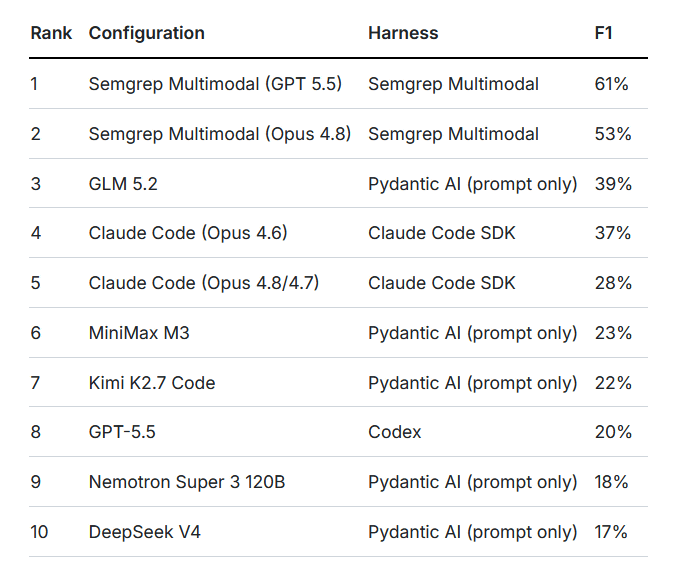
Semgrep stated, 'The biggest surprise was in third place. GLM-5.2 outperformed Claude Code by 7 percentage points (39% to 32%) without any support. An open-weight model run with simple prompts outperformed a state-of-the-art coding agent in a security task that heavily relies on inference.' GLM-5.2 was also cost-effective, costing only about $0.17 (approximately 28 yen) per vulnerability found.
This incident has also been a hot topic on the social news site Hacker News. One user commented that GLM-5.2 is a truly excellent AI model for everyday programming and is far cheaper than Opus or GPT.
GLM 5.2 beats Claude in our benchmarks | Hacker News
https://news.ycombinator.com/item?id=48709670
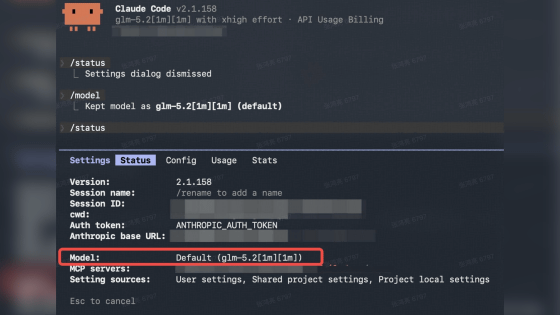
GLM-5.2 is open waitlisted and can be downloaded and used locally. However, the base model requires a very large amount of memory (1.51TB), making it impractical for home use. Several quantized versions of GLM-5.2 have already been released by volunteers, but even the 1-bit quantized version requires 233GB of memory.
A guide for running the Claude Opus-class GLM-5.2 locally has been released; the minimum configuration is estimated to be 223GB of memory - GIGAZINE

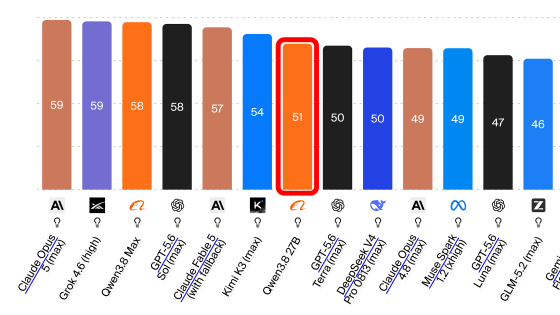
Furthermore, it has been reported that ' Qwen 3.6 27B ,' which is relatively easy to run locally, also delivers very high performance.
Qwen 3.6 27B is the sweet spot for local development - Quesma Blog
https://quesma.com/blog/qwen-36-is-awesome/
Related Posts:


in AI, Posted by log1h_ik