David Ha, CEO of Sakana AI, talks about 'Japanese-style AI.'
David Ha, CEO of Sakana AI, a Japanese AI startup, spoke on the Disrupting Japan podcast about 'AI implementation for Japanese companies,' 'strategies different from the giant model competition,' and 'the approach to AI development tailored to Japan.'
The future of AI looks very different in Japan - Disrupting Japan
Sakana AI is an AI company founded in Tokyo in 2023 by David Ha, Lyon Jones, and Ren Ito. Lyon Jones is one of the co-authors of the paper 'Attention Is All You Need,' which proposed Transformer, the foundation for ChatGPT and other technologies, and Ha is a researcher with experience leading the Japanese team at Google Brain. While it might seem like a company that creates massive AI models from scratch and distributes them to consumers worldwide, Ha says, 'Sakana AI's entry point is different.'
In the US, AI companies often start by releasing chatbots or platform models that anyone can use, aiming to increase users before focusing on monetization. On the other hand, Sakana AI has chosen to partner with major Japanese companies to implement AI workflows tailored to each task, such as reading loan application documents, summarizing arguments, creating drafts of documents, and having staff review them.
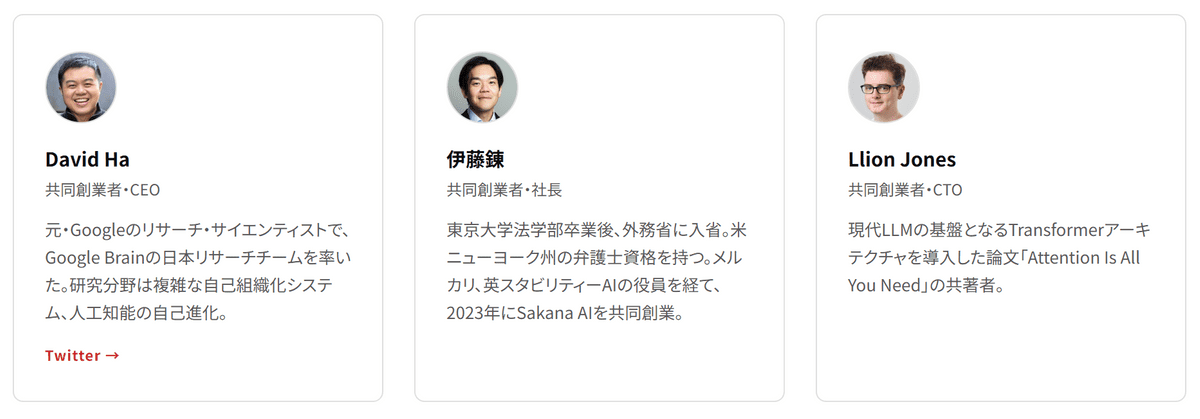
Sakana AI's focus is not on 'AI making decisions on behalf of humans,' but rather on 'AI supporting the work that humans do before making decisions.' For example, in a project with Mitsubishi UFJ Bank, the idea is not to automatically approve or deny loan decisions, but for AI to assist in drafting documents and organizing the supporting evidence used in loan decisions. Because financial decisions affect the future of companies and employees, it is necessary to have a system where humans can read the evidence, agree to it, or make revisions, rather than having AI simply produce conclusions.
In their collaboration with the SMBC Group, they introduced an application that uses multiple AI agents to handle information gathering, analysis, hypothesis building, and document creation for corporate proposals. The AI agents divide tasks according to the purpose and handle multiple processes such as searching, summarizing, and document creation. Instead of humans starting from blank slides, the AI prepares a draft that conforms to internal standards, and the person in charge reviews and finalizes it.
Mr. Ha emphasizes 'routing' as a key concept supporting enterprise AI. AI models have their strengths and weaknesses, such as models that are inexpensive and fast, models that excel at inference, models that are good at coding, and models that are well-suited to the Japanese language and culture. Using an expensive, cutting-edge model for simple document summarization and then using the same model for complex analysis would increase costs, so a system is needed to allocate tasks to the appropriate model.
Mr. Ha stated that 'the routing concept also serves as a precaution against relying entirely on the massive models of the United States and China.' He further touched upon the idea of combining proprietary models, open-source models, and American frontier models, allowing users to exclude models they don't want to use, and argued that 'by not becoming overly dependent on the technology of specific countries or companies, and by having the ability to use them appropriately as needed, it will lead to securing AI sovereignty.'
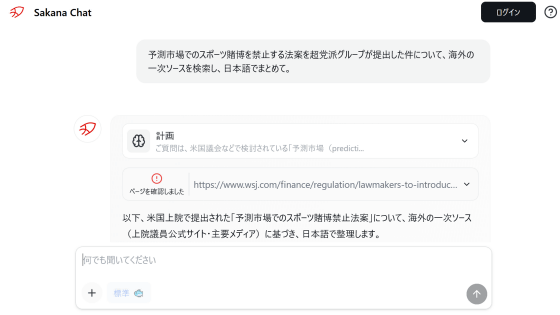
Sakana Chat, which Sakana AI released to the general public in March 2026, also reflects the direction of AI development for Japan. Sakana Chat is equipped with an alpha version of the large-scale language model 'Namazu' series, which has been adjusted for Japan, and also incorporates a web search function. According to Mr. Ha, Namazu is designed not only to match Japanese culture and values, but also to support reasoning and tool usage. A mode that speaks like the Osaka dialect is also available, which is an element that clearly demonstrates the commitment to creating an AI for Japan.
Sakana AI, an AI company based in Japan, has launched 'Sakana Chat,' a free AI chat service tailored for the Japanese market - GIGAZINE
However, adjusting AI for the Japanese market is not simply a matter of translating words into Japanese. Models created overseas may incorporate assumptions from the country and society in which they were developed, and to use them in Japan, it is necessary to reduce bias, add Japanese knowledge and values, and ensure that the mathematical, reasoning, and code generation capabilities are not diminished. According to Mr. Ha, there is also a problem called 'catastrophic forgetting,' where the original capabilities are forgotten during the additional learning process.
Sakana AI has also published research projects such as 'The AI Scientist,' in which AI handles everything from idea generation to experimentation and paper writing. The way they are shifting their research results to business support for companies and using the knowledge gained from those companies to further improve their AI seems to be somewhere between a research institute and a system development company. Mr. Ha says that even the Japanese-style system integration, which was previously seen as difficult to expand, has the potential to become a globally used model if it is augmented with AI.
Sakana AI was established as a limited company in Japan, raised funds from overseas investors, and has also received strategic investment from major Japanese corporations. This is quite an unusual example compared to the common belief that Japanese startups should establish overseas entities if they want to raise large amounts of capital. Mr. Ha also said, 'Establishing a company and starting a business in Japan is not as difficult as people imagine from the outside.'
Japanese companies tend to prioritize practical action over flashy announcements when it comes to AI adoption, which can sometimes make it appear slow from the outside. However, when you look at their efforts to integrate AI into core tasks such as loan application review and proposal writing, you can see that AI usage cannot be measured solely by the number of times chatbots are used. 'Instead of creating massive models to conquer the world, the characteristic of AI adoption in Japan is that they get involved on the ground, use multiple models appropriately, and transform work in a way that allows the person in charge to take responsibility,' says Mr. Ha.
Related Posts:



in AI, Posted by log1d_ts