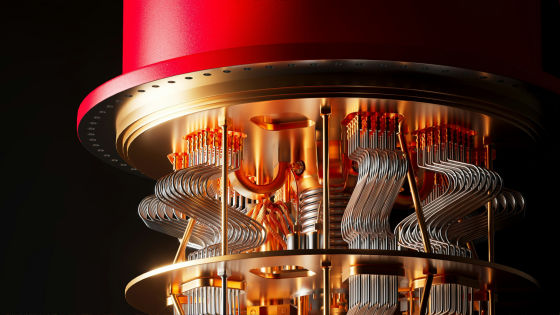
Nature has published a peer-reviewed article arguing that Microsoft's quantum technology, announced for 2025, is questionable due to 'errors in data processing using Python' and 'arbitrary data selection.'
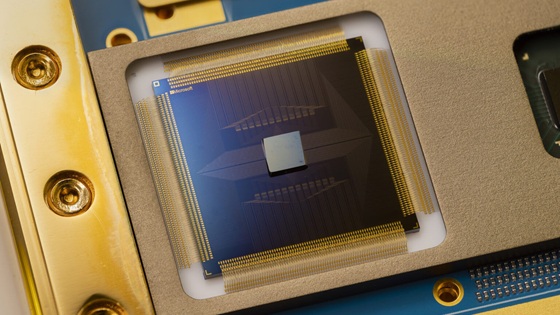
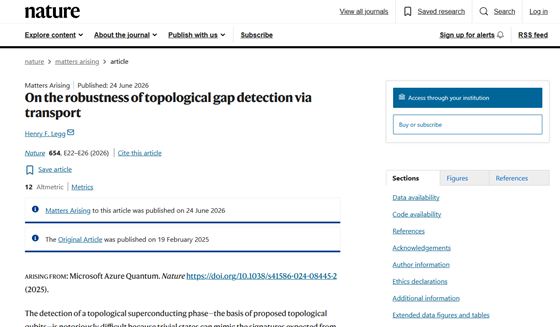
Nature has published a peer-reviewed commentary questioning Microsoft's quantum computing technology, which was announced for 2025. Henry Legge of the University of St Andrews, who wrote the commentary, claims that there are problems with Microsoft's data analysis and software.
On the robustness of topological gap detection via transport | Nature
https://www.nature.com/articles/s41586-026-10567-8
Boffin claims Microsoft's supposed quantum leap does not compute due to 'basic Python errors'
https://www.theregister.com/research/2026/06/24/boffin-claims-microsofts-supposed-quantum-leap-does-not-compute-due-to-basic-python-errors/5260489
Top quantum computer expert claims Microsoft's 'topological qubit' doesn't hold up | Scientific American
https://www.scientificamerican.com/article/top-quantum-computer-expert-claims-microsofts-topological-qubit-doesnt-hold-up/
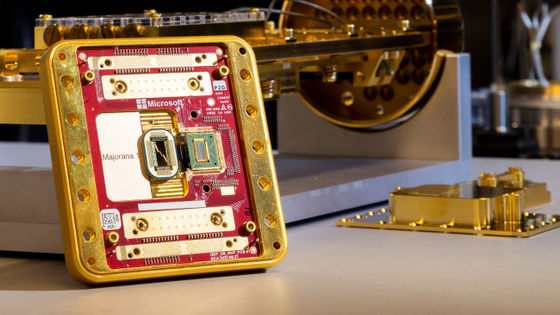
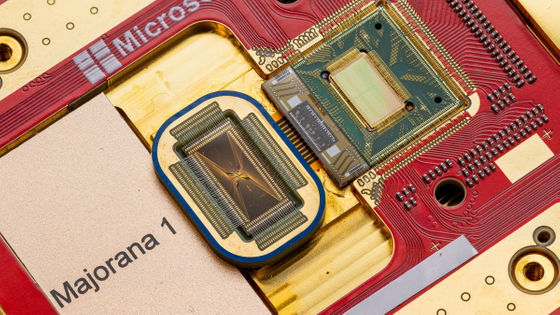
In February 2025, Microsoft reported in Nature that it had developed software to detect tiny gaps in special conductive wires. The company explained that stable detection of these gaps could lead to more robust qubits. Along with this announcement, Microsoft also unveiled a quantum chip called 'Majorana 1,' positioning it as a foundational technology for realizing future topological qubits.
You can find more information about the announcements for Majorana 1 by reading the following article.
Microsoft announces quantum processor 'Majorana 1,' expecting it to 'solve critical industry-scale problems within a few years' - GIGAZINE
However, this Microsoft paper was refuted by some physicists from the time of its publication.
Microsoft claims a breakthrough with its quantum processor 'Majorana 1,' while physicists remain skeptical, stating that 'the published paper lacks sufficient data' - GIGAZINE
Legg also pointed out that the results shown by Microsoft's software were inconsistent and did not constitute conclusive evidence that the gaps had been found.
One of the problems with Microsoft's paper concerns how the data is presented. According to Legg, Microsoft's graphing code was configured to display only the largest region that met the criteria. As a result, other regions that went through the same detection procedure were excluded from the screen, making it appear as if the researchers were only highlighting results that suited their purposes.
Another issue is the way the data is processed in Python. Legg points out that the software code was inverting some of the data based on its position in the data array, rather than the actual voltage values. In other words, it may have been calculating using the order of the data rather than the numerical values themselves, which could lead to misinterpretation of the measurement results.
Furthermore, Legg points out that the broad range of data not included in the original paper contains random noise rather than clear gaps. Legg states that this noisy data indicates disturbances within the device and may not meet the preconditions for the state claimed by Microsoft, and criticizes the fact that 'only the signals they wanted to find were examined in detail, and there was not enough data to question the presence of those signals.'
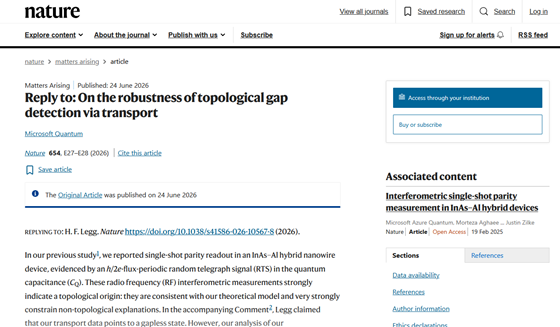
In response to Legg's commentary, Microsoft published a counter-argument in Nature supporting the research findings and development plans, stating that the code issues pointed out were minor and did not adequately consider the measurement results.
Reply to: On the robustness of topological gap detection via transport | Nature
https://www.nature.com/articles/s41586-026-10568-7
Related Posts: