It has been pointed out that tens of millions of songs are being distributed as datasets usable for AI training, thus contributing to the creation of AI-generated music.
The Atlantic reports that a dataset containing tens of millions of songs is being used for AI training. It has been pointed out that some of these songs are protected by copyright, and others require licensing agreements to be used for AI training.
The Millions of Songs Mashed Into AI-Generated Music - The Atlantic
The Atlantic created a searchable database of the music used to train AI | The Verge
https://www.theverge.com/ai-artificial-intelligence/953183/the-atlantic-searchable-database-music-ai-training-data
The suspicion that music-generating AIs are using 'copyright-protected songs' for AI training has been raised for a long time.
Music-generating AIs Suno and Udio have been continuously criticized by music companies for using copyrighted music in their AI training, and in June 2024, the Recording Industry Association of America sued Suno and Udio on behalf of Universal Music Group, Sony Music Entertainment, and Warner Records.
Music giants such as Sony, Warner, and Universal are suing music generation AI services 'Suno' and 'Udio' for copyright infringement - GIGAZINE

To investigate these suspicions surrounding music-generating AI, Alex Reissner of The Atlantic focused on the training data used to train the AI. Reissner found four music datasets shared within the AI development community and investigated their contents. It was revealed that one dataset contained 12 million songs, another 9 million songs, and the remaining two datasets each contained more than 100,000 songs.
These datasets include numerous songs by world-renowned artists such as Bad Bunny, Nirvana, Taylor Swift, Billie Eilish, Pearl Jam, Elvis Costello, Sheryl Crow, and The Beatles.
Three of the four datasets discovered by Reisner are distributed as collections of links to songs on YouTube and Spotify. Reisner points out that AI developers are using automated tools to download actual audio files from these link collections to train their AI. Some of these tools can even bypass logins, advertisements, and mechanisms that lead to creator revenue and subscriber acquisition. However, Reisner points out that such tools violate the terms of service of platforms like YouTube and Spotify. The remaining dataset is from the Free Music Archive, a collection of royalty-free music.
These datasets have been downloaded thousands of times, making it difficult to determine exactly who has used them. However, Reissner points out that Google and Stability explicitly state in their research papers that they have used these datasets.
Furthermore, while some datasets, such as the Free Music Archive, are available for free streaming playback for personal use, the report points out that all of these datasets require a license for commercial use. This raises concerns about the reliability of datasets widely used in AI development.
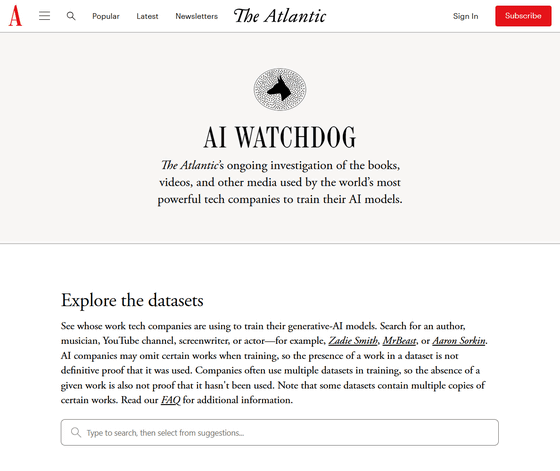
The Atlantic has released a database that allows you to search for songs included in four datasets. Furthermore, this database allows you to search not only for songs, but also for any other media used to train AI models.
AI Watchdog - The Atlantic
https://www.theatlantic.com/category/ai-watchdog/
Related Posts:

in AI, Posted by logu_ii