The National Bureau of Economic Research (NBER) has announced that iPhones are linked to the declining birth rate, pointing out that people's increased smartphone use has reduced opportunities for sexual activity.
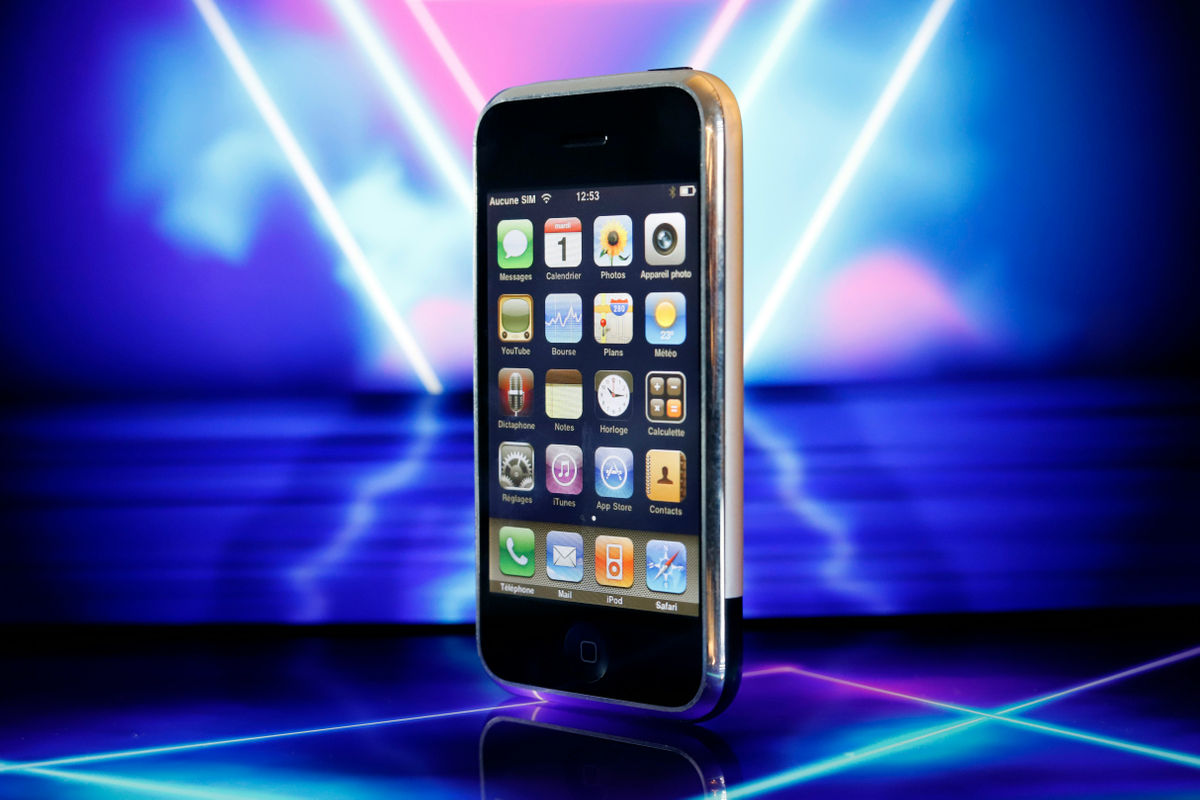
Since 2007, the birth rate in the United States has been declining. Many experts link this decline to the global financial crisis, but a new hypothesis has been proposed that it may be due to the release of the first iPhone in 2007.
Is the iPhone Birth Control? Causal Evidence from AT&T's 2007–2011 Carrier Monopoly | NBER
It's (at least partly) the phones, y'all.
— Caitlin Knowles Myers (@Caitlin_K_Myers) June 8, 2026
New NBER WP this morning with Zeke Hooper: we estimate the diffusion of the iPhone explains 33–52% of the decline in US births from 2007–2011. #econtwitter 🧵 https://t.co/0SVniEzeI9
iPhones could be to blame for declining fertility, says new study | National Post
https://nationalpost.com/health/iphone-birth-control-declining-fertility-study
Killing the mood: smartphones reduce birth rate, studies say
https://www.france24.com/en/live-news/20260608-killing-the-mood-smartphones-reduce-birth-rate-studies-say
In a pre-peer-reviewed paper published through the National Bureau of Economic Research (NBER) by Middlebury College economist Caitlin Myers and others, the hypothesis that the iPhone's popularity led to a decrease in face-to-face interaction and consequently, a decline in sexual activity.
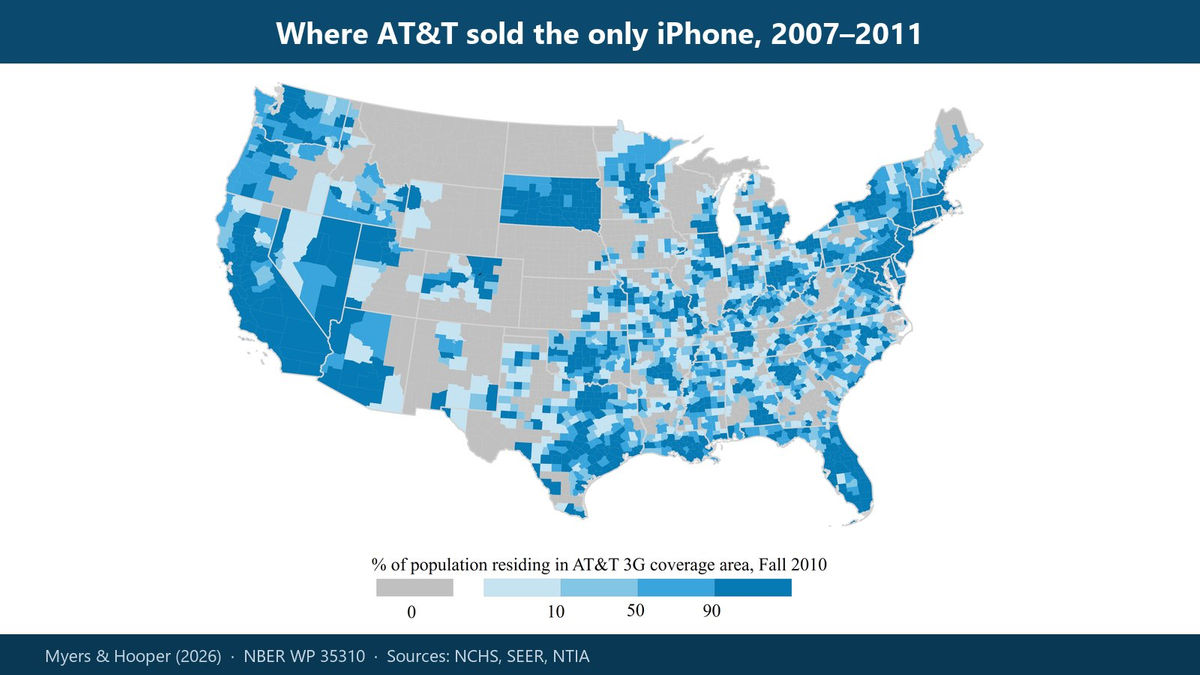
In the United States, iPhones were only available through the AT&T telecommunications company until 2011, resulting in disparities in iPhone ownership rates depending on the state and region where AT&T provided service. Therefore, Myers and his colleagues compared the areas covered by AT&T with birth rates, and also compiled data on areas where AT&T subscribers increased and areas where other telecommunications carriers gained popularity.
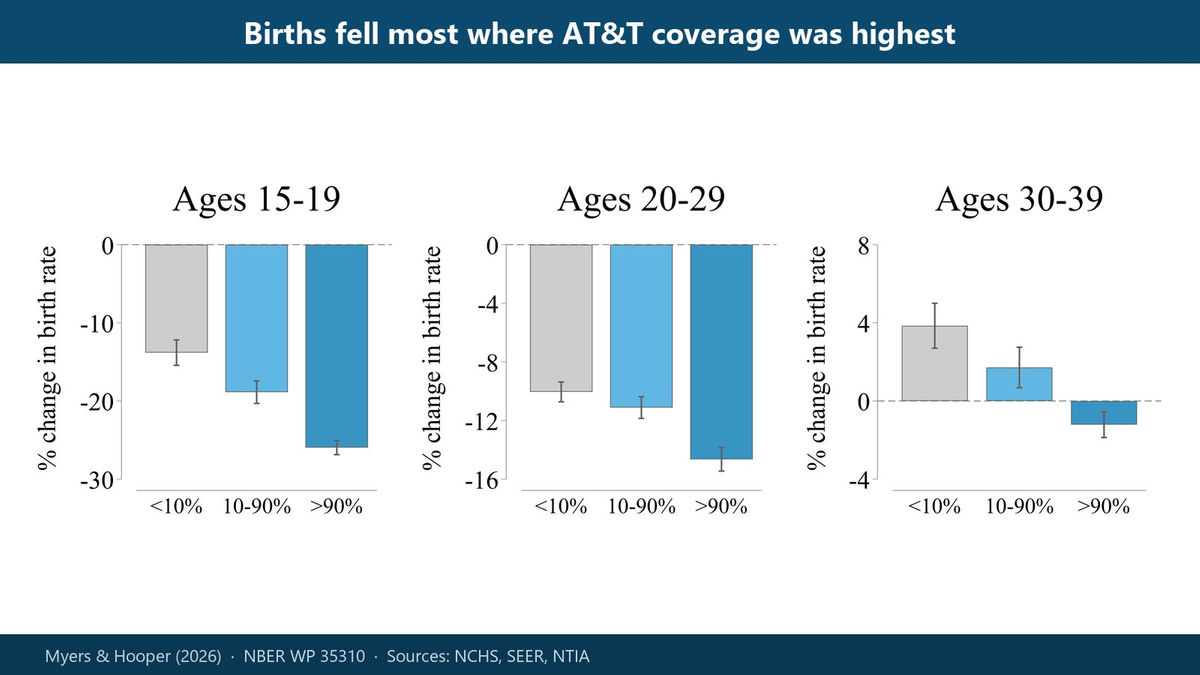
The results showed that in areas where AT&T, or iPhone, has expanded its service area, the birth rate among young people decreased significantly. Specifically, teenage births decreased by 13.8% outside of AT&T's service area, compared to a more substantial decrease of 18.9% in counties partially within the service area and 26% in counties almost entirely within the service area. Furthermore, the number of births among women in their 20s decreased by 10% outside the service area and by 14.6% within the service area, while the number of births among women in their 30s increased by 3.8% outside the service area and decreased by 1.2% within the service area.
Myers and his colleagues suspected spurious correlation and attempted to overturn the results using various methods, including
From this, Myers et al. concluded that 'as smartphones became widespread with the advent of the iPhone, the amount of time spent interacting directly with friends and engaging in sexual activity decreased sharply, and as a result of increased consumption of pornography, which can serve as a substitute for sexual activity with a partner, the birth rate may have declined.' Myers et al. explained that in the period studied from 2007 to 2011, the spread of the iPhone was associated with 33-52% of the decline in the birth rate among women aged 15 to 44.

Another study published in the scientific journal 'Child Development' revealed that in recent years, there has been a decline in young people engaging in adult activities such as sex, dating, drinking, paid work, going out without parental supervision, and driving, and this is suggested to be related to the increase in internet use.
A study published by economists at the University of Cincinnati showed that the decline in birth rates accelerates as smartphones become more widespread, and that this phenomenon is common across countries with fundamentally different healthcare, welfare, economic, and cultural environments.
Myers and his colleagues acknowledge that 'the proliferation of smartphones played a significant role in the decline in the birth rate,' but emphasize that 'it was not the only cause,' explaining that external factors such as the Great Recession and other economic problems also played a role.
Related Posts:








in Science, Smartphone, Posted by log1p_kr